Author: admin

  • Promo Video Blog

    Promo Video Blog

    Today, video is where it’s at,  to help capture visitors attention and Promo provides an extremely cost effective way for your team to start experimenting with video promotion in order to attact web traffic. Promo is dedicated to empowering their customers to promote anything with videos. Promo believes that businesses of all sizes should be able to promote their vision without limits. That’s why they work hard to provide all of the creative assets and tools needed to promote effectively.
    In 2012, Promo started as a slideshow company (Slidely) that helped over 200M people create, discover, and share slideshows and visuals. In Summer 2016, they launched Promo in order to disrupt the way businesses create videos. The hyper revenue growth that we experienced proved that we were on the precipice of something BIG. Promo quickly became the leader in its field. So, we evolved our brand to focus greater effort on Promo and rebranded accordingly. As of 2019, the are now just Promo.com.

    What’s going on today
    Promo is proud to serve tens of thousands of paying customers globally. Being Facebook and Instagram Marketing Partners, and YouTube Video Creative Partners, allows them to keep their fingers on the pulse of digital media best practices and help their customers win with visual content marketing. With a growing collection of services and tools and a strong creative team, Promo is going to change the way businesses promote online.

    How does Promo.com work?
    Promo.com has everything you need in an online video maker. High-quality professional video clips, royalty-free music, customizable video templates, and more.

    Promo.com is easy, instant, and produces awesome results at an affordable price. It’s also fun to use!
    What video sizes can I create with Promo.com?

    With Promo.com you can create:
    • Horizontal videos
    • Vertical videos
    • Square videos
    • Banner videos

    Will videos have a watermark or Promo.com mention?
    Videos you download are yours and do not have a watermark or Promo.com mention.

    Can I use the video after my subscription is over?
    Yes. The videos you download are yours forever.
    Where can I use the videos I create?
    You can post, publish, upload, and share your videos on Facebook, Instagram, YouTube, Twitter, LinkedIn or any other social networks, websites or blogs, as much as you want.

    Are you hosting the videos or can I download the file?
    Both. After you created and customized your videos, you can download them (if you are a Promo.com subscriber). A downloaded Promo.com video is your property and comes with a lifetime license for unlimited sharing. If you prefer, you can share a link to a public version of your video, once it’s published.
    What languages does Promo.com support?
    With Promo.com, you can create videos in every language. Some fonts have limited support for special characters, but all languages are supported.
    Do you provide photos that I can use?
    100% yes! Promo provides over 1.4 Million photos in their FREE image library. There are no limits to how often you can use these images.
    What kind of videos can I create with Promo.com?
    There’s no limit to the type of videos you can create with Promo.com. Our users have created:
    • Marketing Videos
    • Promo Videos
    • Video Ads
    • Social Media Videos
    • Facebook & Instagram Stories
    • YouTube Ads
    • Product videos
    • Explainer videos
    • Event Advertisements
    • Intro videos

    Industries
    • Businesses
    • Real Estate
    • Marketing
    • Travel
    • E-commerce
    • Recruiting & HR

    Special Dates
    • Black Friday & Cyber Monday
    • Thanksgiving
    • Christmas
    • New Years Eve

    For all of your online video marketing needs please call us at 1-877-570-2284 or email us at marketing@nexonta.com

    getty images

  • Tenth Blog: Now Commerce

    Tenth Blog: Now Commerce

    Now Commerce Portal QuickBooks Integration

    B2B Online Ordering System for businesses using QuickBooks Desktop

    Give professional buyers a sophisticated online sales experience, not a shopping cart. Customers can order online 24/7 with full access to custom pricing, inventory and account history. Customers can also check for themselves order status, tracking, invoices, and more. If you are a manufacturer, wholesaler, distributor or simply sell products with SKUs, and you are using QuickBooks Desktop, Now Commerce is built for you.

    Start selling online with the help of a dedicated account manager

    Now will consult with you every step of the way. Setup your online store with custom order forms specific to your business and we’ll integrate your online orders directly with QuickBooks. No additional hardware, software or programming is required—we’ll take care of it all. And accepting orders is just the beginning, the Customer Portal is a comprehensive two-way QuickBooks integration.

    Two-Way
    QuickBooks integration

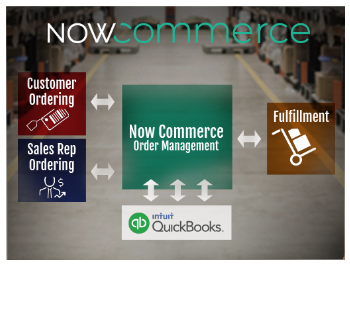
    From Now Commerce to QuickBooks and QuickBooks to Now Commerce, two-way integration is built-in. Customers and sales staff can see real-time inventory, order history, and other key data, and new orders placed online are automatically created in QuickBooks. And if you do off-site warehousing & shipping, we can automate that as well.

    Sell 24 hours a day and 7 days a week with our highly reliable SaaS infrastructure

    We provide all the software, hardware and support to keep your business running. There is no hardware to buy, no software to support and no hosting headaches. Now manages everything, they keep your business online and they keep your IT costs to a minimum.

    Business insight and remote management

    Beyond the operational improvements for your business, Now Commerce comes with powerful management tools. With Now Commerce, managers can review daily orders and inventory levels remotely. Your sales team, in-house and outside, can manage their accounts 24/7 and be notified of any customer activity. And your customers can better manage their orders and delivery schedules.  Setup is always included at no additional charge!

    Now portal pricing includes a dedicated account manager to help you understand what’s involved in selling online. Now will help get your QuickBooks data configured properly, customize your order forms and, of course, integrate everything. Why waste time with limited-functionality demos or buying software you hope you can get to work?


    Two-Way Integration with QuickBooks Desktop

    • Online orders automatically entered in QuickBooks
    • View real-time Pricing & Inventory
    • Check Shipping Status
    • View Pending Orders
    • View Account History – complete account activity including credits/returns
    • Manage Account Information

    Client-Specific Customization

    • Pricing per QuickBooks’ Price Levels
    • Terms and other order parameters per QuickBooks’ settings
    • Advanced Inventory – display stock status per QuickBooks’ Advanced Inventory sites

    Branded with your Logo & Colors

    Customizable order forms

    • Present your products as they should be
    • Streamlined ordering for your customers
    • Simple to advanced “Matrix” order forms

    Reports tab shows QB history

    • Admin users have a reports tab which shows complete QB history: Invoices, Sales Orders, Estimates, and more

    Multiple Roles

    • Admin, Customer, Rep, Customer service, Warehouse

    Custom Pricing

    • automatic integration with QB Price Levels or set customer pricing customer-by-customer in Now Commerce

    We hope you enjoyed our series on e-commerce platforms and we hope you will check in for our next Seven Week blog on Video and Content Marketing.

    Source: http://www.nowcommerce.com/capterra-ecommerce-software?utm_source=capterra


  • Nineth Blog: Volusion e-commerce

    Nineth Blog: Volusion e-commerce

    It all started in 1999 when Kevin Sproles, then 16 years old, started building custom websites for clients. Talking to customers, and building their dream was a passion from the beginning. Doing it all, from sales to support, to product design, Kevin knew what needed to happen to be able to help more people, and soon the first version of Volusion was born: an all-in-one tool for people to run their business.

    From the beginning, it was easy to use, and we were there if you needed help. Volusion’s all-in-one ecommerce solution comes fully loaded with features you need to succeed. Create a store expertly designed to convert browsers to buyers. Sell more with intuitive ordering and swift, secure checkout. Grow your business with state-of-the-art SEO, social and reporting tools.

    Responsive Themes
    Whether your customers are tapping on their phones or clicking on a desktop, our fully customizable themes adapt to any device.
    Rich Content Editor
    Our intuitive Easy Editor tool lets you make changes to your store on the fly: no backend coding required!
    Custom Domain
    Make your store your own and optimize it for sales with a custom domain that lets shoppers — and search engines — easily access your site.
    Navigation Editor
    Give your customers a stellar shopping experience with a variety of navigation styles designed to help them browse with ease.
    Product Category Pages
    If you want to add subcategories, upload images, manage SEO or all of the above, we have the tools you need to customize products.
    Search Functionality
    Help customers locate items quickly and easily with our advanced search tools.
    Homepage Slideshow
    Highlight discounts and products directly on your homepage with our free, professionally-designed Slideshow feature!
    Logo + Favicon upload
    Showcase your brand across your site with our built in promotional tools.
    CSS Editor

    Grow Your Business
    Volusion’s state-of-the-art SEO tools, social integrations and reporting features make it easy to keep tabs on your store while taking your business even further.
    Powerful SEO
    Easily manage all of your metadata — such as descriptions, title tags, URLs and more — to keep your pages, products and categories SEO-friendly.
    Sell on Facebook, Ebay and Amazon
    Expand your store to Facebook, Ebay, Amazon and beyond. Additionally, enjoy Facebook store management right from your Volusion admin!
    Admin Social Management
    Link your social accounts to your store, and even post to Facebook and Twitter from the comfort of your own admin.
    ROI Tracking
    Take a look at how valuable your investments are with comprehensive ROI tracking based on affiliates, ad campaigns and newsletters.
    Create Reports
    Get insights about everything from abandoned and live carts, purchases, RMAs, Product and Category views and CRM tickets.
    Additionally, send helpful reminder emails to folks who have abandoned carts waiting in the wings.
    Create Discounts
    Keep your customers coming back for more by creating discounts with a custom start time, duration and percentage or dollar amount.

    Additionally, define code names and usages for discounts, and link them to specific products, categories or your store itself.
    Gift Cards
    Get giving: generate and manage store gift cards to provide shoppers with exactly what they want.
    Newsletters
    Extra, extra! Our Newsletters feature helps you keep customers in the know.
    Deal of The Day
    Create a Deal of the Day so that shoppers will keep an eye on their inboxes!
    Sitemap Indexing
    Let search engines take a peek at every part of your store with sitemap indexing.

    Robots.txt
    With our editable robots.txt file, you can prevent certain pages from being crawled by search engines.

    Source: https://www.volusion.com/v1/features

  • Eighth Blog on e-commerce: Weebly e-commerce

    Eighth Blog on e-commerce: Weebly e-commerce

    Weebly  is a web hosting service specifically oriented for online shopping, headquartered in San Francisco. Its parent company is Square, Inc., and currently has more than 45 million customers around the world. Weebly was founded by Chief Executive Officer David Rusenko, Chief Technology Officer Chris Fanini, and former Chief Product Officer Dan Veltri

    History
    Dave Rusenko, Chris Fanini, and Dan Veltri co-founded Weebly in 2006. Rusenko and Fanini both attended the College of Information Sciences and Technology at Pennsylvania State University (Penn State) while Veltri attended the university’s Smeal College of Business. The three founders were all 22-year-old students at Penn State when they founded the company. At the time, Penn State required all students to maintain an Internet portfolio, so they built upon this idea and created software that made it easy for anyone to build a personal website.

    Formal development of Weebly began in January 2006 and the invitational beta release was announced in June 2006; The official private-beta launched in September 2006. In January 2007, Weebly was selected for Y Combinator’s winter startup program in Silicon Valley, California This selection represents the time that Rusenko, Veltri and Fanini began working on Weebly full-time.

    In March 2007, Weebly re-launched with its characteristic “what-you-see-is-what-you-get” editing interface. Also in 2007, Weebly raised a US$650,000 financing round from several angel investors, including Ron Conway, Steve Anderson, Mike Maples, and Paul Buchheit.

    In 2008 Weebly added “Pro” accounts and Google AdSense monetization features, as well as compatibility with Google Chrome and Safari. Weebly reached 1,000,000 users in 2008 and released a statement announcing that it had become profitable. During its initial start-up years, Weebly received criticism for its lack of CSS/HTML editing support, and in 2009 it added this functionality.

    In 2011, Weebly raised a growth-stage round from Sequoia Capital and added Roelof Botha to its board of directors.

    In April 2014, Weebly raised $35 million in Series C funding from existing partner Sequoia Capital and Tencent Holdings Ltd. The funds will be used to expand into new markets, increase investment in research and development, and drive Weebly’s mission of empowering people to pursue their passion.

    Rusenko stated in August 2013 that the company signed a lease for a 36,000 square feet (3,300 m2) warehouse in San Francisco, based on an expectation of ongoing growth. The new office will house the majority of a global team of 600 employees in 2014 when it moves into the property. As of August 25, 2013, Weebly had 80 employees and was based in an 11,000 square feet (1,000 m2) space in the Pacific Heights area of San Francisco.

    In October 2015 it was announced that a Berlin office would open in late 2015/early 2016 to offer European-based support and marketing. In April 2016, Weebly integrated JotForm software on its services.

    In 2016, Weebly began to focus in on its ecommerce offering with the release of Weebly 4 and Weebly Promote, an integrated marketing tool built into the platform.

    As more sellers began using the company as the initial entry into their market, the company created features for one click taxes, integrations with Shippo to streamline the shipping process, Facebook Ad creator, integrated email marketing and lead capture, abandoned cart features, the release of Mobile 5.0 to help sellers run their store from anywhere and deep integrations with Square, the payment processing company.

    In early 2018, co-founder Dan Veltri left the company to pursue other interests. In January 2018, Weebly hired its first VP of Brand, Alexis Contos, and her hire marked the first time the 12 person executive team was 50% women and 50% men.

    On April 26, 2018, Square announced that it will acquire Weebly for approximately $365 million in cash and stock
    Weebly: Best Budget eCommerce Platform
    If you’re on a budget or not quite sure whether an online store is right for you, Weebly is a good platform to consider. Their starter plan starts from only £5 per month, you can’t go far wrong! However, if you want to balance the tables by selling lots of products and not spending much, you’ll need opt for Weebly’s business plan.

    Founded by a couple of college friends, Weebly now powers over 40 million users on a monthly basis. And just because they’re a cheaper option, it doesn’t mean they don’t have features to show off. Weebly’s marketing tools are a brilliant introduction into the world of social media and SEO. You can create abandoned cart emails, generate adverts, and monitor your site’s statistics.

    Affordable doesn’t necessarily mean you’re opting for a downgrade. You might not be able to do as much as other website builders, but Weebly definitely packs a punch where it matters.

    Weebly Pros:
    + Shipping management: It might sound a bit boring, but shipping and inventory management is essential if you’re selling products online. Weebly is very good with this tool. They haven’t scrimped on their features just because they’re cheaper than other website builders.

    Weebly’s shipping tool allows you to enable real-time shipping rates. If your business has a DHL, UPS, or FedEx account, you can link your Weebly store directly to it. You can download shipping labels and manage all of your orders in one easy to manage place.

    + 40+ pre-designed pages: If you are struggling with inspiration, Weebly has loads of pre-designed pages for you to work from.
    + Responsive themes: Weebly has a great selection of trendy themes that are mobile responsive.
    + Quick site build: Because Weebly doesn’t have every fancy feature available under the sun, creating an online store and website is really quick and easy.

    Weebly Cons:
    – Blog features: Weebly’s blog features are sadly quite limited. You can’t show your latest and most popular posts.
    – Limited customisation: Although their drag & drop builder is really easy to use, it does lack some features. For example, you can’t change column width, which is pretty standard with other website builders.

    Sources:
    en.wikipedia.org/wiki/Weebly
    www.ukwebhostreview.com/best-ecommerce-platform

  • Seventh Blog on e-commerce: Squarespace

    Seventh Blog on e-commerce: Squarespace

    Squarespace is a private American company, based in New York City, that provides software as a service for website building and hosting. Its customers use pre-built website templates and drag and drop elements to create webpages.

    Anthony Casalena developed Squarespace as a blog-hosting service while attending the University of Maryland. He founded it as a company in 2004, and was its only employee until 2006, when it reached $1 million in revenue. The company grew from 30 employees in 2010 to 550 by 2015. By 2014, it raised a total of $78.5 million in venture capital; added e-commerce tools, domain name services, and analytics; and replaced its coding backend with drag and drop features.

    Company history:

    Casalena began developing Squarespace for his personal use while attending the University of Maryland. He started sharing it with friends and family members and participated in a “business incubator” program at the university. He launched Squarespace publicly in January 2004, initially funded by $30,000 from his father, a small grant from the university, and 300 beta testers who paid a discounted rate. At that time, Casalena was the company’s sole developer and employee, and worked out of his dorm room.

    By the time Casalena graduated in 2007, Squarespace was making annual revenues of $1 million. He moved to New York City, began hiring, and had 30 employees by 2010. That year, Squarespace received $38.5 million in its first round of venture capital funding, enabling it to hire more staff, continue to develop its software, and double its marketing budget. From 2009 to 2012, it grew an average of 266% in yearly revenue. In April 2014, it received another $40 million in funding. By 2015, it had reached $100 million in revenue and 550 employees.

    Squarespace has purchased Super Bowl advertising spots in 2014, 2015, 2016, 2017 and 2018. Its 2017 ad won an Emmy Award for Outstanding Commercial. In 2017, it signed a sponsorship deal with the New York Knicks to add the Squarespace logo to their uniforms.

    After the Unite the Right rally in 2017, Squarespace received a petition with 58,000 signatures and removed a group of websites for violating its terms of service against “bigotry or hatred” towards demographic groups. In 2017, it raised an additional $200 million in funding, boosting its value to $1.7 billion. This funding was earmarked for reacquiring interests from investors.

    In 2018, Squarespace partnered with the Madison Square Garden Company to launch the “Make It Awards”, which award $30,000 to entrepreneurs (4 winners, totaling $120,000)

    As of 2016, Squarespace hosts more than one million websites. Its users employ pre-built website templates, and a variety of drag and drop widgets to add elements such as text and images. Its developers also create custom templates that are sold to users. On-screen instructions walk users through things like search engine optimization and setting up e-commerce.

    Squarespace was initially built for creating and hosting blogs. E-commerce features, such as an integration with Stripe for accepting credit card payments, were added in 2013. In 2014, more commerce features were added; a mobile version of the service was released; a separate facility was added for developers writing custom templates and features; and a logo-creation app was introduced in partnership with icon designer Noun Project

    Think of Squarespace as your very own IT department, with free, unlimited hosting, top-of-the-line security, an enterprise-grade infrastructure, and around-the-clock support.
    Squarespace is Simple to use and it’s Affordable.

    Sources:
    https://www.squarespace.com/tour/all-in-one-website-platform

    https://en.wikipedia.org/wiki/Squarespace

  • Sixth Blog on e-commerce: Drupal E-commerce

    Sixth Blog on e-commerce: Drupal E-commerce

    In 2000, two University of Antwerp students, Dries Buytaert and Hans Snijder, needed an internet connection they could rely on. But permanent internet connections were rare for Antwerp students. So, Dries and Hans set up a wireless bridge between their dorms, sharing Hans’s ADSL modem connection among eight students. It worked, but they thought something was missing: a place to talk to each other.

    Behind the name
    Dries turned that missing feature into an opportunity. He started a small news site with a web board. He and his friends could post notes about the status of their network, talk about where they were having dinner, share interesting news, and more. They’d created a small content framework.

    For a while, the software they’d built was nameless. But when Dries graduated and left his dorm, they needed a way to stay in touch, so they decided to put the internal site online. While looking for the right domain name, Dries considered “dorp.org.” “Dorp” is the Dutch word for “village,” so it fit the small community they’d started.

    Drupal Commerce is open-source eCommerce software that augments the content management system Drupal. Within the context of a Drupal-based site, Drupal Commerce presents products for purchase; walks customers through the checkout process; keeps track of invoices, receipts, orders, and payments; facilitates shipping and payment; and performs other functions needed by online merchants.

    Drupal Commerce was created by Commerce Guys under the leadership of Ryan Szrama, the author of shopping-cart software Übercart. It was originally born as a rearchitecture project of Übercart, and was called “Übercore” until January 14, 2010, when Mr. Szrama renamed it “Drupal Commerce”. Version 1.0 was released on August 23, 2011.

    Drupal Commerce has had steady growth since its introduction. Over 53,000 active sites use it, including U.K. postal service Royal Mail, international language school Eurocentres, McDonald’s (France), and hundreds of consumer brands. The Drupal Commerce market has also supported publication of several instructional books and video courses

    Like Drupal itself, Drupal Commerce can be extended through the use of modules that add functionality and themes that define visual presentation. There are more than 300 Drupal Commerce-specific modules available for free in such categories as payment gateways, shipping service providers, and administrative and development tools.

    Drupal is content management software. It’s used to make many of the websites and applications you use every day. Drupal has great standard features, like easy content authoring, reliable performance, and excellent security. But what sets it apart is its flexibility; modularity is one of its core principles. Its tools help you build the versatile, structured content that dynamic web experiences need.

    It’s also a great choice for creating integrated digital frameworks. You can extend it with any one, or many, of thousands of add-ons. Modules expand Drupal’s functionality. Themes let you customize your content’s presentation. Distributions are packaged Drupal bundles you can use as starter-kits. Mix and match these components to enhance Drupal’s core abilities. Or, integrate Drupal with external services and other applications in your infrastructure. No other content management software is this powerful and scalable.

    The Drupal project is open source software. Anyone can download, use, work on, and share it with others. It’s built on principles like collaboration, globalism, and innovation. It’s distributed under the terms of the GNU General Public License (GPL). There are no licensing fees, ever. Drupal will always be free.

    Drupal 8
    Drupal 8 is the biggest update in Drupal’s history. Creating content is easier. Every built-in theme is responsively designed. It’s available in 100 languages, and its integration tools make it a great hub for complex ecosystems. More than 4,500 people, companies, and organizations contributed their time, experience, and imagination. The result? Over 200 new and improved features. Find out what Drupal 8 can do for you.

    Who uses Drupal
    Drupal is the platform the United States, London, France, and more use to communicate with citizens. It’s the framework media companies like BBC, NBC, and MTV UK rely on to inform and entertain the world. It’s part of how organizations and universities like Amnesty International and the University of Oxford work to make the world a better place. Read Drupal case studies or check out a list of organizations with profiles on Drupal.org.

    Made possible by a global community
    The Drupal community is one of the largest open source communities in the world. We’re more than 1,000,000 passionate developers, designers, trainers, strategists, coordinators, editors, and sponsors working together. We build Drupal, provide support, create documentation, share networking opportunities, and more. Our shared commitment to the open source spirit pushes the Drupal project forward. New members are always welcome.

    Sources:
    https://en.wikipedia.org/wiki/Drupal_Commerce
    https://www.drupal.org/

  • Fifth Blog on e-commerce: 3d cart

    Fifth Blog on e-commerce: 3d cart

    Here is how e-commerce works. Ecommerce marketing is the practice of using promotional tactics to drive traffic to your online store, converting that traffic into paying customers, and retaining those customers post-purchase. … You can use ecommerce marketing to promote your online store as a whole or to drive more sales for specific products. Optimized E-commerce sites will remember what you have purchased, become familiar with your particular taste or workout preference, and suggest items that may be of interest to you. Most online sites begin without any offsetting strategies that could give buyers an equivalent online experience.

    3dcart is a privately held technology company that develops e-commerce software for businesses. The company was founded in 1997 with headquarters in Tamarac, FL. 3dcart develops electronic commerce application for online stores and retail point-of-sale systems.

    3dcart was founded by developer and architect Gonzalo Gil as Infomart 2000, and development started in Tamarac, Florida in 1997. 3dcart was released to the public in 2001. 3dcart platform was created to maximize opportunities for retailers, and manufacturers. 3dcart was 100% bootstrapped, until Jan 2010, when it closed $1.25 million in funding. It saw major growth, when it was announced as the preferred ecommerce solutions for fulfillment by Amazon. In March 2017, the company announced partnership with Square Inc. to integrate and accept credit card payments through its platform.

    3dcart is a cloud-based e-commerce application to create an online retail store, utilizing Microsoft .NET 4.5 and other technologies, including AngularJS, Elasticsearch, Lucene and Entity Framework 6. The 3dcart e-commerce platform has a user interface that features administrative e-commerce tools, which clients can use to manage their online stores. It APIs for storefront as well as multiple shipping and payment interfaces, such as FedEx, UPS and USPS. 3dcart integrates 2checkout, Stripe, Solidcommerce, api2cart and other providers in its payment system.

    For a burgeoning online retailing operation there are several core building blocks with which to make your business a success. A competent web hosting service is critical as is a reliable payment processing gateway, but even more core than those is your ecommerce shopping cart platform. With that focus in mind, 3dcart does a very solid job providing e-tailing startups and fast growing operations the features they need to move forward, especially around mobile customers. While its feature set isn’t quite as deep as that of our Editors’ Choice winners, PinnacleCart and Shopify, it’s well worth consideration.
    • All-inclusive Everything you need for creating an optimized eCommerce website with a customizable online store and shopping cart, complete with a blog for content marketing. Web hosting and domain names are included, and there’s no need for additional eCommerce tools or services, whether you sell physical or digital products.
    • Customer-Friendly Your online shop is built for the best of customer experiences. Easily add high-quality product information and images, and let your customers view, edit, and save their shopping cart as they see fit. Implement eCommerce personalization via cross-selling recommended products.
    • Great-looking With a wide selection of mobile-ready themes suitable for any industry, anyone can start selling their products online now. Our leading eCommerce website builder gives you full control over your website’s look and feel, and you have total access to your theme files so you can customize them to match your brand.
    • Synchronized Sell on social media, multivendor marketplaces, and other channels to grow your eCommerce business and increase sales. Sync your products and orders with eBay, Amazon, Google Shopping, Facebook, and more, with centralized inventory management in your 3dcart store — a necessity for multichannel eCommerce.

    Affordable unlike other eCommerce software solutions, 3d cart does not have setup fees, transaction fees, or hidden fees. Starting at just $19/month.

    Sources:
    https://www.thebalancesmb.com/the-future-of-ecommerce-1141738?utm
    https://www.3dcart.com/

  • Fourth Blog on e-commerce websites – Wix

    Fourth Blog on e-commerce websites – Wix

    Wix.com Ltd. is a cloud-based web development platform that was first developed and popularised by the Israeli company also called Wix. It allows users to create HTML5 websites and mobile sites through the use of online drag and drop tools.

    Along with its headquarters and other offices in Israel, Wix also has offices in Canada, Brazil, Germany, India, Ireland, Lithuania, the United States, and Ukraine.

    Users can add social plug-ins, e-commerce, online marketing, contact forms, e-mail marketing, and community forums to their web sites using a variety of Wix-developed and third-party applications. The Wix website builder is built on a freemium business model, earning its revenues through premium upgrades.

    Wix was founded in 2006 by Israeli developers Avishai Abrahami, Nadav Abrahami, and Giora Kaplan. Headquartered in Tel Aviv, Wix was backed by investors Insight Venture Partners, Mangrove Capital Partners, Bessemer Venture Partners, DAG Ventures, and Benchmark Capital. The company entered an open beta phase in 2007 using a platform based on Adobe Flash. By April 2010 Wix had 3.5 million users and raised $10 million in Series C funding provided by Benchmark Capital and existing investors Bessemer Venture Partners and Mangrove Capital Partners.

    In March 2011, Wix had 8.5 million users and raised $40 million in Series D funding, bringing its total funding to that date to $61 million.

    In June 2011, Wix launched the Facebook store module, making its first step into the social commerce trend. In March 2012, Wix launched a new HTML5 site builder, replacing the Adobe Flash technology. In October 2012, Wix launched an app market for users to sell applications built with the company’s automated web development technology. Wix’s software development kit lets app developers create and offer web apps to the millions of Wix users around the globe.

    By August 2013, the Wix platform had more than 34 million registered users

    Overview
    Wix offers everything you’d expect from a quality website builder. This includes hundreds of easy to customize templates, an intuitive drag-and-drop editor and access to the Wix app market. Regardless of your skill level or technical know-how with Wix, you can create an impressive website in a matter of minutes.

    In addition to a quality website builder, Wix offers a selection of tools to help you grow your business. These include SEO features, a reliable eCommerce platform as well as a newsletter builder. And the best part is that Wix is always adding new features so you can rest assured that your website will also be relevant and up-to-date.

    Features
    Looking for an effective user-friendly platform to run your online store? Wix might be what you’re looking for. Their eCommerce dashboard is easy to use, and their drag and drop interface works well for beginners. You can easily create any type of store and can even add a shopping cart without any technical knowledge. Other useful e-commerce features offered include the option to accept discount codes and coupons.

    Payment Options
    Wix’s eCommerce accepted forms of payment are a bit limited, but customers receive the basics such as PayPal and Authorize.net. Setup is easy, and you have the ability to include a few other payment processors in their add-ons section.

    Plans and Pricing
    Wix plans that include eCommerce features are straightforward and succinctly listed on their plan menu with features and services offered for each plan. Their specially tailored eCommerce plan is $16.50 per month and includes 20 GB of bandwidth and storage, free domain, online store, and is Wix ad free. Additionally, their eCommerce plan comes with a plethora of valuable vouchers and apps at no additional cost and the option to connect your current domain.

    If you wish to upgrade and opt for their VIP plan, you can enjoy all the features offered with their eCommerce plan, but with additional perks of 10 email campaigns a month and a professional site review for $24.50 per month.

    Customer Support
    Members can take advantage of Wix’s comprehensive customer support. There’s a help center where any questions you may have will be answered as quickly as possible. In addition, Wix offers useful, easy to follow tutorials and how to’s on all aspects of the platform. If that doesn’t help, there’s also a FAQ and a forum where you can post and browse other questions.

    Sources:
    https://en.wikipedia.org/wiki/Wix.com

    https://www.thetop10sites.com/ecommerce/wix/

  • Third Blog on e-commerce websites – Shopify

    Third Blog on e-commerce websites – Shopify

    Shopify Inc. is a Canadian multinational e-commerce company headquartered in Ottawa, Ontario. It is also the name of its proprietary e-commerce platform for online stores and retail point-of-sale systems. Shopify offers online retailers a suite of services “including payments, marketing, shipping and customer engagement tools to simplify the process of running an online store for small merchants.” The company reported that it had more than 800,000 businesses in approximately 175 countries using its platform as of December 31, 2018, with total gross merchandise volume exceeding $41.1 billion for calendar 2018

    Shopify was founded in 2004 by Tobias Lütke, Daniel Weinand, and Scott Lake after attempting to open Snowdevil, an online store for snowboarding equipment. Dissatisfied with the existing e-commerce products on the market, Lütke, a computer programmer by trade, instead built his own. Lütke used the open source web application framework Ruby on Rails to build Snowdevil’s online store, and launched it after two months of development

    How does Shopify work?
    As I see it, Shopify is not only an easy way to launch and manage your online store. It’s geared towards supporting store owners in crucial aspects like opening additional channels (e.g. Amazon, eBay or Facebook), offering customer support tools (e.g. live chat) or by taking care of the technical hassles

    Shopify Pricing
    $26 Basic Shopify
    Sell unlimited products. Shopify will charge a 2% transaction fee unless you use Shopify Payments.
    $71 Shopify
    With more ecommerce features like gift cards and abandoned cart recovery. Transaction fees are 1% unless you use Shopify Payments.

    $266 Advanced Shopify
    Get advanced reports and automatically calculated shipping rates. Transaction fees are 0.5% unless you use Shopify Payments.

    Additional plans: The Lite plan to sell on social media can also be purchased for about $9 a month. Shopify also offers an enterprise plan (Plus) for gigantic online stores – it’s not cheap as it starts at $2.000 a month.

    A domain name costs extra (starting at $14 per year for a .com), but can be added through Shopify or any external registrar. If you can, it’s recommendable to use Shopify’s own payment gateway as this will save you additional charges. It’s currently only available in the USA, Puerto Rico, Canada, the UK, Ireland, Australia, New Zealand, and Singapore. Please note that transaction fees won’t be charged for manual payment methods (cash on delivery, bank transfer etc.).

    An excellent solution both for ambitious beginners and professionals. Shopify offers you a platform that makes selling not only easy but also provides the tools to improve your sales. Definitely not the cheapest solution out there but thanks to their support and ecosystem, Shopify takes much of the headache out of running an online store.

    Shopify ease of use
    Don’t be mistaken, although Shopify is really easy to use, it’s an extremely powerful tool too. For example, you can set up and launch your online store in one weekend (no joke). But you could also spend days or even weeks developing a custom solution to fulfill your needs. Personally, I think Shopify lets you do more with fewer clicks than competitors like Volusion or BigCommerce. And Content Management Systems such as WordPress or Magento don’t even come near in terms of ease of use.

    Source: Wikipedia

    Source: https://www.websitetooltester.com/en/reviews/shopify/

  • Second blog on the E-commerce website – WooCommerce

    Second blog on the E-commerce website – WooCommerce

    WooCommerce is an open-source e-commerce plugin for WordPress. It is designed for small to large-sized online merchants using WordPress. Launched on September 27, 2011, the plugin quickly became popular for its simplicity to install and customize and free base product.

    Usage
    WooCommerce is used by a number of high-traffic websites such as Small Press Expo. For the 3rd week of September 2015, Trends indicated that WooCommerce ran on 30% of e-commerce sites and millions of active installs. Ecommerce is rapidly growing worldwide and WooCommerce has over 39 million downloads as a plugin and is currently active on more than three million websites and is the most popular eCommerce platform in 2018. WooCommerce has approximately 4% of the top million HTML pages. In 2015, statistics show that the percentage of online stores that utilize WooCommerce through WordPress.org’s plugin is more than 30% of all stores. The current 2019 market share for WooCommerce is 22% of the top 1 million sites using eCommerce technologies.

    Since Automattic’s acquisition WooCommerce has kept gaining market share, and has now become one of the leading E-commerce platforms on the Internet.

    Extensions 
    WooCommerce has attracted significant popularity because the base product, in addition to many extensions and plugins, is free and open-source. In 2018, WooCommerce has near 330 extensions and over 1,000 plugins. In addition, there are thousands of paid add-ons for fixed prices. Many Premium Themes now offer capability with WooCommerce as well as plugins that make a theme framework compatible.

    Service Providers
    If you’re a service provider, selling online can save you a lot of time, money, and hassle. It can also be more convenient for your clients, who may prefer to book appointments, conduct business, and make payments at the time and location of their choosing. But it can be difficult to figure out the best ways to list your offerings, collect payments from your clients, market to the right audience, and integrate with your existing tools.

    WooCommerce provides the solution for all of those concerns with one platform. Even though you may envision online stores selling physical or digital products, there are many companies using WooCommerce to sell services, rent accommodations, and book appointments.

    WooCommerce is a great fit for service-based businesses. Continue reading to learn how to sell services with WooCommerce and how to expand the functionality of your store to best reach your clients.

    The Benefits of Using WooCommerce to Sell Services
    One of the biggest reasons WooCommerce is the best choice for selling your services online is how customizable it is. You can create virtually any design and add endless functionality to your website thanks to the extension library and database of experts. You can ultimately build the perfect, customized solution for your specific audience.

    Keep everything in one place. Rather than using several different platforms to manage your business, you can control it all right in your WordPress dashboard. Edit your website content, add posts to your blog, and manage your clients’ payments without switching windows. And, if you also sell physical or digital products, your orders are all shown on the same screen. This could lead to less confusion, fewer mistakes, and an easier and less time-consuming workflow.

    Make payments easy for your clients. The easier the payment collection process is for your clients, the easier it will be for them to pay you. With WooCommerce, you can simply send your clients a link to the service they’re purchasing, where they can check out on their computer or on their phone, no matter where they’re located.

    Display services more effectively. Display and list your services in a visually-appealing way. You can also make it easy for your clients to filter and search your store so they can find exactly what they’re looking for.

    Up-sell and cross sell. Without downloading or installing a single extension, WooCommerce gives you the ability to make suggestions for related services and offer clients upgraded service plans when they’re checking out.

    Charge recurring payments. Do you charge monthly for services or put clients on a payment plan? Use WooCommerce with the Subscriptions extension to automatically charge your client’s account. No more chasing after them to pay!

    Easily integrate with your existing tools. WooCommerce integrates with dozens of platforms for email marketing, payment processing, accounting, and client management.

    Source: https://woocommerce.com/blog/
    www.wikipedia.com

☎ ✉
f 𝕏