Category: Blog

  • Battling Competition

    Battling Competition

    16 August 2011

    With smart social media and mass marketing, it is difficult for companies to maintain success in today’s busy market. To achieve greatest profit, a company must be most attractive, convincing, and strategic. According Forbes Magazine, Apple Inc. is the most valuable company worldwide for 2011. Contenders to the multi-billion company include Nestle (placed 5th), Microsoft (placed 6th), Wal-Mart (placed 16th), and Coca-Cola (placed 23rd). To be considered as a top company is a great privilege, based merely on numbers. However, the positioning on a list of the top 25 most valuable companies is not everlasting – situations change, money can be lost, and a company could drop to the very bottom of the list.

    While all mentioned companies are currently leading the way in terms of value, it does not mean that they were always so successful or that they breezed through to that position. Most companies in the world have a tough start, whether for personal or business reasons. Steve Jobs and Steve Wozniak, the initial establishers and incorporators of Apple Inc., were outcasts in school and dropped out of college before pursuing their dream of having their own computer company. With dedication and innate talent, the two eventually developed a multinational company.
    Its ability to outcompete other computer companies has helped Apple Inc. achieve the status it has today.

    Rivalry between companies is not uncommon in the business world and Nestle’s history shows that extensively. Nestle was born out of competition and rivalry between a Swiss man, Henri Nestle, and American brothers who established a company in Switzerland. After 38 years of fierce competition, the companies merged and formed today’s successful and market-leading company, Nestle. Henri Nestle’s original goal of producing healthy milk products, for example, remained the same since his first business day.

    It is clear to see that in order to become successful in the changing marketplace, a company must outcompete others and stay on track in terms of goals and results, working through adversity and doubt from those around. For small businesses, the key to success is proper marketing, specifically online marketing. Without using the internet to promote and achieve traffic leading to sales, a company (whether start-up or not) will not be able to reach its desired results. With the immense level of competition and difficulty in the world, the only way to get to the top is by placing first on Google search results. Search Engine Optimization (SEO) is the key for top level positioning and, therefore, monetary success and overall promotion. Successfully implementing keyword tags and applying a description tag to a company’s website will prove to be the best way to battle the competitive market and place on top.
    Kate Liubansky
    for Nexonta Technologies

  • To tag or not to tag…

    To tag or not to tag…

    02 August 2011
    The use of online tags, or essentially virtual Post-It notes, is probably the most crucial aspect of online marketing. To ensure the visibility of your website, preferably on the first few pages of any search engine like Google, Bing, or Yahoo, one must ‘tag’ their website. Using tags properly will optimize your site for higher traffic and, in turn, greater potential profit. In computer language, this is called Search Engine Optimization (SEO), a service that should not be too costly but bring a great deal of benefits, as long as applied intelligently
    .
    The effects of tagging websites are quite remarkable and the process is not too complex. Tags should be a few words long, short and to the point, and most importantly, tags should match the key words that ordinary people type in their search engines when they search for anything online (hairdresser, restaurant, hotel, and much more). Each page of a company’s website would have a tag attached to it – when those specific key words are searched for, the website would come up, if done wisely by the hired SEO company.

    Of course, in a world with millions of internet users and many companies that use the incredible tool of website marketing for advertisement and overall profit, there is a certain level of competition. For tags to be most advantageous, they should not have the highest level of competition and yet remain within the scope of consumers’ searching minds and quick-typing fingers. Google has a free online database of all search terms to ever be searched, with the ability to provide the exact number of searches a certain key word or phrase was searched for (GoogleAdWords), both globally and locally. Those offering SEO services use this tool to determine what combination of key words will have just the right amount of hits that will allow the web-page to appear on top of competitors.

    With Facebook using tags of people through pictures and notes, other websites must do the same in this day and age to overcome competition, appear on top, and sustain themselves in the dog-eat-dog market. Creating tags could be considered a psychological game too, since individuals’ minds must, in essence, be delved into and their search interests predicted. So, if possible, do some tagging – the benefits will continue to pour in!
    Kate Liubansky for
    Nexonta Technologies Inc.

  • Green Words!

    Green Words!

    18 July 2011

    Long gone are the days where recycling simply applied to paper and plastics. From metals to building materials and even water, recycling has evolved from the straightforward goal of “Reduce, Reuse, Recycle” to the more current purpose that includes renewing, rebuying, rethinking and respecting. The idea of processing and converting used materials to further useable objects has been around since the time of Plato. In those days, people were unable to extensively extract raw materials and create new items. Instead, they reused the old, created the new, and thus did not deal with the aftermaths of extraction. Fast forward to 2011 and extraction of raw materials is at its peak, consequences and impacts of which are being witnessed and suffered by Planet Earth. Not only are raw natural resources extracted, processed, and eventually discarded in a landfill, even more detrimental is the amount of waste produced, energy spent (and wasted), and pollution created. Recycling of materials allows for a decrease in waste and pollution and, in turn, overall improvement to the environment.

    One of the most fascinating and practical recycling concepts currently being developed is the recycling of water. Water is one of the greatest natural resources and human necessity on Earth. While 70% of the surface of Earth is covered by water, less than 3% of all this water is freshwater, an amount that is slowly shrinking due to climate change and many human-related causes. Drinking water, in most countries, is used for a variety of applications, including agricultural irrigation, industrial cooling systems, and sanitary needs. Of all possible applications, the only ones that are in real need of freshwater are drinking and cooking. The rest, as surprising as may sound, can use recycled water (cleaned and treated) in order to eliminate the depletion of freshwater. Instead of using drinking water to flush toilets, irrigate lawns at home, or wash cars, we can use gray water (wastewater from various domestic activities excluding toilets) that has been cleaned and ready for application. Currently, many companies are developing methods that will avoid using freshwater in their daily activities in hopes of reducing their environmental impacts. Recycling of water, as is evident, will ensure the survival of this precious resource as well as the living organisms depending so greatly upon it.

    Recycling, usually coupled with the environment, may take on different forms, one of which is that of words. While words do not have the wasteful and polluting nature that physical materials have, words and the art or literature they create are able to be reused and reinvented in a similar way. Words can help sell a business and attract attention, increasing its success and potential for growth. Google’s worth is in the billions, most of which is derived from their advertising revenues. Creating such profits comes from the ability to use words to advertise to millions of people, all over the world, who merely have access to internet. The art and science of attracting people to other websites involves working with words, used previously in a variety of market and industry sectors, in creative ways for people to perceive them in a new and fresh way. Google’s ingenuity with words and aptitude of striving for innovation, success, and benefiting impact on the environment seems endless. With the goal of reducing impact of freshwater, Google has actually begun using recycled water or rainwater collection systems for cooling purposes.

    As we continue to grow innovatively, our use of the internet will persist intensely. The use of words in a recycled manner will need to evolve creatively for companies to market to the right people at the right time. Innovative growth will also rely on our abilities to safeguard the planet we live on for progress to occur. Without enough water and other natural resources, living on this planet will be tough, regardless of the words used to paint a pretty picture.
    Kate Liubansky for
    Nexonta Technologies Inc.

  • 6 Key Elements to Successful Link building!

    6 Key Elements to Successful Link building!

    28 June 2011

    Since 1998 links have been the foundation of Google’s ranking algorithm. But too many people still don’t realize that 90% of what they need to do is to get other sites to link to them. Gareth Davies summarizes Patrick Altoft’s recent SES presentation on some basics of link building, including brand v keyword-rich links, competitor analysis, content syndication and replicating competitors’ links. Patrick Altoft takes link building very seriously – so seriously, in fact, that at his digital agency, Branded 3, they have a tool that checks every link they’ve ever built for clients … every day! Based upon a presentation at this year’s London SES, the following article takes Patrick Altoft’s principles and suggests six things you must know about link building.

    1) Be clear that links are the most important ranking factor
    Since 1998 links have been the foundation of the Google ranking algorithm. However, many people still don’t realize that 90% of what they need to do is to get other sites to link to them. When Seattle-based SEO agency SEOMoz created their ranking factors top-5 list, four out of five of the top ranking factors were link building related. “90% of what we do as an agency is link building … sometimes it’s 100%”, says Patrick. However, simply acquiring five to10 links a month is never going to be a large enough volume these days, and the difficulty isn’t just building links, but figuring out what links you need to get.

    2) Avoid paid link networks
    It’s a given that Google monitors the quality of a website’s links and the rate at which they are acquired. So good advice is to never ever use a link network to buy links, as that will create a spike of poor quality links (not a good signal to send Google). Every day some link builders are seduced by the convenience of link networks. It can be quick, it can be easy and people still believe that they influence rankings – but there can be a price to pay, as even US retail giant JC Penney found out. (See case study below.) If a website achieves decent rankings and it has built some of its links from a network, people can be scared to turn the link network off. However, at Patrick’s agency Branded3 the solution is simple – turn off paid link networks. “We turn them off and we have never noticed any ranking changes … so my advice is turn off any link networks if you’ve got them,” says Patrick.
    The JC Penney Case studyBack in February of this year a New York Times journalist investigated JC Penney’s SEO tactics. As one of America’s leading retailers, JC Penney had high rankings for many search phrases across their industry.

    However, the New York Times investigated their link building and found lots of examples of paid links from low quality, unrelated websites that linked to JC Penney. These low quality paid links were targeting keywords that JC Penney seemed to rank consistently well for. Therefore, it began to look like these low quality paid links were helping JC Penney rank well.
    As many will be aware, Google’s public policy stands against paid link networks. So the New York Times contacted Google and told them what they had discovered and advised Google that the story was going to go live in the newspaper.
    Matt Cutts, the head of Google’s web spam team, set about addressing the issue. Immediately after a manual Google review of the website, the power of JC Penney’s paid links suddenly disappeared for many phrases – for some of them they fell from #1 to position #71 on Google’s results pages.
    The moral of the story is that the links were so bad, Google couldn’t ignore it

    3) How to find awesome link prospects in nine steps
    Patrick uses a 9-step process when looking to mine new link prospects. The process the agency follows is this:
    • Research and find the top 20 keywords in the niche
    • Get data on the top 20 websites that rank for each keyword, and make sure none of the competitors are duplicated
    • Use a backlink analysis tool to download all the links for all the competitors
    • Put all of this data into Excel and put all the links in separate tabs
    • Filter out any duplicate domains
    • Get the list of unique domains linking to each competitor and sort by domain authority
    • Use Excel to filter link types eg, to ac.uk, .nhs, .edu, .gov
    • Visualize your link profile in Excel and use pivot charts
    Automate your link prospecting process
    Wordtracker’s Link Builder tool automates a similar process to Patrick’s. With Link Builder you can enter a keyword and it will return the inbound links to the top 10 ranking URLs (and their domains). Link Builder will then prioritize these link prospects and categorize them into blogs, trusted sites, directories, social media and more. Try Link Builder for free for 7 days here.
    When link building it’s important not to waste time on trying to get links that are not easy to replicate. It can be very difficult to get the golden links that competitors have. So when link prospecting, it is important to think about why each link is given.
    Is the competitor’s link a paid link? Is it a partner link? Did the company sponsor a trade show or event, etc? Certain links obtained from ‘special relationships’ should be discounted as targets.

    4) Build brand authority with ‘your brand’ links
    When it comes to link building, the more brand links you have, the more brand authority you will have in Google. Smaller companies don’t usually have as much of a natural brand presence online as larger firms, so it can be a good idea to proactively build brand links.
    (A brand link is a link containing your brand name in the anchor text (aka link text) – this might include a link that just uses your URL as the link text.)
    Be prepared to do this for up to six months to help build brand authority – to catch up with top sites, a website will need a lot of natural links and a lot of brand links.
    One way to build lots of brand links quickly is to run a linkbait campaign with your brand name (perhaps in the headline of the content being promoted).
    So when link building for a smaller brand, first catch up on building brand links and then move onto links containing your target keywords in their link text.

    5) Get the ‘link quality’ mix right
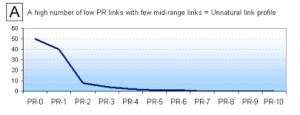
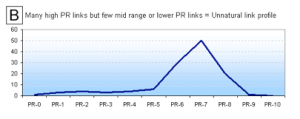
    If you are link building, your backlink profile should look as natural as possible. See A and B charts below for examples of unnatural backlink profiles …

    If all your backlinks are only from very low PageRank pages without any higher quality links, this can look unnatural to Google. (Example A above)

    Likewise, if all your links are from high PageRank websites and you don’t have many mid-to-lower quality links then this can look unnatural, too. (Example B)

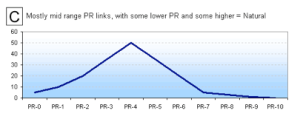
    Patrick suggests that the best link landscape is for most of the backlinks to be of mid-range quality. You would therefore have a few low quality links, a few high quality links and then plenty of mid-range links. (Example C)
    Note: While PageRank (PR) value is used a lot in SEO as an easy way to describe site authority, it can be a little misleading. So do not be surprised if you find websites with low or even zero PR dominating rankings. As a result, link builders need to look at the volume and quality of inbound links to a website to really assess the site. A natural link profile for a website would therefore suggest that it has many links from websites who themselves have an average amount of inbound links.

  • Happy Sunday! Pre Monday Blog!

    Happy Sunday! Pre Monday Blog!

    26 June 2011
    Sail away from the safe harbour…
    “Twenty years from now you will be more disappointed by the things that you didn’t do than by the ones you did do. So throw off the bowlines. Sail away from the safe harbor. Catch the trade winds in your sails. Explore. Dream. Discover.” – Mark Twain

  • Great SEO article by Jill Whalen!

    15 June 2011
    Search Engine Marketing Issues
    ++Who Keeps Spreading Silly SEO Stupidity, and Why?++

    Not a week goes by where a reader or a client doesn’t ask me a question based on some bad SEO advice they heard or read somewhere. Most of the time they don’t know it’s bad advice. They assume that if they read it in a blog, went to a seminar, listened to a webinar or even discussed it with a company that provides SEO as a service, the advice must be solid. Sometimes (usually if they’re a long-term HRA reader 😉 they may think it sounds a bit fishy, and smartly ask for my opinion.

    While it’s true that among SEO industry veterans there can be disagreement about what works and what doesn’t, there are some SEO tactics that have been known by all who have even the slightest bit of intelligence to be useless. And yet they still crop up as SEO advice — all the time!

    Just last week I got an email from a longtime HRA subscriber who told me that his friend had attended a seminar where the speaker told them they should submit their website to search engines on a monthly basis, and proceeded to provide them with the name of a tool that would do so for only $99 per month!

    And just yesterday, someone emailed me for my opinion when she read in another email newsletter that Google only indexed the first 100 words on a page!
    When I hear this sort of irresponsible and incorrect information being spread to impressionable Internet marketers in the making, I get irate. In fact, here’s what I said in response to the question about submitting sites to the search engines:

    “I honestly can’t believe that there could still be, in 2011, someone who would speak to an audience on any form of Internet marketing who would recommend submitting to search engines, let alone one that would recommend spending $99 (or even 10 cents) a month to do so. In fact, it enrages me. That person who spoke must be a sales rep for that [submission tool] company, and he or she should be thrown out of the business and not allowed to speak on the topic ever again.” While it is likely that the speaker was a paid sponsor there to peddle his putrid website submission tool to clueless newbies, I started to wonder about others who spread this sort of silly SEO stupidity, and why.
    Here’s what I came up with:

    It’s easy to implement. This is likely the main reason that SEO stupidity spreads like wildfire, and the reason that is the basis for all the other reasons. SEO — that is, real SEO — is hard. Stupid SEO is easy. (So what if it doesn’t work? That’s just a small inconvenience!)
    Incompetent SEOs have a vested interest in perpetuating silly SEO. The more people who think that SEO is about submitting to search engines or about meta keywords, the more people will sign up for their boondoggle services and the more ill-gained money they’ll have lining their pockets

    Old articles get recirculated. There are more than 15 years’ worth of old, out-of-date SEO articles from a variety of sources that may look credible on the surface (and perhaps were at one time), but that provide advice that has nothing to do with SEO in the 21st century. Just do a Google search for “Should I submit to search engines?” and you’ll see all sorts of fun stuff. Even Google’s Webmaster Guidelines point to their Add-URL page, which is all but worthless.

    Designers and developers know just enough SEO to be dangerous. I’ll just point you to my “85 Reasons Why Website Designers / Developers Keep SEOs in Business” article to explain this one.
    Forum circle jerks. There are, surprisingly, still a lot of SEO forums in the online world, most of them full of newbies. While it’s great that new people in our industry want to learn SEO, they need some professional and competent SEOs there to guide them. Yet on many forums it’s a case of the blind leading the blind. A newbie thinks some silly SEO technique works and spreads it to the other newbies. Eventually one of the more enterprising young SEOs writes the “Newbie Bible to Stupid SEO” and at that point what is said must be true (cuz it’s in the bible!).
    Believing what you read or hear instead of figuring it out for yourself. This truly irks me to no end and is definitely one of the major causes for the spread of many a silly SEO idea. If something you read sounds credible, then by all means give it a try. But unless you see proof of it working with your own eyes, then don’t believe it…even if the most credible person in the SEO world wrote or said it.

    Mixing up cause and effect. Another one of my pet peeves that has been common since the beginning of SEO time. Just because you changed the positioning of a word in your title tag and the next day you ranked one place higher in Google doesn’t mean that your change is what caused it. It may have, but it may not have. We used to joke on the High Rankings Forum that if you keep a cabbage on your monitor it will increase your rankings. Why not? It’s as likely as some of the silly SEO theories that are based on poorly drawn conclusions that mix up cause and effect.
    They’re set in their ways. We all know that people hate change. Many SEOs are no different. But just because a 1990s search engine could only index a certain number of kilobytes of information on a page (likely due to bandwidth constraints) doesn’t mean that today’s Google works that way. The search engines themselves have made huge strides over the years, and while the basics of making a great site will always remain the same, the mechanics of how to do that change often. So to the person who recently asked me if hand-coded HTML pages will rank better than dynamically generated ones, the answer is a definitive NO, even if it may have been true in 1996!

    Coincidentally, just as I finished writing all of the above, I received an email from my friend and colleague Karon Thackston, who has a new client who was previously told by one of those silly SEOs, “You need a THOUSAND words of copy on your eCommerce Home Page, and cram it full of keywords”! She was also told by another silly SEO, “You need to rewrite ALL the copy on your entire site because it’s no longer ‘fresh.’” Apparently, he qualified “fresh” as anything over 60 days old. Sigh.
    With SEO stupidity such as that being spouted to unsuspecting website owners each and every day, as well as for the reasons stated above, I fear it’s going to be many more years before most people can sort out the facts from the SEO fiction.

    Jill
    Jill Whalen is the CEO of High Rankings, an SEO Consulting company in the Boston, MA area since 1995. Follow her on Twitter @JillWhalen
    Share your comments and thoughts here.
    Tweet
    P.S. If anyone would like to republish the above article, please email me your request and where it will reside, and I’ll send you a short bio you can use with it for your site.


  • Summer is here Blog!

    Summer is here Blog!

    13 June 2011

    Summer is the warmest of the four temperate seasons, between spring and autumn. At the summer solstice, the days are longest and the nights are shortest, with day-length decreasing as the season progresses after the solstice. The date of the beginning of summer varies according to climate, culture, and tradition, but when it is summer in the southern hemisphere it is winter in the northern hemisphere, and vice versa.

    The Western definition based on equinox to solstice is more frequently used where a temperature lag of up to half a season is common. Summer is the period from the summer solstice to the autumn equinox.Unofficially, the U.S. summer season is commonly regarded as beginning on Memorial Day weekend in May and ending on Labor Day weekend in September. Summer marks the beginning of outdoor patio’s, barbecue’s, parties and the beach, finally the wonderful welcome of warm weather and out door activities.

    This summer has been especially welcomed because Canada had such a long and cold Canadian winter just driving in the downtown core in downtown Toronto there is an excitement in the air and as well a flury of events and concerts in and around the city. The best way to find out what is going on around your city from coast to coast is to Goolge your local city for local events where you will find anything from street festivals to concert events. The list is endless and there is something for everyone.

    While it has been a bit of a difficult time for many businesses and individuals summer is a time that the economy will generally show signs of growth with families going out more and spending on activities this will usually provide a boost in the economy. Also there is a trend going on right now where many people are choosing to stay in their local community rather than going away on vacation and spending money they are choosing to spend it right here at home instead this is great for the over all local economy since when local businesses grow this provides more revenue for companies to hire on new employees and to help create a stronger local economy.

    Summer is finally here and it would be great if we could use the wonderful weather as a distraction from all of the negative news out there and with so much going on in and around your city it is a great time to reconnect with your local community by supporting local events this is how we can all build a strong economy once more.

    Nexonta technologies Inc

  • Risk Management Blog!

    Risk Management Blog!

    06 June 2011
    Risk management is the identification, assessment, and prioritization of risks followed by coordinated and economical application of resources to minimize, monitor, and control the probability and/or impact of unfortunate events or to maximize the realization of opportunities. Risks can come from uncertainty in financial markets, project failures, legal liabilities or credit risk.

    The etymology of “business” relates to the state of being busy either as an individual or society as a whole, doing commercially viable and profitable work. The term “business” has at least three usages, depending on the scope — the singular usage to mean a particular organization; the generalized usage to refer to a particular market sector, “the music business” and compound forms such as agribusiness; and the broadest meaning, which encompasses all activity by the community of suppliers of goods and services.
    In today’s business environment is is almost certain that companies will experience some form of risk in there day to day business activities from perhaps not finding the right candidate for a position in your organization to expanding in a particular sector of the market which might be changing rapidly because of technological advancements in that particular sector. This is why it is becoming more and more important for companies to do proper due diligence when it comes to growth and expansion. Google is a great example of how business have changed their approach to marketing.

    Years ago companies would only develop goods and services that could be developed and brought to the market place followed by an elaborate marketing campaign however today all one has to do is do a Google search and see what people are looking for online and if there is alot of demand for a particular product or service but few players offering that product or service then perhaps this might be a sector of the market place that your company should expand in. Long gone are the day’s when the corporations dictated what the consumer should consume, today companies would be wise to pay attention to what the consumer is looking for in order to make their lives more comfortable.

    While it is clear that it will be a little while until we get out of this economic tail spin, judging from alot of social indicators it is clear that the family unit is once again becoming very important. Given the fact that appreciation for family is what got western society to such an advanced state of prosperity it is no secret that this same focus will lead us to make better economic decisions for the good of the family unit as well as the communtiy as a whole. Once quality of family life takes importance over wealth accumulation then we can once again be on the path to economic growth once more. Today there is a certain degree of risk in any business for large and small companies but unlike 50 years ago things change quickly and the biggest risk that alot of companies can take today is by standing still and not taking any risk at all.

    Nexonta Technologies Inc

  • Welcome to Change Blog!

    Welcome to Change Blog!

    26 May 2011
    Change management is a structured approach to shifting/transitioning individuals, teams, and organizations from a current state to a desired future state. It is an organizational process aimed at empowering employees to accept and embrace changes in their current business environment.In project management, change management refers to a project management process where changes to a project are formally introduced and approved. these are examples of Organizational Change:
    Location changes
    Missionary changes
    Strategic changes
    Operational changes (including Structural changes)
    Technological changes
    Changing the attitudes and behaviors of personnel

    As a multidisciplinary practice that has evolved as a result of scholarly research, Organizational Change Management should begin with a systematic diagnosis of the current situation in order to determine both the need for change and the capability to change. The objectives, content, and process of change should all be specified as part of a Change Management plan. While change is never easy it is essential for the growth and developement of any organization. In today’s economic environment it is essential to change with the changing tides of economic and social environments in order to stay ahead of the curb.

    Change Management processes may include creative marketing to enable communication between change audiences, but also deep social understanding about leadership’s styles and group dynamics. As a visible track on transformation projects, Organizational Change Management aligns groups’ expectations, communicates, integrates teams and manages people training. It makes use of performance metrics, such as financial results, operational efficiency, leadership commitment, communication effectiveness, and the perceived need for change to design appropriate strategies, in order to avoid change failures or solve troubled change projects.

    Successful change management is more likely to occur if the following are included:
    Benefits management and realization to define measurable stakeholder aims, create a business case for their achievement (which should be continuously updated), and monitor assumptions, risks, dependencies, costs, return on investment, dis-benefits and cultural issues affecting the progress of the associated work. Today the world is moving from an industrial frame to a technological and this has created huge gaps in traditional leadership with a younger more tech savvy generation in fact the challenge before many CEO’s today is how to convert traditional brick and mortar business models to keep up with technological advancements. It is a challenge indeed however with enough trial and error the gap will shorten but there will be many business casualties along the way.

    While there is no set formula for steady sustained growth in today’s new economy it is clear that those companies which have harnessed the limitless power of the internet and technology are ahead of the pack and will stay there while other companies struggle to to catch up with the changing times. Given the fact that most businesses and individuals don’t like change it is clear that whatever industry or culture you operate in today change is essential and necessary and those who embrace it will ultimately come out on top.

    Nexonta Technologies Inc

  • Welcome to the Elite!

    Welcome to the Elite!

    11 May 2011
    Elite (occasionally spelled élite) (Latin, eligere – “to elect”) refers to an exceptional and/or privileged group that wields considerable power within its sphere of influence. Depending on the context, this power might be physical, spiritual, intellectual and/or financial. Political elite In sociology, an elite is a group of relatively small size, that is dominant within a large society, having a privileged status perceived as being envied by others of a lower line of order. If such an elite wields political power, it almost invariably puts itself in a position of leadership, whether it be expected or volunteered, and often subjects the holders of elite status to pressure to maintain that leadership position as part of status.

    Some elite groups speak a language that is not shared by the commonality: in Tsarist Russia and in Vietnam, the elite spoke French, in the Philippines the elite spoke, and in many cases still speak, Spanish. In Plantagenet England, the elite spoke Anglo-Norman, while Finland was ruled by a Swedish-speaking elite up to the beginning of the 20th century and in Ptolemaic Egypt the elite spoke Koine Greek. In ancient India, Sanskrit was spoken by the elite class.

    SEO and Google is one other way the elite wield their power and influence over the masses the first page of Google ranking cannot and should not be understated for it’s importance, companies spend thousands of dollars a month for that coveted first page position and this is because being on the first page of google in your particular industry translates into traffic for your website and we all know that if there is no traffic then chances are your website is probably not doing much for your company. Think of it like this, when you do a Google search looking for a particular product or service how many times do you keep going down the first page and flip over to the second page? Chances are if you are like 85% of Google users not likely. This is because of two reasons first you will probably find what you are looking for on the first page of your search results and the second reason is if it is not on the first page most of us assume that it is not available and really who wants to leave the elite cause if they don’t have what we are looking for then it’s probably not available.

    Most clients build websites in order to have a web presence for their organization while this is very important today in these lean times your online presence can be just as important as the quality of the goods and services that your organization provides and this is what will set your company apart from the masses. There are not allot of spots on the first page and for sure there is only one number one spot and this is why it is important that you should pay very close attention to the over all performance of your online marketing activity because your company might offer a higher quality good or service than your competitor does however if your competitor has that first page ranking and you are no where to be seen in the search results this could be the reason that she is driving a Porsche and you are still driving the mini van as your weekend vehicle. Top 3% get there and let Nexonta Technologies Inc show you how.
    Nexonta Technologies Inc

☎ ✉
f 𝕏