Author: admin

  • What are you training for???

    What are you training for???

    Original Blog Posted: 28 Jul 2012

    The Olympic BLOG

    26 February 2010
    I thought it only fit to write a blog on the Olympics which is a pleasant distraction taking our attentions away from the doldrums of our present day to day life and offering us the opportunity to witness what years of hard work for the worlds top athletes produce in the 7 minutes of pure performance. Watching these games I can’t help but think that in many ways we are like Olympic hopefuls with our podiums being a happy family life, a successful business or a great career, I mean the training is more or less the same we focus and train hard to be the best in our respective fields while dealing with the ins and outs of everyday challenges only to face variables like the speed skater Sven Kramer from the Netherlands who was disqualified from winning gold at the Winter Olympics cause of bad advice from his coach. His response ”that was an expensive mistake” or the American skier Julia Mancuso whose two split times on her aborted run indicated she would have been near the lead had she finished, felt robbed. She thought race officials should have prevented her from starting or stopped her earlier.

    This is just life and the harder we try the more we feel cheated when life happens to us but the great thing about the Olympics is there is always 2014 and you bet that with the right attitude and outlook on life these athletes will be back to finish what they started. I was inspired by the Blog of Heather Moyse our bobsled gold medal co winner along with Kallie Humphries, when she said of the Nagano Olympics “I have unfinished business” and wolla 4 years later gold. The beauty of everyday Olympics is that we don’t have to wait four years to win a medal, we can get better tomorrow or the week after the choice is ours. If an Olympic athlete can train for 4 years between greatness in their lives I think we can manage to improve day by day after all winning gold is there for all of us it just depends on what you are training for.

    So to all my fellow Olympians go for gold in whatever your personal pursuit of excellence may be.
    Dream Big!
    Nexonta Technologies Inc

  • Great blog by Jill Whalen

    Great blog by Jill Whalen

    Original Blog posted: 16 Jul 2012

    16 July 2012

    Search Engine Marketing Issues

    ++Paying for Penalties: Lies That Shady SEO Companies Tell++

    Ever since Panda and Penguin (Google’s major changes to how they rank websites in order to fight web spam) have hit, a lot of companies have lost a large percentage of their website visitors. Bewildered by their sudden misfortune, many of these business owners have turned to me to review their websites and their SEO practices to determine where they went wrong and what they need to do to get back into Google’s good graces.

    While many of them had been doing their own SEO based on what they’ve picked up through the years, a few have had SEO companies (and I use this term loosely) “helping” them. Sadly, what some of these companies do worked okay in a pre–Panda-Penguin world, even though it was garbage that doesn’t come close to following SEO best practices. The fact that it worked is what has kept SEO web spammers in business for so long. And it’s possible that to a certain extent what they’re doing may still work for a short time — at least until Google reprocesses their ranking formula. That’s when the panda poop hits the fan!

    If it were just a matter of the links no longer counting, it wouldn’t be so bad. But these days not only does the site lose any additional Google traffic they may have gained from the bad SEO, they start receiving even less traffic than they were getting before the bad links.

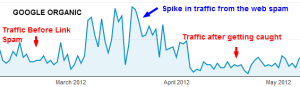
    Here’s an example of this:

    great blog by gillian whaen 1.

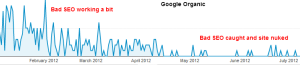
    And here’s another example:

    great blog by gillian whaen

    You’ll notice in both of these examples that the start of the major loss of Google traffic started toward the end of April, right around when the Penguincame first came to town. In the first instance, the client was (and is) very web UNsavvy. She knows very little about her own website and online marketing in general, let alone much about SEO. I’m not sure if she contacted the SEO company directly to “help” her, or if it was unsolicited. Either way, the web spammers quickly found they were dealing with their favorite type of customer — trusting and naïve. Not to mention desperate. The website had been losing traffic and sales since the early Panda days in 2010. (Due to not much content and simply not keeping up with what other companies in the space were doing.)

    Signs That Your SEO Sucks
    When I reviewed the site and looked at the links pointing to it, I saw a lot of terribly written spammy blog (splog) posts having been submitted to irrelevant, crappy splog networks, article submission sites, and fake directories. They all had a few different keyword phrases that pointed back to the home page of the client’s site. The dates of the posts were all from around the time that the site had its initial boost in Google traffic.

    These links were obviously fake, purchased and extremely low in quality. For instance, one was in a directory on a domain that had a section pertaining to link building services as well as a splog full of wonderful articles which nobody in their right mind would be interested in reading — ever. In fact, the client’s site was linked from a number of directories that all looked the same, but were on different domain names and using a different name and background color. High class and high quality they were not! My favorites were the links right next to ones for “buying text links”! (They’re a nice change from the ones next to credit card and payday loan links!)

    Shoddy SEO That You Pay For
    In addition to creating barely readable content and submitting it to their icky splog networks, this SEO company also wrote useless, grammatically incorrect articles and put them into a blog on the client’s own site. Of course these all had anchor text pointing back to the home page. I was surprised that they didn’t even go to the trouble of pointing the anchor text to the most appropriate pages within the site instead of the home page, but that may have taken some actual work to figure out where they should go! (Web spammers don’t believe in actually working.)
    To top it off, they even stuck a link to their own SEO site with the anchor text of “SEO” on every page of the client’s site! (It wasn’t clear to me whether she gave them permission to do this or not.)

    When I pointed out all of the above in my SEO site audit report to the client, I told her to have the company remove all of the links and explained why they were bad. And here’s where it got weird. The company emailed her back trying to convince her that they were not a spammy SEO company at all and that everything they were doing for her was on the up-and-up. When she asked them for a list of the links they had built for her, they had the gall to say that only black hat link building companies would be able to provide a list of their links. (Huh?)

    Whom Do You Trust?
    But the really scary part is that their answers sounded credible and believable to one who wouldn’t know better. This poor client was stuck between a rock and a hard place. She had me on the one hand telling her that what this company did was likely a big reason why she was no longer making any sales, and them telling her, “But you’re ranking for the keywords we chose together.” (This was true to some extent because the site was still ranking for some of the non-competitive phrases that nobody searches for.) And then they tried to scare the client by telling her that if they removed the links, her rankings would plummet and she’d lose even more traffic. They also tried to weasel out by saying that perhaps her shopping cart was not working properly (which, even if true, wouldn’t account for the nearly complete loss of Google traffic).

    Finally, in answer to their half-truths, I told her that any reputable SEO company knows that the types of things this company does are considered to be web spam — certainly after Google

    Penguin, if not before. And the very fact that they were continuing to claim that what they were doing was all well and good showed just how horrible and unethical they were. In fact, I was so enraged by this that I told her to tell them that if they didn’t want to remove the spammy junk and wouldn’t give her money back, I’d be happy to write about them to my 25K newsletter subscribers.

    At this point I haven’t heard back from her. I decided to write this article anyway (without naming names) so that others can learn from it. I hope that the more this kind of SEO gets talked about and pointed out as the web spam that it is, the more others will stop spending money to get themselves penalized by Google.
    Jill
    ________________________________________
    Jill Whalen is the CEO of High Rankings, an SEO Consultingcompany in the Boston, MA area since 1995. Follow her on Twitter @JillWhalen
    If you learned from this article, be sure to invite your colleagues to sign up for the High Rankings Advisor SEO Newsletter so they can receive similar articles in the future!

  • Urls for better SEO:

    Original Blog Posted: 05 Jul 2012

    Search engines like Google scan URLs, title tags, and other tags to glean information about what your website or blog post is really about. What better what to communicate this than by putting keywords into your URLs? If you’re not incorporating keywords into your domain name and other URLS in your website, you’re missing out on web traffic, bottom line.

    Ways to optimize your URL
    Begin by checking your domain name? Is it SEO rich? A yoga studio that has the word “yoga” in its domain will get more hits than one in the same city that has a generic name, and the same goes for hair salons, veterinarians, and other businesses that provide a specific service. If you’re just getting started building a website, place a keyword in the domain to get off to a good start.
    Of course, not everyone can start fresh with a new domain. If you have a strong presence on an existing domain, modifying that URL is not a good idea. It risks confusing clients, who may not be able to find you or may think your businesses has changed hands in some way. In this case, place keywords in sub pages and try using them in blog posts. For example, a domain of mikesrestaurant.com and mikesrestaurant.com/menu are not very descriptive, but mikesrestaurant.com/pizza effectively tells Google that your restaurant serves pizza. This can give you a boost in SERPs. If you’ve localized your page, users searching for pizza in your city can find your restaurant in the first pages of search results, which makes them much more likely to place that late-night delivery order with you.

    What to Watch For
    Too much SEO can do harm. A search engine scans your website for keywords, but if that keyword is repeated too many times, the search engine can actually downgrade your site. So-called keyword stuffing will actually hurt your SERPs, not help them. Choosing long URLs–those over 115 characters–may get you marked down as spam. One tip to keep URL counts down: Use hyphens instead of underscores. Underscores are counted as characters but hyphens are not! Additionally, Google ranks each work less in a long URL than a short one, so keywords hold less power. If you use query parameters in your URLs so that you can track where traffic is coming from, be wary of using too many. One is generally acceptable but multiple queries can throw search engine robots into a loop they cannot get out of.
    Begin incorporating these keyword tips into your URLs, sub pages, blog posts, and other web content. You should notice increased traffic and higher SERPs, which will lead to more business over time.

    About the Author: John Zwissler @ AddMe.com www.addme.com

  • Another Great article by John Zwissler

    Original Blog Posted:30 Jun 2012
    Scoring Big on Smaller Search Engines
    Posted on June 16, 2012 by John Zwissler

    More and more, it’s not just Google. Internet searchers do use the mega search engine, to the tune of 62 million searches a day. However, users are turning to alternative search engines, perhaps due to concerns about the privacy of Google searches. Users perform an average of 33 million searches per day on alternative search engines, and these users are actually searching longer than folks looking for a quick Google or Yahoo answer.

    If you’re not marketing to the alternative search engine submission and search engine users, which represent a full one-third of searchers at present, you are missing out the chance to market your message and your brand to millions of users per day. It’s not as simple as a submit my website button.

    The best time to reach internet searchers is in the middle phase of their search. At search outset, a user interested in upgrading her patio furniture or purchasing a nonviolent video game for his kids might type in a generic search term, such as “vinyl patio furniture” or “video games for kids.” These queries will help the user find general information about furniture, games, or whatever else they are looking for. After researching for a while, the user begins to form a preference and might perform targeted searches on search engines or online shopping platforms such as Amazon or eBay for a manufacturer’s patio table or a specific video game title. This is where you want your ad to come in, directing searchers to your patio furniture outlet, your gaming store, or anything else.

    There are a few ways to start tapping into this secondary search market, performed on retail and other search sites. First, evaluate your current strategy to develop a thoughtful replacement. Are you using keywords that will be recognized in indexing a website and that target potential customers? Searches performed outside standard business hours are likely to be performed on a mobile device or tablet. Are you targeting this market? Consider where your products are likely to be sold, then use this to guide your strategic partnerships. Develop a mobile-optimized ad channel by targeting local search applications and boosting your online presence on local search networks to garner mobile search results. Consider advertising your brand on product search sites such as Amazon, then place the ads so they target users searching for the type of product you offer.

    As you shift your marketing strategy to include these methods, keep track of usage data and evaluate those stats! If one channel is underperforming for you, try another. As you develop a web marketing strategy that targets users as they evaluate and consider what to buy, you’ll notice increased revenue stream.

    About The Author:John Zwissler from AddMe.com – AddMe is a resource for free search engine submission and online marketing tools. Try our free search engine submission and subscribe to our bi monthly newsletter.

  • Great blog by Wil Reynolds!

    Original Blog Posted: 15 June 2012

    10,462 entries over 4.5 years – what I have learned tracking my time, and what you can too
    Written by Wil Reynolds 8 Comments
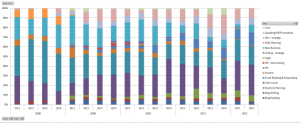
    great blog by wil reynolds

    What is that above? Its not a meme/cat photo. Its data. That’s blood sweat and tears the digital version. It’s 10,462 entries of how I have spent my time at SEER over the last 4.5 years. Let me break down for you how I use this chart to answer 2 simple questions:
    Am I working on what I love most?
    Am I working on where I am most valuable to SEER?
    You can not improve what you do not measure!
    We preach it as digital marketers, but do we do it for ourselves?? I do, I want to take you through the last 4 and a half years, day by day, task by task and see if I am living up to the goal of spending more time on what I like most about my job.

    Most agencies use time tracking all wrong, in our 10 years history and up until last year we never used time tracking to determine profitability per project, we used it to determine how we spend our time and does that connect to our goals. At SEER we track every second, but we use mostly to allow all of us to practice kaizen (the Japanese word describing continual improvement). I don’t know if anyone at SEER has ever done this, but I wanted to do it this weekend to better get a grip on my hours, and make sure I was progressively spending more time on the things I love most.
    Take a breath and open your time tracking tool, start working on reporting. Start living by your calendar, stop overpromising. Its a lot easier to say no to people when you have planned your day and know that there is NO way you can squeeze in their request w/o a re-prioritization. This is why I don’t believe in being overwhelmed, I believe in re-prioritizing.
    But reprioritizing is a day to day tactic, I wanna talk about the strategy of looking at what you love to do in your job and where you spend your time, by looking at your trends over a quarter or year or longer, so that I what I just did.

    The first thing you should start with is an understanding of what you LOVE about your job, what is OK, and what you HATE. Write them down. Using this tactic could be interesting for many of you who are doing some soul searching.
    So for me, what are my “things”?

    My goals with my time are to spend time on the things I love and where my value is greatest to our clients, I do that by:
    • Investing a large amount of my time working on client work, I like building strategies for clients, it makes me happy
    • Spend time with my team and working to build a strong culture
    • Being a student and a teacher, learning from my peers and sharing my knowledge with others

    Those are my big goals.
    Having tracked my time since 2007, I can start to look at my time and see am I putting time into the things I love.
    One very important thing…keep your items tracked to 15-20 items at most, getting too granular is usually a recipe for disaster.
    Step 1 Export all your time. I use Harvest (for now, toggl seems to let me work faster), I like any time tracker that runs in the background while I work.
    One note about my data, I would say that about 40% of my email time is client related, but it just happens so quickly that I don’t swap between timers, one MAJOR weakness in harvest is that everything is scroll box instead of an autocomplete, which really slows down time tracking (toggl uses autocomplete).
    Step 2 You must get friendly with pivot charts, check tutorials after you get your data, it will help. Crack open excel and massage the data a bit to get it right (if you are like me, you’ve changed the way you track your time over the years so you’ll need to massage the items a bit.
    Step 3 Start playing with different items you spend your time on, as a chart like this isn’t very helpful, so get used to filtering:

    great blog by wil reynolds1

    Let me show you my step 3′s and how they let me know if I am working on what I love and where my impact is best…
    Re-evaluate major initiatives you have invested in that used to take up a lot of your time. for me that was business development.

    I hired someone in Q2 2010 to help with business development, it just got too much for me to handle, and wasn’t where my time was best spent and I love DOING SEO Strategy more than SELLING SEO Strategy, so I hired them, eventually I decided to get someone else on board and make that person full time. Our leads from 2010 to 2011 about doubled yet you can see my second hire was able to keep me out of things more than my first and work independently, letting me work on what I loved and what she loved. Jamie B is so full of win its insane!

    great blog by wil reynolds1

    Now I layer in my other big time suck…email. Both are trending down, this is a good thing (I have moved to inbox zero and I think that has been helping me a lot).

    great blog by wil reynolds2

    So what were the items trending up?
    HR and Speaking / Promotion of SEER. So does that fit my mission? Does it fit what I care about? Well in some ways yes, HR is about connecting with your team and building culture. Attending conferences as a participant and a speaker allow me to constantly learn and be able to add value to clients while also helping us hire and build culture, so I am OK with that. Traveling to conferences also fulfills another major goal, which is to spend time with my wife, who is an avid traveler as well.

    great blog by wil reynolds3

    By having this in a pivot table I can easily dig into HR notes to see if my time spent is on “process HR” or “people HR”, I bet if you look at Crystal Anderson’s HR hours they spiked recently, on top of running the SEM team she also loves working with us on operations improvements and alignment. And after I saw Rypple (think of it as basecamp for reviews) and what it could do to help us get better at reviews, I knew I wanted to roll it out, I knew our team would appreciate more frequent updates and more structure. Crystal volunteered to run with it, again doing something she loves/has strength in and letting me stay focused on what I love/have strength in, I love when things work out that way. Years ago my hours on HR would have spiked to do this (because once I believe something is good, I will do it) thus taking my time away from what I love/where I am best utilized. But I also know that interviewing alone is a HUGE part of that, and I expect that to trend down soon, as SEER has hired about 10 SEO’s this year so far to get ahead of all the penguin craziness which is driving high lead flow once again.
    Its not all rainbows and unicorns though. As you can see, my blog time took a hit, but I think the 4 hours I put into this one should bring me up a bit. More concerning to me is that my reading has taken a hit. I have kind of supplanted some of my reading with attending events to get an information rush all at once, and you can see that. But with all the change occurring on Google my time reading which is highly R&D focused should be trending up sharply over the next 2 quarters.

    great blog by wil reynolds4

    Notice none of my goals revolve around working on the finances of the business, and by hiring the RIGHT bookkeeper (big spike came after I had to play cleanup to the WRONG bookkeeper) and a COO, I think we are in good shape, financial reporting is stronger than ever and I am spending less time than ever on it!! Sweet!

    great blog by wil reynolds5

    You can also see what happens when you change your labels, oops, but some easy massaging in Excel fixes all of that.

    great blog by wil reynolds6

    Lastly is the BIG picture, I like to take the bigger things that take up my time / that I like to do and compare it to what my #1 goal is, which is to make sure SEER is delivering on our promises to our clients, which to me means in spite of growing like crazy and dealing with all the issues that come along with growth, that I am still spending more and more of my time on the things that matter most & make me happy, working on client projects directly and with my team. Spending all that time on email is 90% connecting with the team or my clients, so I am ok with that even though it is trending down as that answering emails is reactionary and often tactical, its the time spent on client work that I get to really dig into that is the strategic part and that part is growing healthily. I’m looking forward to breaking 40% in the next 2 years.
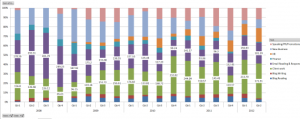
    great blog by wil reynolds7

    So I beg you all to do this, it helps with stress but also career direction. When you sit down with your boss this is a great way to say hey, right now I am spending 70% on task X, and professionally I’d like that to be task Y (assuming you aren’t fudging numbers) – how can we get X down to 50% and Y up from 10% to 30%? Then you should connect that move of responsibilities into what the company goals are, that is a huge part. I know everyone at SEER can do this exercise when they want. Its an important step to sometimes look at yourself and say, hey…this is CRAZY that I am spending 50 hours a month on this task! When you do this you are empowering your team members to take a more active role in pitching management on what they could do that would be more beneficial to the company and to our clients if we could rearrange time deployed. For those of you who track time meticulously, this is a WONDERFUL tool to understand your time.

    For those of you who have never done it, start now.
    seo, Time management, 10,463 entries over 4.5 years, Wil Reynolds,, all

  • Great article by Gillian Cook

    Original Blog Posted: 1 June 2012

    ________________________________________
    By Gillian Cook on April 17, 2012 in seo with 3 Comments
    Last Friday I had the joy of attending Brighton SEO and listening to Philip Sheldrake’s presentation on future visions for SEO. He presented some very interesting stuff on how the World Wide Web as we know it will evolve and how we will make sense of the ever increasing volume of data contained within the web. Our role in SEO is set to change, however SEOs that are adaptable, flexible and willing to work with different types of information and different departments within the organisation will survive.

    More People, More Things, More Data

    The world’s population is rapidly growing and is set to reach 8 billion people in the next decade. We produce and consume large quantities of resources. The amount of data we produce is extensive; from content and documents on the internet, to output signals from electronic devices to environmental sensory trackers that measure things like temperature, electricity consumption, traffic and flow of water. We can quite easily collect this data however applying intelligence to turn it into useful information by identifying patterns is becoming more and more difficult.

    Big Data, Big Info & Maybe Big Knowledge?
    Big data is the term coined to describe data sets that are so large it becomes difficult and awkward to extract valuable information from them within a reasonable time frame. We can quite easily collect this data however the larger the sample set the more difficult turning it into useful information becomes.. To take it one step further is to turn this information into knowledge and make the data work for us in ways that have been previously unattainable.

    A New Era For The Web
    The third decade of the web and we are beginning to witness a change in how the data contained within the internet is being rationalised and organised. Sheldrake used three different names for to describe this new era.
    “Web 3.0”
    “The Web of Data”
    “The Semantic Web”

    I wish to use the term The Semantic Web as semantics is the study of meaning and this era represents how we will make sense of the data contained within the internet. We are growing and evolving the web to convert the current web of unstructured documents into meaningful data that can be manipulated and filtered by machines. These machines will be able to join sets of complicated data, helping us become aware of what is going on and solve problems that previously were not able to achieve.

    How will this work?
    Resource Description Framework (RDF) provides a standardised language for defining web based ontologies which enable richer integration and interoperability of data. It’s a way of structuring web information using a variety syntax formats called triples.
    {subject} {predicate} {object}
    Gillian Cook works in SEO.
    RDF extends the linking structure of the Web to use URIs to name the relationship between things as well as the two ends of the link. Using this simple model, it allows structured and semi-structured data to be mixed, exposed, and shared across different applications.
    Using RDF we are able to categorise data correctly and by doing this we are able to link data in new ways. Linked Data is a term coined for the best practice of exposing, sharing and connecting pieces of data, information, and knowledge on the Semantic Web using URIs and RDF.
    This isn’t something that is forecast for the future it’s something that is already happening now. Google are already encouraging the use ofMicroformats – simple conventions or entities with their own properties that can be used on web pages to describe a specific type of information – e.g. a review, a recipe, a business.
    What Does This Mean For SEO
    When we consider how SEO is perceived, at times it seems like SEO’s are doing everything in their power to elevate their websites to the golden prize of 1st position in the SERPs, even if it means breaking the rules of the Google game. Yet when conceived in this way, SEO is a limited practice as the internet will become more regulated and transparent hence diminishing this type of online behaviour.
    However if we consider our role in SEO as working with search engines to deliver users the right content at the right time in the right format then our position is no longer in jeopardy. Content for content’s sake will need to change as organisations become defined by their flows of data and information. The role of SEO will be defined as “improving the presentation, discoverability, machinability and usefulness of data, information and knowledge for all stakeholders”. As Pierre Farr mentioned at the start of the conference, SEO is not dying it is simply evolving over time as we have seen it do in the past. What’s good to know is that that according to Sheldrake, SEOs have the relevant skills to take on the challenges of the future.

  • Great blog by John Zwissler

    Original Blog Posted: 1 Jun 2012

    Tips for Success in Content Networks:
    Small business owners save themselves a great amount of time and money by utilizing the most effective strategies to manage their online advertising campaigns. Business owners with Google Adwords accounts may advertise their goods and services on content networks as well as in general search.

    A content network is a network of websites that provide content: text content, video content, and audio content. These sites allow advertisers to show ads next to the content. It is not enough to simply have your advertising show up on pages in the content network. Success in business advertising on content networks depends upon the following techniques.
    When creating content network campaigns in your Google Adwords account, always turn off search. By the same token, turn off content networks when you create campaigns for search. Keep content network and search campaigns separate.

    Create unique keyword lists for each campaign. A “keyword” is actually a word or a phrase connected to a specific search campaign. To successfully advertise in content networks, limit your campaign keywords to only one to three words. Longer phrases used as keywords are unlikely to result in relevant matches.
    Make a list of keywords that describe the type of sites on the content network on which you want your business ad to run. For search campaigns, it is best to create as many keyword phrases as you can think of to describe that site and how your ad relates to it. Creativity is highly useful. The more specific keywords you come up with, the more likely you will find a handful that sound best and will bring more traffic to you.

    For content networks, however, keywords should describe the sites in more general, broad terms. This is a different strategy from designing keywords for search. Using broader keyword terms widens the net for more relevant sites to show your ad.

    Maintain separate keyword lists for search campaigns and content networks.
    Google scans the millions of pages in the content network on an ongoing basis. Google looks for matches between your keywords and other campaign data to put your ad on the most relevant sites.

    To succeed in content networks, you must keep track of all of the sites on which your ad appears. Pay attention to how much traffic you get from each site. Exclude low performing sites from your campaign.

    It is also advisable to bid lower on content networks than you bid on search campaigns. Keep search and content network campaigns separate, use broad search term keywords for content networks, and keep track of which website in the network send you traffic for advertising success.
    About the Author: John Zwissler @ AddMe.com www.addme.com

  • Great content Blog!

    Original Blog Posted: 29 May 2012

    Why is Fresh and Original Content Important?
    If you read through any blog or article about website optimisation, online marketing or Seach Engine rankings you will see time and time again that ‘regular updates’ or ‘fresh content’ is mentioned as the key to achieving and maintaining your top ranking position for your business website. But why exactly is this? What are the tips and tricks to use when writing your content? How much content is enough and how much is too much? We thought it was our duty to provide you with a comprehensive guide to the whys and hows of writing fresh, original and quality content for your website and to explode some myths along the way. We will also look at how to get the most out of your website content once it is written.

    Fresh Content for Visitors
    The key thing to remember when creating your website is your visitors and how you will encourage them to return to your website again and again. Take an online store. Of course, adding new products to your lines is very important but what makes a customer choose to buy a new product from you rather than one of your competitors? Well, probably the one thing that makes you return to your favourite high street shops when you go out and buy goods, sound advice and product know-how from the staff on the shop floor.

    Having an online store without useful product reviews, hints and tips and articles is the equivalent of going into a major retailer and having a question about the new television you want to buy met with a shrug of the shoulders and a ‘dunno’ from the sales assistant. We have probably all had this experience in the past and know how off putting it can be.

    So, how do you avoid being that sales assistant and demonstrate that you have all the product knowledge required to advise your online customers about their purchase? Well, we would certainly advise that you write a review of each new product you stock and make sure your product descriptions are thorough and accurate. For example, the new television you have in your range, does it have HDMI sockets? If so, how many? Is it full HD? Does it have a built in Freeview tuner? Don’t make your customers go elsewhere to find this information and hope they come back because they won’t.

    You can go further than this though by writing reviews and ‘road tests’ of your new product ranges. Why not compare three HD televisions and write an article about it or even advise your customers on the best way to set up their new television in their living room to get the most out of it? You could even make a YouTube video demonstrating the features of the television and post it on your website. It is this level of detail that will make your online store stand out from the crowd and keep customers coming back to you.

    Remember that just because you are online it doesn’t mean you can ignore good customer service!

    Fresh Content for Search Engines
    Search Engines love fresh content. Their ‘bots’ or ‘spiders’ crawl the web looking for new pages and content and you will be amazed how much difference a new article or blog post can make to your rankings. Remember that you are competing for your search engine ranking and it is not a given that your website will appear in even the first ten pages of a Google Search just because you want it to.

    Your competitors will all be writing fresh content for their websites and the Search Engines will know this. If the last update was made to your website six months ago then you will eventually drop below the website that has content added every week. Lack of regular updates will make your website appear less relevant to Search Engine results very quickly and this can be the demise of any online business.

    If you leave a website to get stagnant then the regularity with which your website is ‘crawled’ will drop dramatically and, soon enough, the investment you made in your website when it was first built becomes dead money.

    Why Does Content Have to be Original?
    When being faced with the daunting task of creating fresh website content on a regular basis it is tempting to copy and paste content from other people’s websites. Back to our television again, why should you write a compelling review of the new HD television when there are twenty others already online? Why shouldn’t you just copy what they have done? Afterall, that content will be fresh to your website.

    Well, Search Engines know all about duplicate content. In fact this warning appears on the Google Webmaster pages;
    “In the rare cases in which Google perceives that duplicate content may be shown with intent to manipulate our rankings and deceive our users, we’ll also make appropriate adjustments in the indexing and ranking of the sites involved. As a result, the ranking of the site may suffer, or the site might be removed entirely from the Google index, in which case it will no longer appear in search results.”

    What you are doing may be in all innocence but wrecking your rankings in this way can be very frustrating indeed, especially if your website gets removed from the index.
    Of course you cannot discount that you may also be infringing copyright by copying someone else’s content. This can have serious legal ramifications for your website or business if you are caught and prosecuted.

    Tips for Maximising Your Content
    So we guess we have laboured the point about why fresh content is important to your website but what about some tips to get the most out of the content you have written?
    1. Make sure your website can have new content and pages added easily. This is where a CMS (Content Management System) website can be very valuable. You will want to be able to add content yourself and not have to pay your web designer every time you want an update.

    2. Update regularly. Keep up-to-date with your industry yourself. If you own a technology web store then read publications such as T3 or watch The Gadget Show whenever you can to get ideas about new articles or features to write about.

    3. Keep it relevant and interesting. It isn’t easy writing articles or blog posts so maybe look online for some hints and tips about article writing or maybe even consider a college or distance learning course. Reduce the risks of losing your audience by breaking your content into bite-sized chunks or paragraphs.

    4. Proof read everything. How something is written is as important as writing it in the first place. Poor grammar or spelling can give the wrong impression about your website.

    5. Link your keywords. You will know what keywords are important to your business so emphasise these with a link to a main landing page on your website. For instance, writing an article about the new range of 3D televisions available could include the phrase ‘brand new 3D TVs on the market’. If this phrase is linked back to your page of the 3D TVs you have in stock it can highlight to Search Engines that these keywords and that page are important. Your pages should act like a spider’s web with all of the strands pointing to the pages that will actually make you some income.

    6. There is such a thing as too much content. For a regular website a page or two of new content a week should be plenty. Make sure you get your best and most relevant material noticed by not ‘crowding it out’ with content for the sake of it.

    7. Use social media. Encourage your readers to ‘Digg’, ‘Like’ or ‘Tweet’ your articles by making it really easy to do so. Including buttons for this on articles can be extremely valuable as when users read the article and click that they want to share it on Facebook a link will appear in their Facebook profile which will be visible to all their friends who may well visit as well.

    8. Create links back to your website yourself. Don’t wait for your visitors to share how good your latest article is. Post it on social media and article sharing websites straight away.

    Conclusion
    Building and maintaining your online presence is hard work. Writing fresh content can be daunting and may be way down your priority list when you have so much else to do in a day but do try and generate interest in your website by offering customers what they want. Make the time to write articles, features and blogs for your website. Be the online expert in your field and encourage others to share the pages of your website and you’ll see the benefits much more quickly than you might think.
    If you are in the Bristol area and would like any further help and advice about creating fresh content for your website then contact us at Yoto Creative.

  • Google Panda Updates in 2012

    Original Blog Posted: 24 May 2012

    Google’s Panda Updates in 2012 are Changing the Game for SEO
    Internet Marketing,Search Engine Optimization 2 May 2012

    If you own a commercial website in a competitive market online, it is possible that you noticed some alarming shifts in your site’s search engine ranking position around the end of February and into March of 2012. Similarly, if you are a search marketer, you likely noticed some significant movement in the rankings for some of the sites your manage. The following is a description of some of the major updates that were made to Google’s algorithm over the past 13 months that will likely have a lasting impact on SEO for the foreseeable future.

    February 2011: Google Launches Panda Algorithm Update
    Since February 2011, when Google first introduced it’s new Panda search results ranking algorithm, there have been some very dramatic shifts in emphasis towards “higher quality sites”. For instance, many news sites and social networking sites have been seeing a higher surge in ranking positions over more static sites that contain lots of advertising. With the initial Panda update in last year, the change reportedly affected around 12% of all search results.

    November 2011: Fresh Content is Even More Important
    Following from this initial release, over the past year Google has been adding minor updates to help further refine the quality of search results, however another major update came in November 2011. It was announced that an algorithm change that rewards freshness would impact up to 35% of all search queries. This change would make having a blog on your site for instance be that much more valuable going forward (as if it wasn’t already?).

    January 2012: Update Focuses on the Quality Inbound Links.
    As inbound links to your website have historically been one of the strongest indications of site relevance and popularity, the algorithm is now better at scrutinizing between real authentic links and artificial links.

    February 2012: Google Rewards Better Onsite Quality Factors
    Higher Emphasis Toward On-page Factors: Google is now measuring how users interact with websites to help score the relevance of a site with regards to search queries. How long a user stays on a page, whether they bounce off right away and even how fast the page load time is are now all more heavily weighted factors. This is ultimately a great thing in my opinion because it will mean that sites that want to place high will now have to produce better, more relevant content in a way that is more attractive and captures the interest of search visitors. Google also introduced penalties for sites that are crowded with paid links and display ads above the first half of the page. Sites like this will have experienced a bit of a downgrade according to this update.

    April 3rd, 2012: Anchor Text Scoring
    Google announced another change in April that will influence how it scores and evaluates anchor text links. This is a significant shift as far as search marketers are concerned, as anchor text links have traditionally been a very strong component for getting a site to rank well for a particular keyword. A more in depth description of this update can be found here.
    So there you have a review of some of the major updates that have affected search since the initial roll out of Panda. In essence, Google has made some significant changes that will ultimately deliver a better list of quality sites and make for a better user experience. The walk away is that business owners and search engine optimizers will need to do a better job at getting their sites to conform to these new standards. Changes like these are positive for everyone in my opinion, because they help encourage a better standard of quality, while helping to reinvigorate the approach to building and optimizing websites. True, it can sometimes be traumatic when a dramatic shift occurs, but it is everyone’s job to stay on top of these updates and to plan accordingly.

  • 7 Reasons You Need a Facebook Page for Your Business:

    Original Blog Posted: 18 May 2012

    There are many social networks competing for time and attention, but Facebook remains king. Adding a Facebook page for your business can be a vital business marketing tool, as well as a way for you to communicate with customers, raise brand awareness, and promote products, sales, and services. It’s free to get started on Facebook, and you can get your page up and running in as little as 15 minutes. To really make your page work for promotion and connecting with users, be savvy about posting regularly and follow these best practices.

    Top 5 Reasons to Build a Facebook Page
    1. It’s All About the Branding
    Facebook represents a branding opportunity that you just can’t pass up. Chances are, whatever you’re selling, your customers use Facebook on a weekly or daily basis to connect with peers. By getting your product or service up on Facebook, you get the chance to connect with your fans and potential customers where they hang out. Personalize your profile and your page with images that tell a story about your brand.

    2. New Ways to Communicate with Customers
    Facebook lets you communicate with customers by posting news articles, polls, photos and other information to your Wall. Customers can comment on your posts, leave posts of their own, and connect with you. By adding business information, such as location, you enable customers to “check in” at your business using FacebookPlaces.

    3. Customer Acquisition Opportunity
    Because anyone can like your Facebook page, this gives you unlimited growth potential for new customers. Existing Fans can refer friends and family to your page with a simple click, and may be incentivized to do so if you run discount offers and other promotional giveaways. Facebook insights offer targeted ad analysis that may help you strengthen ad campaigns.

    4. Helps Build Company Authority
    In the old days, having a well-known brick and mortar store was your ticket to brand authority. These days, web real estate is where the action is, a Facebook profile is part of that image. If you don’t have one, you risk being labeled as old fashioned. When users search on Facebook for your company, they expect to find a Page. When they don’t, it signals that you’re out of touch. Similarly, users will see your Facebook presence when web searching for your business, and may remember to like your brand next time they log onto Facebook.

    5. Dominate Google SERPs for your Brand or Product
    Since all Facebook Page activity is in the public domain, search engines index all of the likes, posts, and other transactions that happen on your page. The more active you are, the higher your webpage and brand climb in search engine results pages (or SERPs). The more time and energy that you put into your Facebook page, the more you’ll dominate in Google returned search results.

    Top 2 Reasons to Build Page Likes
    An active page is attractive to visitors. If a user finds your Facebook page, but the last post was three months ago, that sends the message that your brand or product is less active than your competitors. While posting daily may be a burden to your business, strive for regular interactions, such as one to two times a week. Reasons to build page likes include:

    1. Build Brand Authority
    Liking engages users and makes them feel like someone is listening. This can make users more likely to give product feedback, connect with you on social media, and feel that sense of trust and connection that keeps users faithful to your brand or product.

    2. Increase audience for your Facebook page activity
    As users comment on your Facebook page or like your page status, the action of their liking is displayed on their own Facebook page. This translates directly to more eyeballs on your content, which can lead to new likes, new fans, and new relationships.
    About the Author: John Zwissler @addme.cm

☎ ✉
f 𝕏