Tag: seo

  • Great blog by Wil Reynolds!

    Original Blog Posted: 15 June 2012

    10,462 entries over 4.5 years – what I have learned tracking my time, and what you can too
    Written by Wil Reynolds 8 Comments
    great blog by wil reynolds

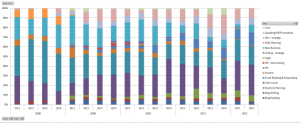
    What is that above? Its not a meme/cat photo. Its data. That’s blood sweat and tears the digital version. It’s 10,462 entries of how I have spent my time at SEER over the last 4.5 years. Let me break down for you how I use this chart to answer 2 simple questions:
    Am I working on what I love most?
    Am I working on where I am most valuable to SEER?
    You can not improve what you do not measure!
    We preach it as digital marketers, but do we do it for ourselves?? I do, I want to take you through the last 4 and a half years, day by day, task by task and see if I am living up to the goal of spending more time on what I like most about my job.

    Most agencies use time tracking all wrong, in our 10 years history and up until last year we never used time tracking to determine profitability per project, we used it to determine how we spend our time and does that connect to our goals. At SEER we track every second, but we use mostly to allow all of us to practice kaizen (the Japanese word describing continual improvement). I don’t know if anyone at SEER has ever done this, but I wanted to do it this weekend to better get a grip on my hours, and make sure I was progressively spending more time on the things I love most.
    Take a breath and open your time tracking tool, start working on reporting. Start living by your calendar, stop overpromising. Its a lot easier to say no to people when you have planned your day and know that there is NO way you can squeeze in their request w/o a re-prioritization. This is why I don’t believe in being overwhelmed, I believe in re-prioritizing.
    But reprioritizing is a day to day tactic, I wanna talk about the strategy of looking at what you love to do in your job and where you spend your time, by looking at your trends over a quarter or year or longer, so that I what I just did.

    The first thing you should start with is an understanding of what you LOVE about your job, what is OK, and what you HATE. Write them down. Using this tactic could be interesting for many of you who are doing some soul searching.
    So for me, what are my “things”?

    My goals with my time are to spend time on the things I love and where my value is greatest to our clients, I do that by:
    • Investing a large amount of my time working on client work, I like building strategies for clients, it makes me happy
    • Spend time with my team and working to build a strong culture
    • Being a student and a teacher, learning from my peers and sharing my knowledge with others

    Those are my big goals.
    Having tracked my time since 2007, I can start to look at my time and see am I putting time into the things I love.
    One very important thing…keep your items tracked to 15-20 items at most, getting too granular is usually a recipe for disaster.
    Step 1 Export all your time. I use Harvest (for now, toggl seems to let me work faster), I like any time tracker that runs in the background while I work.
    One note about my data, I would say that about 40% of my email time is client related, but it just happens so quickly that I don’t swap between timers, one MAJOR weakness in harvest is that everything is scroll box instead of an autocomplete, which really slows down time tracking (toggl uses autocomplete).
    Step 2 You must get friendly with pivot charts, check tutorials after you get your data, it will help. Crack open excel and massage the data a bit to get it right (if you are like me, you’ve changed the way you track your time over the years so you’ll need to massage the items a bit.
    Step 3 Start playing with different items you spend your time on, as a chart like this isn’t very helpful, so get used to filtering:

    great blog by wil reynolds1

    Let me show you my step 3′s and how they let me know if I am working on what I love and where my impact is best…
    Re-evaluate major initiatives you have invested in that used to take up a lot of your time. for me that was business development.

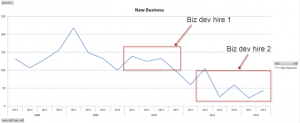
    I hired someone in Q2 2010 to help with business development, it just got too much for me to handle, and wasn’t where my time was best spent and I love DOING SEO Strategy more than SELLING SEO Strategy, so I hired them, eventually I decided to get someone else on board and make that person full time. Our leads from 2010 to 2011 about doubled yet you can see my second hire was able to keep me out of things more than my first and work independently, letting me work on what I loved and what she loved. Jamie B is so full of win its insane!

    great blog by wil reynolds1

    Now I layer in my other big time suck…email. Both are trending down, this is a good thing (I have moved to inbox zero and I think that has been helping me a lot).
    great blog by wil reynolds2

    So what were the items trending up?
    HR and Speaking / Promotion of SEER. So does that fit my mission? Does it fit what I care about? Well in some ways yes, HR is about connecting with your team and building culture. Attending conferences as a participant and a speaker allow me to constantly learn and be able to add value to clients while also helping us hire and build culture, so I am OK with that. Traveling to conferences also fulfills another major goal, which is to spend time with my wife, who is an avid traveler as well.

    great blog by wil reynolds3

    By having this in a pivot table I can easily dig into HR notes to see if my time spent is on “process HR” or “people HR”, I bet if you look at Crystal Anderson’s HR hours they spiked recently, on top of running the SEM team she also loves working with us on operations improvements and alignment. And after I saw Rypple (think of it as basecamp for reviews) and what it could do to help us get better at reviews, I knew I wanted to roll it out, I knew our team would appreciate more frequent updates and more structure. Crystal volunteered to run with it, again doing something she loves/has strength in and letting me stay focused on what I love/have strength in, I love when things work out that way. Years ago my hours on HR would have spiked to do this (because once I believe something is good, I will do it) thus taking my time away from what I love/where I am best utilized. But I also know that interviewing alone is a HUGE part of that, and I expect that to trend down soon, as SEER has hired about 10 SEO’s this year so far to get ahead of all the penguin craziness which is driving high lead flow once again.
    Its not all rainbows and unicorns though. As you can see, my blog time took a hit, but I think the 4 hours I put into this one should bring me up a bit. More concerning to me is that my reading has taken a hit. I have kind of supplanted some of my reading with attending events to get an information rush all at once, and you can see that. But with all the change occurring on Google my time reading which is highly R&D focused should be trending up sharply over the next 2 quarters.

    great blog by wil reynolds4

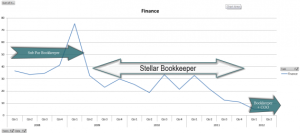
    Notice none of my goals revolve around working on the finances of the business, and by hiring the RIGHT bookkeeper (big spike came after I had to play cleanup to the WRONG bookkeeper) and a COO, I think we are in good shape, financial reporting is stronger than ever and I am spending less time than ever on it!! Sweet!
    great blog by wil reynolds5

    You can also see what happens when you change your labels, oops, but some easy massaging in Excel fixes all of that.

    great blog by wil reynolds6

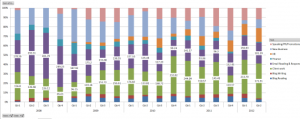
    Lastly is the BIG picture, I like to take the bigger things that take up my time / that I like to do and compare it to what my #1 goal is, which is to make sure SEER is delivering on our promises to our clients, which to me means in spite of growing like crazy and dealing with all the issues that come along with growth, that I am still spending more and more of my time on the things that matter most & make me happy, working on client projects directly and with my team. Spending all that time on email is 90% connecting with the team or my clients, so I am ok with that even though it is trending down as that answering emails is reactionary and often tactical, its the time spent on client work that I get to really dig into that is the strategic part and that part is growing healthily. I’m looking forward to breaking 40% in the next 2 years.
    great blog by wil reynolds7

    So I beg you all to do this, it helps with stress but also career direction. When you sit down with your boss this is a great way to say hey, right now I am spending 70% on task X, and professionally I’d like that to be task Y (assuming you aren’t fudging numbers) – how can we get X down to 50% and Y up from 10% to 30%? Then you should connect that move of responsibilities into what the company goals are, that is a huge part. I know everyone at SEER can do this exercise when they want. Its an important step to sometimes look at yourself and say, hey…this is CRAZY that I am spending 50 hours a month on this task! When you do this you are empowering your team members to take a more active role in pitching management on what they could do that would be more beneficial to the company and to our clients if we could rearrange time deployed. For those of you who track time meticulously, this is a WONDERFUL tool to understand your time.

    For those of you who have never done it, start now.
    seo, Time management, 10,463 entries over 4.5 years, Wil Reynolds,, all

  • Great article by Gillian Cook

    Original Blog Posted: 1 June 2012

    ________________________________________
    By Gillian Cook on April 17, 2012 in seo with 3 Comments
    Last Friday I had the joy of attending Brighton SEO and listening to Philip Sheldrake’s presentation on future visions for SEO. He presented some very interesting stuff on how the World Wide Web as we know it will evolve and how we will make sense of the ever increasing volume of data contained within the web. Our role in SEO is set to change, however SEOs that are adaptable, flexible and willing to work with different types of information and different departments within the organisation will survive.

    More People, More Things, More Data

    The world’s population is rapidly growing and is set to reach 8 billion people in the next decade. We produce and consume large quantities of resources. The amount of data we produce is extensive; from content and documents on the internet, to output signals from electronic devices to environmental sensory trackers that measure things like temperature, electricity consumption, traffic and flow of water. We can quite easily collect this data however applying intelligence to turn it into useful information by identifying patterns is becoming more and more difficult.

    Big Data, Big Info & Maybe Big Knowledge?
    Big data is the term coined to describe data sets that are so large it becomes difficult and awkward to extract valuable information from them within a reasonable time frame. We can quite easily collect this data however the larger the sample set the more difficult turning it into useful information becomes.. To take it one step further is to turn this information into knowledge and make the data work for us in ways that have been previously unattainable.

    A New Era For The Web
    The third decade of the web and we are beginning to witness a change in how the data contained within the internet is being rationalised and organised. Sheldrake used three different names for to describe this new era.
    “Web 3.0”
    “The Web of Data”
    “The Semantic Web”

    I wish to use the term The Semantic Web as semantics is the study of meaning and this era represents how we will make sense of the data contained within the internet. We are growing and evolving the web to convert the current web of unstructured documents into meaningful data that can be manipulated and filtered by machines. These machines will be able to join sets of complicated data, helping us become aware of what is going on and solve problems that previously were not able to achieve.

    How will this work?
    Resource Description Framework (RDF) provides a standardised language for defining web based ontologies which enable richer integration and interoperability of data. It’s a way of structuring web information using a variety syntax formats called triples.
    {subject} {predicate} {object}
    Gillian Cook works in SEO.
    RDF extends the linking structure of the Web to use URIs to name the relationship between things as well as the two ends of the link. Using this simple model, it allows structured and semi-structured data to be mixed, exposed, and shared across different applications.
    Using RDF we are able to categorise data correctly and by doing this we are able to link data in new ways. Linked Data is a term coined for the best practice of exposing, sharing and connecting pieces of data, information, and knowledge on the Semantic Web using URIs and RDF.
    This isn’t something that is forecast for the future it’s something that is already happening now. Google are already encouraging the use ofMicroformats – simple conventions or entities with their own properties that can be used on web pages to describe a specific type of information – e.g. a review, a recipe, a business.
    What Does This Mean For SEO
    When we consider how SEO is perceived, at times it seems like SEO’s are doing everything in their power to elevate their websites to the golden prize of 1st position in the SERPs, even if it means breaking the rules of the Google game. Yet when conceived in this way, SEO is a limited practice as the internet will become more regulated and transparent hence diminishing this type of online behaviour.
    However if we consider our role in SEO as working with search engines to deliver users the right content at the right time in the right format then our position is no longer in jeopardy. Content for content’s sake will need to change as organisations become defined by their flows of data and information. The role of SEO will be defined as “improving the presentation, discoverability, machinability and usefulness of data, information and knowledge for all stakeholders”. As Pierre Farr mentioned at the start of the conference, SEO is not dying it is simply evolving over time as we have seen it do in the past. What’s good to know is that that according to Sheldrake, SEOs have the relevant skills to take on the challenges of the future.

  • What to Look Out For When Hiring an SEO Company

    What to Look Out For When Hiring an SEO Company

    Original Blog Posted: 8 May 2012
    What to Look Out For When Hiring an SEO Company
    There are many companies that will offer you to increase your SEO rankings, and every SEO company will assure you that they are the best. However, and there are a few things to look out for when you are shopping around on the market to hire an SEO company to help increase the rankings of your website:
    “We guarantee high rankings.”

    When an SEO company guarantees that they can provide the highest rankings of any company around, that is when you need to be a bit skeptical. SEO is not a simple 1,2,3 process and there is no formula to follow to increase your search engine optimisation rankings. There are some tactics used by SEO companies to get your website ranked highly, but they are only effective for a short period of time, and are often referred to as black hat tactics.

    This is not something you want your website associated with. The best web ranking experts will recognise that the search engine optimisation of your website is a continual challenge and that they will have to continually be working in order to keep your website ranked highly. No search engine optimisation company worth its salt will “guarantee” number one page rankings, and you should look for a company that is honest in their assessment of your SEO website rankings potential.

    Portfolio of Previous Websites
    Usually an SEO company that provides the best services will provide you with a portfolio of SEO work for previous customers who have been pleased with their services. You should ask for references from any company that you are considering working with, and you should always contact the people to obtain their opinion on the services of the particular search engine optimisation company. They can talk a great game, but usually the clients will be able to provide you with an accurate assessment of their service.

    Process is Key
    You need to ensure that the processes and techniques used by the search engine optimisation company are ethical, effective, and efficient. Many SEO companies use SEO processes and tactics that are black hat and unethical, and you want to avoid these like the plague. Black hat SEO tactics will often result in your website getting banned, so you want to find a company that uses ethical practices. Most search engine optimisation companies will not provide you with detailed information on their processes; this can be an indicator that they engage in black hat practices. A reputable SEO company will give you enough to help you to understand what they are going to do.

    These are three things that should cause warnings flags to go up in your mind when interviewing an SEO company to work with your website, and you should keep these things in mind as you search for the best SEO company to work with.

    It is important that you find a quality SEO company, as only the best search engine optimisation companies will be able to help you achieve true success with your website through ethical and effective SEO practices and techniques.

    Contact us today at 01-5252-144 to learn how Lighthouse Internet Marketing can help with your search engine optimisation, social media,website design, mobile websites or other Internet marketing by needs completing our Free Online Request Form.

  • Why is SEO so important to your website!

    Why is SEO so important to your website!

    02 May 2012

    Importance of SEO to Your Website
    A website is like an investment wherein you spend money on the domain name and hosting as well as exert effort on designing it and filling each page of informative content. And as an investment, you expect a great return in the long run. But how could a website become profitable if you don’t market it?
    Search engine optimization (SEO) is the science of making a website rank in search engines such as Google, Yahoo, and Bing. It is the procedure done by marketers to boost their site’s popularity online as well as gather visitors and prospective clients. It is almost like traditional advertising except that it’s done online and a little less hyped.

    While it is easy to launch a website, marketing it can get tricky. As of today, there are more than billions of websites on-line. As e-commerce slowly dominates the business world, every entrepreneur is taking advantage of the trend and ventured to internet marketing as well. You can already imagine how stiff the competition is. But if you understand SEO and do it correctly, you may actually have a chance of succeeding in this business.


    Benefits of SEO
    Generally, SEO helps the marketer gain more traffic and repetitive visitor to their website. SEO is the key tool for you to be able to drive constant traffic into your website from different sources. Without optimizing your website, there’s very little chance that your site will be visited by your target audience. In fact, it may not have any traffic at all. Here is a short list of benefits of optimizing your website:

    Increased Visibility – SEO can boost the number of visitors for your website. By selecting keywords or phrases, which are related or fully describe what your site’s content is about, your target audience will be able to find you faster and easier through search engines.

    why is seo so important to your website 1

    In traditional marketing, it is you who should look for prospective customers. In SEO, it is your customer searching for you. All that you need to do is be found by incorporating the right keywords to your site and building links to it as much as you can.

    Targeted Traffic – When we invest in advertising, we beg and pray for conversion. This is where the magic of SEO lies. Compared to traditional marketing, SEO secures high conversion rates. SEO drives targeted traffic to your website. You are assured that people who see your ad or who browses your website are searching for your product and are interested in getting it. All that you need to do is impress them with how efficient your product is compared to other brands.

    High Return on Investment (ROI) – An effective SEO strategy can bring a higher ROI. As aforementioned, SEO guarantees high conversion rates and thus increase sales and your overall profit.

    Cost Effective – Compared to other campaigns, SEO is cheaper and lasts longer than Pay per Click Ads. It does not require that much of a capital unlike doing TVC’s and print ads. You only need minimum capital for such an effective campaign, which guarantees long term exposure.

    Measurable Results – This is another advantage of SEO. You can actually quantify the results of your effort. And tools such as Google Analytics and Alexa are there to help you in monitoring your website’s performance in search engines. There are visual presentations (graphs and charts) to elaborate details on conversion rates, keyword popularity, referral sites, actual traffic and page views, and other information you want to know about your website.

    There are plenty more benefits of SEO that you should learn about. If you have a website that has yet to be optimized, contact an SEO specialist today and get started with your campaign. It is never too late to rise to the top of search results.

    NEED A SEO SPECIALIST? CLICK THIS NOW FOR A FREE CONSULTATION.

  • Business Insight and Beyond

    Business Insight and Beyond

    05 May 2012

    The Importance of Web Design, SEO and SEM
    By Richard Moore

    Whether your company is large or small, you must have a web presence that works for your business. Commanding a powerful presence on the World Wide Web has become a table stake. A company’s web design details and web presence has replaced a wide array of communication vehicles.

    Nowadays customers, suppliers, and even potential investors form a first impression from a company’s web presence. And it’s not just the homepage – a good cover followed by unfriendly navigation, hard to decipher visuals, or simply too many graphic images will ruin a visit to a website.

    Next, you have to be sure that the front end, “the market engine,” is tied tightly to all of your company’s back-office functions. Everything must work smoothly so that billing, customer care and relationship management, inventory, shipping, and even sales can use your web presence as an integrated business tool.

    So in a nut shell, here is basically the steps to great web design when you tie it into SEO and SEM. Getting yourself a favorable listing in search engines is a matter of following these two steps when designing your website pages.
    Step 1: Use your TITLE Tag Properly!
    Most search engines place a lot of weight on the content of your TITLE tag. Your page’s title is very important and you should design it properly. Do not set the title of your page to something totally unrelated to your site. For example: “Welcome!” or “Thank You For Visiting!” simply will not do.
    When surfing the net I often see plenty of pages where the title is “Untitled Document” or “Title Your Page Here” – the page owner hadn’t even specified a title at all. It’s unfortunate because those pages are missing out on potential search engine ranking.
    Your TITLE tag should clearly represent what your site is about. If you’re building a page that talks about your company’s products, the title should thoroughly reflect that topic. “Our Products” or “Product Listings” is a bad choice for a page title – people are probably going to be searching for your company by name or by the type of product you sell. Thus, using our website as an example: “Vancouver Web Design, SEO Vancouver, BC Web Design”. What ever business you are in, make sure your title tag reflects exactly who you are and what you do.
    Also consider using keywords in your TITLE tag. For example, let’s say you’re selling real estate. You might want to make the title of your main page “Seattle Real Estate, Real Estate Agency in Seattle, Listing Homes, Property and Commercial listing for the Seattle Area!”
    As you can see, this title gets right to the point about the topic of the page. It also uses your keyword: “Seattle Real Estate,” and more specifically “Real Estate Listings in Seattle” (twice). Someone searching for “Real Estate” is more likely to find YOUR page than a page titled “Homes For Sale.”

    Step 2: Keywords aren’t just for META tags
    Over the years, META tags have been hawked as “the” way to get good listings in the search engines. Early on, this was true – when META tags were first created in the HTML specifications, search engines put a lot of weight on them. Several years ago you could literally boost yourself to the top of the search results by including repetitive keywords in your META tags.
    However, META tags have now become the most abused part of web pages. People routinely add META keywords to their page which have no relevance to their site’s topic. For example, many webmasters use META keywords like “pics” or “mp3” even if their site has nothing to do with those categories. They’re hoping that people who search for hot topics will stumble across their page and stop by.
    Those tactics do not work anymore. META tags now carry a surprisingly low weight in all of the popular search engines. What is important now is the overall content of your page. Search engines have algorithms (methods) for determining what your web pages are really about. These algorithms are closely-guarded secrets, for obvious reasons.
    However, they all focus on one thing these days: the REAL content in your web page. If you create a web page about “The Company ABC Business Opportunity” but include META keywords like “free pics” and “download music,” your site’s not going to be indexed under the topics you defined in your keywords. In fact, it might be rejected altogether!
    Not only should you make sure that your META keywords tag appropriately reflects the content of your page, you should ensure that the text content of your page contains a good distribution of your keywords. Mention your company name often (and evenly) throughout your site.
    For Example: “Our Company is the best company around. Imagine working at home and being your own boss – Our Company makes it possible! Your potential for earnings with Our Company is unlimited. Our Company allows you to sell as much as you want or as little as you want. The amount of money you make with Our Company depends on how much effort you put into your Our Company business.”
    Using your company name strategically and throughout your web page is going to get you much higher rankings when someone performs a search for Our Company. As you can see, the keyword (Our Company) is evenly distributed. Don’t try bunching up your keywords at the end of the page, that doesn’t work and may prevent you from being listed at all. You should concentrate on using keywords as part of your site’s content, and spreading them evenly throughout your text.
    As you can see, these two steps are pretty simple. It’s all a matter of incorporating them into the design of your web pages – or redesigning your pages to fit, if your site is already live and submitted. There is never any guarantees that your website will end up #1 in the search results, but I do guarantee that if you follow these two steps you’ll achieve better overall rankings.
    Above all else, avoid common spammer tactics like grouping keywords at the bottom of your page, or trying to “hide” keywords by making the text the same color as your page’s background. Search engines look for these methods and will often disqualify your page if they encounter what they think is spam.
    About The Author
    Richard Moore is founder and CEO of Vancouver Web Design by Vancouver Creative Consultants. He is one of the leading web design and seo experts and Vancouver Web Design by Vancouver Creative Consultants is one of the largest web design firms in North America. You can check out the website at http://www.vancouvercreativeconsultants.com
    Article Source:http://www.articlecity.com/articles/web_design_and_development/article_1887.shtm

  • The importance of SEO

    The importance of SEO

    Original Blog Posted: 2 May 2012

    The Importance of SEO

    Written by Dallas

    Search Engine Optimization (SEO) is the key tool for the website owners to get more traffic to the website. Optimization of a website is crucial to get traffic and maintain the level over the search engine. The main aim of the search engine optimization is to get more traffic from diverse sources and to get repetitive visitors.
    • SEO plays a crucial role in online business websites as well as other interactive sites. With regular update of content on website, SEO helps to get more traffic. There are other ways like link exchange and subscribe to RSS Feed that are more crucial parts under SEO work.
    • Based on the specific keywords SEO can generate good traffic and ultimately affect the revenue for e-commerce site. You can see many e-commerce sites which are getting success with SEO to get more traffic. The exchanging of link and made directory can enhance the traffic towards the site.
    • It is crucial to maintain the position on the search engines like Google, yahoo and others. The SEO ranking can be monitored by Alexa and other ranking site to monitor the position over the search engine. You can monitor your website by getting the rank to know the status of your website.
    • A Search Engine Optimizer needs to look for the new keywords and work on specific key words to get new traffic. Many SEO tools are useful to get article or text submission automatically. A Search Engine Optimizer must be aware about the latest tools to get submitting text over free article directories.
    • Practicing website optimization with ethics is more important. There are many Search Engine Optimizers which are using shortcuts to get the better result but ultimately they are trapping under crawler.
    • The ultimate goal for the website owner and SEO is to get the traffic and appears in first five pages of the search engine and maintain the positing online and also to get the repetitive users on their website.

    Every business and service websites need SEO to keep their position in the Google or other search engine. It is SEO’s responsibilities to keep website as front runner in search engines.

  • Why is SEO so important to your website!

    Why is SEO so important to your website!

    Original Blog Posted: 2 May 2012

    Importance of SEO to Your Website

    A website is like an investment wherein you spend money on the domain name and hosting as well as exert effort on designing it and filling each page of informative content. And as an investment, you expect a great return in the long run. But how could a website become profitable if you don’t market it?

    Search engine optimization (SEO) is the science of making a website rank in search engines such as Google, Yahoo, and Bing. It is the procedure done by marketers to boost their site’s popularity online as well as gather visitors and prospective clients. It is almost like traditional advertising except that it’s done online and a little less hyped.

    While it is easy to launch a website, marketing it can get tricky. As of today, there are more than billions of websites on-line. As e-commerce slowly dominates the business world, every entrepreneur is taking advantage of the trend and ventured to internet marketing as well. You can already imagine how stiff the competition is. But if you understand SEO and do it correctly, you may actually have a chance of succeeding in this business.

    Benefits of SEO
    Generally, SEO helps the marketer gain more traffic and repetitive visitor to their website. SEO is the key tool for you to be able to drive constant traffic into your website from different sources. Without optimizing your website, there’s very little chance that your site will be visited by your target audience. In fact, it may not have any traffic at all. Here is a short list of benefits of optimizing your website:

    Increased Visibility – SEO can boost the number of visitors for your website. By selecting keywords or phrases, which are related or fully describe what your site’s content is about, your target audience will be able to find you faster and easier through search engines.
    In traditional marketing, it is you who should look for prospective customers. In SEO, it is your customer searching for you. All that you need to do is be found by incorporating the right keywords to your site and building links to it as much as you can.

    Targeted Traffic – When we invest in advertising, we beg and pray for conversion. This is where the magic of SEO lies. Compared to traditional marketing, SEO secures high conversion rates. SEO drives targeted traffic to your website. You are assured that people who see your ad or who browses your website are searching for your product and are interested in getting it. All that you need to do is impress them with how efficient your product is compared to other brands.

    High Return on Investment (ROI) – An effective SEO strategy can bring a higher ROI. As aforementioned, SEO guarantees high conversion rates and thus increase sales and your overall profit.

    Cost Effective – Compared to other campaigns, SEO is cheaper and lasts longer than Pay per Click Ads. It does not require that much of a capital unlike doing TVC’s and print ads. You only need minimum capital for such an effective campaign, which guarantees long term exposure.

    Measurable Results – This is another advantage of SEO. You can actually quantify the results of your effort. And tools such as Google Analytics and Alexa are there to help you in monitoring your website’s performance in search engines. There are visual presentations (graphs and charts) to elaborate details on conversion rates, keyword popularity, referral sites, actual traffic and page views, and other information you want to know about your website.

    There are plenty more benefits of SEO that you should learn about. If you have a website that has yet to be optimized, contact an SEO specialist today and get started with your campaign. It is never too late to rise to the top of search results.

  • On site SEO/ Off Site SEO

    30 April 2012

    The Two Part SEO Equation

    There is two parts to the SEO Equation that you should be aware of:

    On Page Optimization

    Off Page Optimization


    On Page Optimization is making sure that your website pages are optimized properly so that search engines know what your pages are about.

    Off Page Optimization is all about getting backlinks to your website from other websites. Backlinks determine how important your website is because search engines perceive backlinks as votes.

    The SEO tips below focus on On Page Optimization and should assist the reader in forming a basic understanding of how to create human friendly web pages which are easily understood by the most popular search engines.

    Know this. There are thousands of search engines but only two of them will bring you most of the traffic. They are google and yahoo. Another search engine that brings me a little traffic is msn but I do not focus too much on tactics for that engine.

    Focus your attention on the engines that will bring you the most visitors first and work your way down.

    On Page SEO

    1. Insert keywords within the title tag so that search engine robots will know what your page is about. The title tag is located right at the top of your document within the head tags. Inserting a keyword or key phrase will greatly improve your chances of bringing targeted traffic to your site.

    Make sure that the title tag contains text which a human can relate to. The text within the title tag is what shows up in a search result. Treat it like a headline.

    1. Use the same keywords as anchor text to link to the page from different pages on your site. This is especially useful if your site contains many pages. The more keywords that link to a specific page the better.
    2. Make sure that the text within the title tag is also within the body of the page. It is unwise to have keywords in the title tag which are not contained within the body of the page.

    Adding the exact same text for your h1 tag will tell the reader who clicks on your page from a search engine result that they have clicked on the correct link and have arrived at the page where they intended to visit. Robots like this too because now there is a relation between the title of your page and the headline.

    Also, sprinkle your keywords throughout your article. The most important keywords can be bolded or colored in red. A good place to do this is once or twice in the body at the top of your article and in the sub-headings.

    1. Do not use the exact same title tag on every page on your website. Search engine robots might determine that all your pages are the same if all your title tags are the same. If this happens, your pages might not get indexed.

    I always use the headline of my pages as the title tag to help the robots know exactly what my page is about. A good place to insert the headline is within the h1 tag. So the headline is the same as the title tag text.

    1. Do not spam the Meta Description or Keyword Tags by stuffing meaningless keywords or even spend too much time on this tag. SEO pros all agree that these tags are not as important today as they once were. I just place my headline once within the keywords and description tags.
    2. Do not link to link-farms or other search engine unfriendly neighborhoods.
    3. Do not use doorway pages. Doorway pages are designed for robots only, not humans. Search engines like to index human friendly pages which contain content which is relevant to the search.
    4. Title tags for text links. Insert the title tag within the HTML of your text link to add weight to the link and the page where the link resides. This is like the alt tag for images.

    My site contains navigation menus on the left and right of the page. The menu consists of links not images. When you hover over the link with your mouse, the title of the link appears. View the source of this page to see how to add this tag to your links.

    1. Describe your images with the use of the alt tag. This will help search engines that index images to find your pages and will also help readers who use text only web browsers.
    2. Submit to the search engines yourself. Do not use a submission service or submission software. Doing so could get your site penalized or even banned.

    Here is the submission page for google: http://www.google.com/addurl.html

    Submit only once. There is no need to submit every two weeks. There is no need to submit more than one page. Robots follow links. If your site has a nice link trail, your entire site will get indexed.

    My site has a nice human friendly link trail which robots follow easily. All my pages get indexed without ever submitting more than the main index page once.

    Off Page SEO

    After you have finished your On Page Optimization, you will need to focus the rest of your time on Off Page Optimization. On Page Optimization alone will not get good results (Especially forcompetitive keywords). Great results are achieved when both On Page and Off Page Optimization are combined together.

    More SEO Tips

    Get the facts here: http://www.google.com/webmasters/. This page will explain most of what you should focus on along with what you should forget about.

    If you have been thinking about handing over the task of SEO to someone outside of yourself, you should read some warnings before you part with any money. http://www.google.com/webmasters/seo.html


    About The Author

    The author, Ed Zivkovic reveals how anybody can do their own SEO work and get higher search engine rankings atBacklinksFever.com


  • The power of SEO!

    Original Blog Posted: 26 Apr 2012

    WHY IS SEO SO IMPORTANT?

    Many people don’t realize this but SEO (Search Engine Optimization) is the key thing that underpins all successful Internet Marketing campaigns. In fact, one of the biggest factors that determine whether you succeed or fail with an online marketing campaign is the keywords you target.

    Why is this? Well, the basis of any Internet Marketing campaign is to get more traffic to your web site so that you can then build your emailing list, which is itself a major key to converting your visitors to happily buying customers of your products and services, and having the correct keywords can give you a very major advantage in this.

    Many people don’t realize that keywords should be used not only at your web site but in your blog posts, your on-line articles, videos, links from other sites and yes, even your tweets and Facebook posts, as well as anywhere you appear on-line.

    On top of that, many people make the mistake of building their web site first and then end up having to rebuild it after they’ve done their keyword research because they didn’t realize how important the content layout and keyword placement is.

    Once you have your correct keywords, and you have correctly optimized your web site for those keywords (NOT in the keyword meta tag in your web page code, since that is completely ignored by Google), over time, with other basic SEO techniques, your site will rise in the rankings in the Search Engine Results Pages.

    The more you have correctly identified the good-traffic, low-competition keyword phrases, the more chances you have of being on the top Google results pages for those keywords, and thus the more chances of your web site being found by people searching for your exact offerings.

    What is described above and in the other SEO blog post is what’s called “On-Page SEO”. Equally important in rising your web page in the ranks is “Off-Page SEO”. This is the number of links to your site occurring across the web.

    There are many ways to get these links, which will be covered in other posts, and they include blogging, writing articles and press releases, YouTube videos, and your interactions on social media sites like Facebook, Twitter etc.

    If your link-building activities all include use of your correctly-target keywords, the sooner you will rise in the rankings and start being found by your targeted publics.

    Doing your Internet Marketing without having correctly identified and using your keywords is like trying to run a marathon with both legs strapped together. You won’t get nearly as far nearly as quickly!

    Let me know if you found this information useful. What other things about SEO or Internet Marketing would you like to know?
    Tony Rockliff

  • The power of SEO!

    26 April 2012
    WHY IS SEO SO IMPORTANT?

    Many people don’t realize this but SEO (Search Engine Optimization) is the key thing that underpins all successful Internet Marketing campaigns. In fact, one of the biggest factors that determine whether you succeed or fail with an online marketing campaign is the keywords you target.

    Why is this? Well, the basis of any Internet Marketing campaign is to get more traffic to your web site so that you can then build your emailing list, which is itself a major key to converting your visitors to happily buying customers of your products and services, and having the correct keywords can give you a very major advantage in this.
    Many people don’t realize that keywords should be used not only at your web site but in your blog posts, your on-line articles, videos, links from other sites and yes, even your tweets and Facebook posts, as well as anywhere you appear on-line.

    On top of that, many people make the mistake of building their web site first and then end up having to rebuild it after they’ve done their keyword research because they didn’t realize how important the content layout and keyword placement is.

    Once you have your correct keywords, and you have correctly optimized your web site for those keywords (NOT in the keyword meta tag in your web page code, since that is completely ignored by Google), over time, with other basic SEO techniques, your site will rise in the rankings in the Search Engine Results Pages.

    The more you have correctly identified the good-traffic, low-competition keyword phrases, the more chances you have of being on the top Google results pages for those keywords, and thus the more chances of your web site being found by people searching for your exact offerings.

    What is described above and in the other SEO blog post is what’s called “On-Page SEO”. Equally important in rising your web page in the ranks is “Off-Page SEO”. This is the number of links to your site occurring across the web.

    There are many ways to get these links, which will be covered in other posts, and they include blogging, writing articles and press releases, YouTube videos, and your interactions on social media sites like Facebook, Twitter etc.

    If your link-building activities all include use of your correctly-target keywords, the sooner you will rise in the rankings and start being found by your targeted publics.
    Doing your Internet Marketing without having correctly identified and using your keywords is like trying to run a marathon with both legs strapped together. You won’t get nearly as far nearly as quickly!

    Let me know if you found this information useful. What other things about SEO or Internet Marketing would you like to know?

    Tony Rockliff

☎ ✉
f 𝕏
error: Content is protected !!