Tag: seo

  • AI Can Build the Marketing Plan. Humans Still Have to Drive

    AI Can Build the Marketing Plan. Humans Still Have to Drive

    AI marketing agencies are entering a new chapter. Tools like ChatGPT and Claude have changed the way businesses think about marketing. Today, an organization can describe its business, ideal customer and goals to an AI tool and, within seconds, receive a surprisingly detailed marketing plan.

    That is a big change.

    For years, businesses often relied on marketing agencies to tell them what they needed to do. They would sit down with an agency, explain their business and wait for a strategy to be developed.

    Now, companies can get a first look at that strategy themselves.

    So, does that mean marketing agencies are becoming obsolete?

    Not at all.

    It means their role is changing.

    And in many ways, AI may be taking a backseat while humans get back in the driver’s seat.

    Marketing Has Changed. Again.

    Marketing has always evolved with technology.

    Print advertising changed the game. Then came radio and television. The internet transformed everything again. Search engines created SEO. Social media changed how brands communicate with customers.

    Then AI arrived.

    Large language models like ChatGPT and Claude have taken things another step forward.

    A business owner can now ask:

    “How should I market my business to women between 45 and 60 who are interested in improving their health?”

    Within seconds, AI can suggest target audiences, content ideas, advertising channels, messaging, budgets, timelines and even campaign concepts.

    That is incredibly powerful.

    It also changes the conversation between businesses and marketing agencies.

    The End of One-Size-Fits-All Marketing

    One of the biggest changes AI has brought to marketing is access to information.

    Businesses no longer have to accept a generic marketing package simply because that is what an agency sells.

    The old approach might have looked something like this:

    Website + social media + Google Ads + SEO + email marketing = marketing plan.

    But what if that isn’t what the business actually needs?

    AI makes it easier to ask better questions.

    What is the company’s ideal customer?

    Where does that customer spend time?

    What problem is the company solving?

    How competitive is the market?

    How much can the business realistically spend?

    What should happen first?

    How long might it take to see results?

    These questions can now be explored before a business ever signs a marketing contract.

    That is a good thing.

    It forces everyone to become more thoughtful about marketing.

    AI Can Create the Plan. But Can It Execute It?

    This is where things get interesting.

    AI can produce a marketing strategy in seconds.

    But a strategy sitting inside a document doesn’t generate leads.

    Someone still has to build the website.

    Someone has to optimize the pages.

    Someone has to create the content.

    Someone has to set up campaigns.

    Someone has to analyze what is working.

    Someone has to make changes when something isn’t working.

    And most importantly, someone has to understand the business behind the numbers.

    This is where humans still matter.

    AI can tell you that your company should target a particular audience.

    A human has to understand whether that audience actually makes sense for the business.

    AI can recommend a content strategy.

    A human has to know whether the content sounds like the company or like something generated by a machine.

    AI can suggest keywords.

    A human still needs to understand the customer’s intent behind those searches.

    The difference is important.

    AI can help create the roadmap. Humans still have to drive the car.

    The Marketing Agency Is Becoming the Execution Partner

    This may be one of the biggest shifts we see over the next few years.

    Marketing agencies may spend less time selling businesses on what marketing they need and more time executing the marketing strategy those businesses have already researched.

    That doesn’t make agencies less valuable.

    It changes where their value comes from.

    Instead of saying:

    “Trust us. We know what you need.”

    The conversation becomes:

    “You know where you want to go. Let’s build the right system to get you there.”

    That is a very different relationship.

    And frankly, it could be a better one.

    Businesses become more informed.

    Agencies become more accountable.

    And marketing becomes more focused on execution and measurable results.

    AI Makes Marketing Budgets Easier to Understand

    Another major advantage is budgeting.

    Marketing has traditionally been difficult for businesses to forecast.

    A company might ask:

    “How much should we spend on marketing?”

    The answer has always depended on the business, the market, the competition, the customer and the goals.

    AI can’t predict the future.

    But it can help businesses build reasonable scenarios.

    A company can explore different approaches and ask questions such as:

    * What could a $2,000 monthly marketing budget support?
    * What would a $5,000 budget allow us to do?
    * Which activities should come first?
    * What could we realistically accomplish in six months?
    * Which channels should we test before investing more heavily?

    That information can make marketing conversations much more productive.

    Instead of starting with a blank sheet of paper, businesses can start with a working hypothesis.

    Then the humans take over.

    This Is Where ElevexSEO Fits In

    At ElevexSEO, we see this shift as an opportunity.

    We don’t believe businesses should have to choose between AI and human marketing expertise.

    They should use both.

    AI can help businesses research opportunities, organize ideas, identify potential strategies and make better decisions.

    Then experienced marketing professionals can take those ideas and turn them into an actual workflow.

    That could include SEO, content creation, website optimization, keyword targeting, technical improvements and ongoing performance analysis.

    The goal isn’t to replace the human.

    The goal is to give the human better tools.

    And that is where AI becomes really useful.

    The Future Isn’t AI vs. Humans

    There has been a lot of discussion about whether AI will replace marketing professionals.

    We think that is the wrong question.

    The better question is:

    How can humans use AI to become better marketers?

    The businesses that figure this out will have an advantage.

    They won’t blindly hand their marketing over to AI.

    They also won’t ignore it.

    They will use AI to research faster, think through possibilities and build better strategies.

    Then they will rely on people to bring those strategies to life.

    That is the balance.

    AI provides speed.

    Humans provide judgment.

    AI provides ideas.

    Humans provide context.

    AI can process enormous amounts of information.

    Humans understand relationships, emotions, nuance and the real-world challenges of running a business.

    Put those things together and marketing becomes much more powerful.

    Marketing Agencies Aren’t Going Away. Their Role Is Evolving.

    The marketing agency of the future may look very different from the agency of the past.

    Businesses will be more informed.

    AI will handle more of the research and planning.

    Marketing teams will have better data.

    And agencies will increasingly become execution partners, technology partners and optimization partners.

    That isn’t a step backward.

    It may actually be a step forward.

    The days of paying for a generic marketing package and hoping it works are slowly disappearing.

    Businesses want to know what they are doing, why they are doing it and what they can realistically expect.

    AI is helping make that possible.

    But someone still needs to turn the plan into action.

    That’s where humans come back into the driver’s seat.

    Ready to Put AI to Work for Your Marketing?

    You don’t have to figure out the future of marketing alone.

    At ElevexSEO, we combine AI-powered tools with human marketing expertise to help businesses turn ideas and strategies into real SEO and digital marketing workflows.

    If you’ve already used ChatGPT or another AI tool to explore your marketing options, that’s a great starting point.

    Now let’s turn those ideas into action.

    Want to see what your marketing strategy could look like?

    Talk to ElevexSEO today and let’s build a marketing plan that makes sense for your business, your budget and your ideal customer.

  • As the Global Economy Rolls Forward, Is Your SEO Keeping Up?

    As the Global Economy Rolls Forward, Is Your SEO Keeping Up?

    The global economy is finally picking up speed again, and businesses everywhere are feeling the push to catch up. But here’s the thing: it’s not just about getting back to “normal.” It’s about staying ahead. And in today’s world, that means leveraging AI to make your SEO smarter, faster, and more effective.

    AI isn’t just a buzzword anymore. It’s changing the game for search engine optimization. From identifying trending keywords to analyzing your competitors’ strategies, AI gives you insights you just can’t get manually. It’s like having a super-smart assistant who never sleeps, always scanning the digital landscape to help your business get noticed.

    But here’s the kicker: knowing which keywords to focus on is still one of the biggest challenges for businesses. That’s where ElevexSEO comes in. We make it simple. You get a head start with 5 free, high-performing keywords tailored for your business, helping you reach the right audience faster. No guesswork, no wasted time.

    If you’re ready to stop chasing the market and start leading it, there’s no better time than now. Let AI work for your SEO, and let ElevexSEO be the partner that puts you ahead of the curve.

    Get started today—your 5 free keywords are just a click away.

  • Building a Global Brand in Today’s Digital World

    Building a Global Brand in Today’s Digital World

    Building a Global Brand in Today’s Digital World

    In the digital age, building a global brand has become more accessible and complex than ever before. With the internet bridging geographical gaps and social media amplifying voices, brands now have the opportunity to reach and engage with a global audience. However, the competition is fierce, and standing out requires a strategic approach. Here’s a guide to building a global brand in today’s digital world.

    1. Define Your Brand Identity

    Your brand identity is the foundation of your global presence. It encompasses your mission, values, voice, and visual elements. To create a strong brand identity:
    – Mission and Values: Clearly define what your brand stands for and the value it brings to the world. This helps in creating a consistent message that resonates across different cultures.
    – Brand Voice: Develop a unique and authentic voice that reflects your brand’s personality. Whether it’s formal, friendly, or humorous, consistency in communication builds recognition.
    – Visual Elements: Invest in a professional logo, color scheme, and typography. These elements should be consistent across all platforms to ensure brand recognition.

    2. Understand Your Target Audience

    To build a global brand, you need to understand your audience’s diverse needs and preferences. Conduct thorough market research to:
    – Identify Demographics: Know the age, gender, location, and interests of your target audience in different regions.
    – Cultural Sensitivity: Be aware of cultural differences and adapt your marketing strategies accordingly. What works in one country might not work in another.
    – Consumer Behavior: Understand how your audience interacts with brands online, what platforms they use, and what influences their purchasing decisions.

    3. Leverage Digital Marketing Channels

    Digital marketing is crucial for building a global brand. Utilize a mix of channels to maximize your reach:
    – Social Media: Platforms like Facebook, Instagram, Twitter, LinkedIn, and TikTok are powerful tools for engaging with a global audience. Tailor your content to each platform’s unique features and audience.
    – Content Marketing: Create valuable and relevant content that addresses the needs of your audience. This could be blogs, videos, infographics, or podcasts. Localize content to resonate with different regions.
    – Search Engine Optimization (SEO): Optimize your website and content for search engines to improve visibility. Consider local SEO strategies to rank higher in different regions.
    – Email Marketing: Build an email list and send personalized content to your subscribers. Segment your list based on location and preferences to ensure relevance.

    4. Invest in E-commerce and Mobile Optimization

    In today’s digital world, a seamless online shopping experience is crucial:
    – E-commerce Platform: Choose a reliable e-commerce platform that supports international sales, multiple currencies, and various payment methods.
    – Mobile Optimization: Ensure your website is mobile-friendly. With the growing number of mobile users worldwide, a responsive design is essential for user experience and SEO.
    – Customer Support: Provide excellent customer service with multilingual support. Quick response times and helpful interactions build trust and loyalty.

    5. Utilize Influencer Marketing

    Influencers can help you reach new audiences and build credibility:
    – Identify Relevant Influencers: Collaborate with influencers who align with your brand values and have a significant following in your target regions.
    – Authentic Partnerships: Focus on building long-term relationships with influencers for authentic promotion rather than one-off campaigns.
    – Measure Impact: Track the performance of influencer campaigns through metrics like engagement, reach, and conversion rates.

    6. Analyze and Adapt

    Continuous improvement is key to maintaining a global brand:
    – Analytics Tools: Use tools like Google Analytics, social media insights, and email marketing reports to track your performance.
    – Feedback Mechanism: Collect feedback from customers to understand their experiences and areas for improvement.
    – Adapt Strategies: Be flexible and willing to adjust your strategies based on data and feedback. The digital world is dynamic, and staying relevant requires agility.

    Building a global brand in today’s digital world is a multifaceted endeavor that requires a clear identity, understanding of your audience, effective use of digital channels, a strong e-commerce presence, strategic influencer partnerships, and continuous adaptation. By leveraging these strategies, you can create a brand that resonates with audiences worldwide and stands out in the competitive digital landscape.

  • The SEO Process!

    Putting It All Together!

    So you have found a good industry appropriate domain and picked out a layout that you like for your company’s online appearance. The next step is for our technical team to make sure that your Headers are in place, check the length and relevancy of your Title tag, check the length and relevancy of your description meta tag, check the number of keywords and relevancy of your keyword meta tag, Analyze the Robots meta tag directives and check if the search engines are allowed to spider the page, We also have to check each page for the most relevant keywords or key phrases, check how the page may be displayed within search engine results, check links found both external and internal URLs on each page, Check the keywords found in the Anchor tags or links. Check the keywords found in the Anchor tags (links) Check the keywords found in the image Alt attributes check the page Heading and phrase elements. And the final stage in the SEO friendly planning is to check the site structure. Keep in mind that Google indexes information according to categories and sections and so each page should be sectioned with different targeted keywords and key phrases so that each page of your website can be crawled and indexed separately for its content.

    The ALT attribute is a critical step that is often overlooked. This can be a lost opportunity for better rankings. In Google’s webmaster guidelines, they advise the use of alternative text for the images on your web site: Use the alt attribute to provide descriptive text. In addition, we recommend using a human-readable caption and descriptive text around the image. Why would they ask us to do that? The answer is simple, really; search engines have the same problem as blind users. They cannot see the images. At this point your site is generally ready to be hosted on a server and submitted to the various Search engines Google, Yahoo, Ask and Bing or Msn etc.. While there is no perfect SEO and no guarantee that your site will stay on the position that you optimize for you can insure through proper coding and obeying Google guidelines that your website will be indexed and perform well with a proper linking strategy and blog writing.

    Keep in mind that Google is interested in providing the best and most current and accurate information available for it’s users and so it is important that when hiring on a website development company that they pay special attention to practices like high keyword density as it can, on some search engines, trigger spam filters, which may result in a penalty for your site’s ranking. Even without such a penalty, your site’s rankings will not benefit from this tactic. Many webmasters and inexperienced or unethical SEOs abuse the use of this attribute, trying to stuff it with keywords, hoping to achieve a certain keyword density, which is not as relevant for rankings now as it once was. Today it is all about Links and Blogging and having your site Crawled or Cached on a regular basis!

    Please note that SEO is not a 100% accurate science for search engine algorithms! Nobody knows the exact algorithms that the search engines use! Therefore, SEO attempts to provide the best listing results for your company but no SEO firm can guarantee that spot as the Google algorithm changes from time to time.
    There you have it!
    Nexonta Technologies Inc

  • Did you ever notice?

    Did you ever notice?

    12 September 2013

    Did you ever notice that we can be oblivious to our surroundings? Case in point you go to buy an automobile and while looking you start noticing vehicles that you had not noticed before even though they have been passing you on the road on a daily basis for months. The trigger is the hunt! When hunting certain criteria start to form your decision making process and based on your fundamental needs for that particular vehicle then you start to be steered in directions that were totally oblivious to you prior to your search.

    Once the search has begun, Maslow’s hierarchy of needs is a theory in psychology proposed by Abraham Maslow kicks in. This theory presupposes that Maslow’s hierarchy of needs is often portrayed in the shape of a pyramid with the largest, most fundamental levels of needs at the bottom and the need for self-actualization at the top. The most fundamental and basic four layers of the pyramid contain what Maslow called “deficiency needs” or “d-needs”: esteem, friendship and love, security, and physical needs.

    Once all of these needs are satisfied it is then and only then that one can start to concentrate on the important issues of color and price of the automobile. This is the same trigger when an individual buys a home to picking which political candidate to back. Are your needs going to be met? In fact, in many cases it is not until our needs are challenged or potentially jeopardize that we usually start taking notice to certain external factors which have been around us the whole time.

    A great example of this phenomenon is Malcolm Gladwell book which defines a tipping point as “the moment of critical mass, the threshold, the boiling point”. The book seeks to explain and describe the “mysterious” sociological changes that mark everyday life. As Gladwell states, “Ideas and products and messages and behaviors spread like viruses do”.

    Like life, SEO is really a question of inches and seconds. Does your company’s product or service meet the need of one particular individual or a large company at a particular time and place? Can you be easily found? Does your company go above and beyond for its client’s satisfaction? If you can answer yes to any of these questions then your company will be able to address many business needs in today’s challenging business system. Then it is only a matter of time before everyone starts noticing you and your business.

    Nexonta Technologies Inc.

  • Summertime SEO

    Summertime SEO

    24 June 2013
    Summertime SEO

    For many of us, summer is a time for vacations and getting away from everyday life for a while. Summertime has rolled around again and for most companies, business shows a big time down turn. It’s hot outside and people are in and out of the office or on vacation. Nobody really has any motivation to work.

    But when it comes to your SEO efforts, one thing you don’t want to do is let it be. Remember, your SEO doesn’t need the same break that you do; in fact, it could even be harmful. Take care of your blogging, website content and social media today so you can have the peace of mind you deserve.

    Go on, blog ahead. Whether you write your own blog posts or you have someone crafting it for you, plan your topics and write the content in advance. This way, you can schedule your posts to publish while you’re away and continue to feed fresh content to search engines. If you really can’t work ahead of schedule, assign someone you trust to take over your blogging duties while you’re gone.
    The summer is also a great time to redo your company website if you are experiencing downtime. If your company website is in need of a full redesign, it is always better to tackle these projects during a slow time, rather than peak time. Mobile websites are the new trend of the future. There are now so many cell phones in use that you would be missing out on a lot of traffic if you did not utilize these tools today then you will definitely get left behind. Reports show that PC sales are down by as much as 13%. One reason for this is that many people are using their smart phones and tablets to browse the internet. In fact most people in European countries don’t use computers but use their smart phones to surf the net.

    Summer is also a great time to do joint marketing with other complimentary services. Get some coupons into a “Welcome” package. Most accommodations offer an envelope full of these things to every guest. It’s a very cost effective way of getting the name of your company in front of new eyes. It’s all about brand recognition. The more eyes you can get your name in front of, the better chances you have of being remembered and since the sheer numbers of eyes drastically increase during the Summer season, this the perfect time to do some joint or co-op marketing. Get your name out there.

    Nexonta Technologies Inc.

  • SEO is Google’s Lingerie

    SEO is Google’s Lingerie

    28 May 2013

    Our team just finished doing some work on a client who has a lingerie store. And I realized that SEO does for websites what lingerie does for women. How you might ask? Lingerie for most people is something that women wear under their clothes. Although some women would beg to differ on this point. Most women feel fully put together when all their whole outfit is put together including their under garments. Lingerie makes women feel sexy, confident and able to take on the world. It’s like the top secret weapon that helps women get recognized.

    This why SEO is like lingerie for your website. Let`s look at this a bit closer, to start by having titles, keywords, meta descriptions and alt tags on your website, it’s all behind the scenes work, but it gives you the confidence in knowing that Google will have a better chance of finding your site. The keywords, meta titles, descriptions and alt tags all help you get noticed on the internet.

    Make sure you have your top secret weapon in place for your website – SEO – lingerie for Google. And see who starts noticing you.

    Nexonta Technologies Inc.

  • Welcome to September!!!

    05 September 2012

    Image Optimization for SEO:
    In order to run a successful website, you need to receive as much targeted traffic as possible. Using search engine optimization techniques is a terrific way to move your website up the search rankings and increase the number of daily visitors to your website. There are many different tips and tricks you can employ when running an SEO campaign. Adding images to your content is one of the better methods you can use to help improve your search engine optimization.

    Increase Time on Site
    Recently, search engines have started looking for signals that tell them whether or not people on the Internet find your content useful and interesting. Since search engines are trying to put the most relevant content in front of their users, they are trying to gather as much information as possible about which websites are the best. One signal search engines are paying closer attention to is the time spent on your site. If someone visits your site and spends a good deal of time looking at your content and viewing several pages, the search engines will assume your content is highly valuable and relevant to the user.

    Adding images to your content will increase the amount of time someone will spend on your site as it will require them to scroll down the page to continue reading what you have written. Also, if you post high quality images, your website viewers may spend additional time on your site admiring your picture and viewing other images you have posted.

    The alt text associated with images on your site is another way images improve your SEO. Alt text allows you to write a description about your image so the search engines know what the picture is when they are crawling your site. Alt text allows you to add additional keywords to your site without being penalized by the search engines.
    When you are writing the alt text for your images, it is important to be as descriptive as possible and focus on longtail keywords. By placing longtail keywords in your alt text, you increase your chances of having your images show up in the search results, increasing the amount of traffic to your website.

    Better Overall Content
    Adding images to your site helps you produce better overall content. If someone visits your site and sees nothing but a wall of text, they are more than likely going to quickly leave your site as they do not want to read through everything you have written. Posting images throughout your content will make your website easier on the eyes of your readers and increase your chances of having your content shared through social media, especially Pinterest. Make sure to include a Pinterest “pin it” button on all of your images to make it very easy for someone to share your website’s content through the social media website.

    There are many tricks and techniques you can use to improve your website’s search engine optimization. One of the easiest ways to give your site an SEO boost is to include images with your content. Images will increase the amount of time visitors spend on your site, allow you to include more SEO friendly text in the alt text descriptions and will allow your site to be shared through social media, which can have a huge impact on your search engine optimization.
    About the Author
    John Zwissler @ AddMe.com www.addme.com

  • Great blog by Jill Whalen

    Great blog by Jill Whalen

    Original Blog posted: 16 Jul 2012

    16 July 2012

    Search Engine Marketing Issues

    ++Paying for Penalties: Lies That Shady SEO Companies Tell++

    Ever since Panda and Penguin (Google’s major changes to how they rank websites in order to fight web spam) have hit, a lot of companies have lost a large percentage of their website visitors. Bewildered by their sudden misfortune, many of these business owners have turned to me to review their websites and their SEO practices to determine where they went wrong and what they need to do to get back into Google’s good graces.

    While many of them had been doing their own SEO based on what they’ve picked up through the years, a few have had SEO companies (and I use this term loosely) “helping” them. Sadly, what some of these companies do worked okay in a pre–Panda-Penguin world, even though it was garbage that doesn’t come close to following SEO best practices. The fact that it worked is what has kept SEO web spammers in business for so long. And it’s possible that to a certain extent what they’re doing may still work for a short time — at least until Google reprocesses their ranking formula. That’s when the panda poop hits the fan!

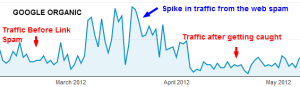
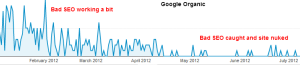
    If it were just a matter of the links no longer counting, it wouldn’t be so bad. But these days not only does the site lose any additional Google traffic they may have gained from the bad SEO, they start receiving even less traffic than they were getting before the bad links.

    Here’s an example of this:

    great blog by gillian whaen 1.

    And here’s another example:

    great blog by gillian whaen

    You’ll notice in both of these examples that the start of the major loss of Google traffic started toward the end of April, right around when the Penguincame first came to town. In the first instance, the client was (and is) very web UNsavvy. She knows very little about her own website and online marketing in general, let alone much about SEO. I’m not sure if she contacted the SEO company directly to “help” her, or if it was unsolicited. Either way, the web spammers quickly found they were dealing with their favorite type of customer — trusting and naïve. Not to mention desperate. The website had been losing traffic and sales since the early Panda days in 2010. (Due to not much content and simply not keeping up with what other companies in the space were doing.)

    Signs That Your SEO Sucks
    When I reviewed the site and looked at the links pointing to it, I saw a lot of terribly written spammy blog (splog) posts having been submitted to irrelevant, crappy splog networks, article submission sites, and fake directories. They all had a few different keyword phrases that pointed back to the home page of the client’s site. The dates of the posts were all from around the time that the site had its initial boost in Google traffic.

    These links were obviously fake, purchased and extremely low in quality. For instance, one was in a directory on a domain that had a section pertaining to link building services as well as a splog full of wonderful articles which nobody in their right mind would be interested in reading — ever. In fact, the client’s site was linked from a number of directories that all looked the same, but were on different domain names and using a different name and background color. High class and high quality they were not! My favorites were the links right next to ones for “buying text links”! (They’re a nice change from the ones next to credit card and payday loan links!)

    Shoddy SEO That You Pay For
    In addition to creating barely readable content and submitting it to their icky splog networks, this SEO company also wrote useless, grammatically incorrect articles and put them into a blog on the client’s own site. Of course these all had anchor text pointing back to the home page. I was surprised that they didn’t even go to the trouble of pointing the anchor text to the most appropriate pages within the site instead of the home page, but that may have taken some actual work to figure out where they should go! (Web spammers don’t believe in actually working.)
    To top it off, they even stuck a link to their own SEO site with the anchor text of “SEO” on every page of the client’s site! (It wasn’t clear to me whether she gave them permission to do this or not.)

    When I pointed out all of the above in my SEO site audit report to the client, I told her to have the company remove all of the links and explained why they were bad. And here’s where it got weird. The company emailed her back trying to convince her that they were not a spammy SEO company at all and that everything they were doing for her was on the up-and-up. When she asked them for a list of the links they had built for her, they had the gall to say that only black hat link building companies would be able to provide a list of their links. (Huh?)

    Whom Do You Trust?
    But the really scary part is that their answers sounded credible and believable to one who wouldn’t know better. This poor client was stuck between a rock and a hard place. She had me on the one hand telling her that what this company did was likely a big reason why she was no longer making any sales, and them telling her, “But you’re ranking for the keywords we chose together.” (This was true to some extent because the site was still ranking for some of the non-competitive phrases that nobody searches for.) And then they tried to scare the client by telling her that if they removed the links, her rankings would plummet and she’d lose even more traffic. They also tried to weasel out by saying that perhaps her shopping cart was not working properly (which, even if true, wouldn’t account for the nearly complete loss of Google traffic).

    Finally, in answer to their half-truths, I told her that any reputable SEO company knows that the types of things this company does are considered to be web spam — certainly after Google

    Penguin, if not before. And the very fact that they were continuing to claim that what they were doing was all well and good showed just how horrible and unethical they were. In fact, I was so enraged by this that I told her to tell them that if they didn’t want to remove the spammy junk and wouldn’t give her money back, I’d be happy to write about them to my 25K newsletter subscribers.

    At this point I haven’t heard back from her. I decided to write this article anyway (without naming names) so that others can learn from it. I hope that the more this kind of SEO gets talked about and pointed out as the web spam that it is, the more others will stop spending money to get themselves penalized by Google.
    Jill
    ________________________________________
    Jill Whalen is the CEO of High Rankings, an SEO Consultingcompany in the Boston, MA area since 1995. Follow her on Twitter @JillWhalen
    If you learned from this article, be sure to invite your colleagues to sign up for the High Rankings Advisor SEO Newsletter so they can receive similar articles in the future!

  • Urls for better SEO:

    Original Blog Posted: 05 Jul 2012

    Search engines like Google scan URLs, title tags, and other tags to glean information about what your website or blog post is really about. What better what to communicate this than by putting keywords into your URLs? If you’re not incorporating keywords into your domain name and other URLS in your website, you’re missing out on web traffic, bottom line.

    Ways to optimize your URL
    Begin by checking your domain name? Is it SEO rich? A yoga studio that has the word “yoga” in its domain will get more hits than one in the same city that has a generic name, and the same goes for hair salons, veterinarians, and other businesses that provide a specific service. If you’re just getting started building a website, place a keyword in the domain to get off to a good start.
    Of course, not everyone can start fresh with a new domain. If you have a strong presence on an existing domain, modifying that URL is not a good idea. It risks confusing clients, who may not be able to find you or may think your businesses has changed hands in some way. In this case, place keywords in sub pages and try using them in blog posts. For example, a domain of mikesrestaurant.com and mikesrestaurant.com/menu are not very descriptive, but mikesrestaurant.com/pizza effectively tells Google that your restaurant serves pizza. This can give you a boost in SERPs. If you’ve localized your page, users searching for pizza in your city can find your restaurant in the first pages of search results, which makes them much more likely to place that late-night delivery order with you.

    What to Watch For
    Too much SEO can do harm. A search engine scans your website for keywords, but if that keyword is repeated too many times, the search engine can actually downgrade your site. So-called keyword stuffing will actually hurt your SERPs, not help them. Choosing long URLs–those over 115 characters–may get you marked down as spam. One tip to keep URL counts down: Use hyphens instead of underscores. Underscores are counted as characters but hyphens are not! Additionally, Google ranks each work less in a long URL than a short one, so keywords hold less power. If you use query parameters in your URLs so that you can track where traffic is coming from, be wary of using too many. One is generally acceptable but multiple queries can throw search engine robots into a loop they cannot get out of.
    Begin incorporating these keyword tips into your URLs, sub pages, blog posts, and other web content. You should notice increased traffic and higher SERPs, which will lead to more business over time.

    About the Author: John Zwissler @ AddMe.com www.addme.com

☎ ✉
f 𝕏
error: Content is protected !!