
28 June 2011

Since 1998 links have been the foundation of Google’s ranking algorithm. But too many people still don’t realize that 90% of what they need to do is to get other sites to link to them. Gareth Davies summarizes Patrick Altoft’s recent SES presentation on some basics of link building, including brand v keyword-rich links, competitor analysis, content syndication and replicating competitors’ links. Patrick Altoft takes link building very seriously – so seriously, in fact, that at his digital agency, Branded 3, they have a tool that checks every link they’ve ever built for clients … every day! Based upon a presentation at this year’s London SES, the following article takes Patrick Altoft’s principles and suggests six things you must know about link building.
1) Be clear that links are the most important ranking factor
Since 1998 links have been the foundation of the Google ranking algorithm. However, many people still don’t realize that 90% of what they need to do is to get other sites to link to them. When Seattle-based SEO agency SEOMoz created their ranking factors top-5 list, four out of five of the top ranking factors were link building related. “90% of what we do as an agency is link building … sometimes it’s 100%”, says Patrick. However, simply acquiring five to10 links a month is never going to be a large enough volume these days, and the difficulty isn’t just building links, but figuring out what links you need to get.
2) Avoid paid link networks
It’s a given that Google monitors the quality of a website’s links and the rate at which they are acquired. So good advice is to never ever use a link network to buy links, as that will create a spike of poor quality links (not a good signal to send Google). Every day some link builders are seduced by the convenience of link networks. It can be quick, it can be easy and people still believe that they influence rankings – but there can be a price to pay, as even US retail giant JC Penney found out. (See case study below.) If a website achieves decent rankings and it has built some of its links from a network, people can be scared to turn the link network off. However, at Patrick’s agency Branded3 the solution is simple – turn off paid link networks. “We turn them off and we have never noticed any ranking changes … so my advice is turn off any link networks if you’ve got them,” says Patrick.
The JC Penney Case studyBack in February of this year a New York Times journalist investigated JC Penney’s SEO tactics. As one of America’s leading retailers, JC Penney had high rankings for many search phrases across their industry.

However, the New York Times investigated their link building and found lots of examples of paid links from low quality, unrelated websites that linked to JC Penney. These low quality paid links were targeting keywords that JC Penney seemed to rank consistently well for. Therefore, it began to look like these low quality paid links were helping JC Penney rank well.
As many will be aware, Google’s public policy stands against paid link networks. So the New York Times contacted Google and told them what they had discovered and advised Google that the story was going to go live in the newspaper.
Matt Cutts, the head of Google’s web spam team, set about addressing the issue. Immediately after a manual Google review of the website, the power of JC Penney’s paid links suddenly disappeared for many phrases – for some of them they fell from #1 to position #71 on Google’s results pages.
The moral of the story is that the links were so bad, Google couldn’t ignore it
3) How to find awesome link prospects in nine steps
Patrick uses a 9-step process when looking to mine new link prospects. The process the agency follows is this:
• Research and find the top 20 keywords in the niche
• Get data on the top 20 websites that rank for each keyword, and make sure none of the competitors are duplicated
• Use a backlink analysis tool to download all the links for all the competitors
• Put all of this data into Excel and put all the links in separate tabs
• Filter out any duplicate domains
• Get the list of unique domains linking to each competitor and sort by domain authority
• Use Excel to filter link types eg, to ac.uk, .nhs, .edu, .gov
• Visualize your link profile in Excel and use pivot charts
Automate your link prospecting process
Wordtracker’s Link Builder tool automates a similar process to Patrick’s. With Link Builder you can enter a keyword and it will return the inbound links to the top 10 ranking URLs (and their domains). Link Builder will then prioritize these link prospects and categorize them into blogs, trusted sites, directories, social media and more. Try Link Builder for free for 7 days here.
When link building it’s important not to waste time on trying to get links that are not easy to replicate. It can be very difficult to get the golden links that competitors have. So when link prospecting, it is important to think about why each link is given.
Is the competitor’s link a paid link? Is it a partner link? Did the company sponsor a trade show or event, etc? Certain links obtained from ‘special relationships’ should be discounted as targets.
4) Build brand authority with ‘your brand’ links
When it comes to link building, the more brand links you have, the more brand authority you will have in Google. Smaller companies don’t usually have as much of a natural brand presence online as larger firms, so it can be a good idea to proactively build brand links.
(A brand link is a link containing your brand name in the anchor text (aka link text) – this might include a link that just uses your URL as the link text.)
Be prepared to do this for up to six months to help build brand authority – to catch up with top sites, a website will need a lot of natural links and a lot of brand links.
One way to build lots of brand links quickly is to run a linkbait campaign with your brand name (perhaps in the headline of the content being promoted).
So when link building for a smaller brand, first catch up on building brand links and then move onto links containing your target keywords in their link text.
5) Get the ‘link quality’ mix right
If you are link building, your backlink profile should look as natural as possible. See A and B charts below for examples of unnatural backlink profiles …
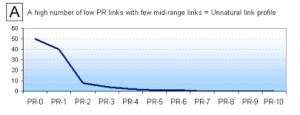
If all your backlinks are only from very low PageRank pages without any higher quality links, this can look unnatural to Google. (Example A above)
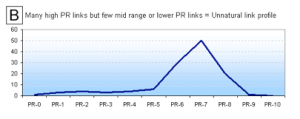
Likewise, if all your links are from high PageRank websites and you don’t have many mid-to-lower quality links then this can look unnatural, too. (Example B)
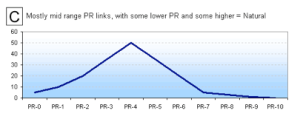
Patrick suggests that the best link landscape is for most of the backlinks to be of mid-range quality. You would therefore have a few low quality links, a few high quality links and then plenty of mid-range links. (Example C)
Note: While PageRank (PR) value is used a lot in SEO as an easy way to describe site authority, it can be a little misleading. So do not be surprised if you find websites with low or even zero PR dominating rankings. As a result, link builders need to look at the volume and quality of inbound links to a website to really assess the site. A natural link profile for a website would therefore suggest that it has many links from websites who themselves have an average amount of inbound links.