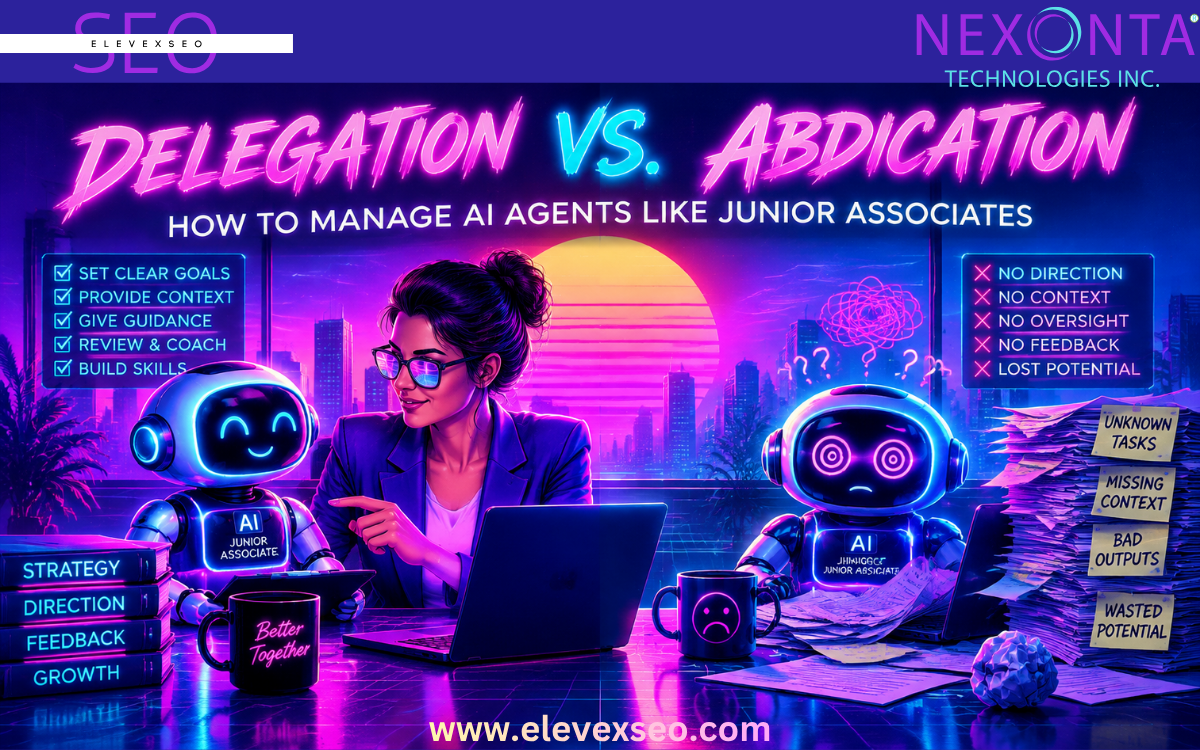
Imagine hiring a new employee who can work around the clock, handle repetitive tasks, organize information, and help your business move faster. Sounds great, right? But would you give that employee full control of your business on their first day?
Probably not.
The same thinking applies to managing AI agents. As businesses introduce Agentic AI into their operations, one of the biggest challenges isn’t simply deciding what tasks to automate. It’s knowing how much responsibility to give AI, when to step in, and how to build trust over time.
There is an important difference between delegation and abdication. Understanding that difference can make all the difference between a successful AI strategy and an expensive mistake.
At ElevexSEO, we believe technology should help people do more, not replace the human judgment that makes businesses successful.
Let’s explore what that looks like in practice.
What Is the Difference Between Delegation and Abdication?
Delegation is giving someone responsibility for a task while providing clear instructions, expectations, and appropriate oversight.
Abdication is handing over responsibility and walking away.
Think about a new junior associate joining your company. You wouldn’t expect them to understand every process, customer expectation, or business rule on day one. You would train them, explain their responsibilities, review their work, and provide feedback.
Over time, as they demonstrate good judgment and consistent performance, you would give them more independence.
AI agents should be managed in much the same way.
An AI agent can perform tasks, follow instructions, connect systems, and make decisions within defined boundaries. But that doesn’t mean it should automatically have unrestricted authority.
Good AI management starts with delegation, not blind trust.
Why Treat AI Agents Like Junior Associates?
Agentic AI is different from traditional automation.
Traditional automation usually follows a set of predefined rules. Agentic AI can take a goal, break it into smaller steps, use available tools, and work through a process with varying degrees of independence.
For example, an AI agent might be assigned to:
- Research potential customers and organize lead information.
- Prepare follow-up emails for a sales team.
- Monitor incoming customer inquiries.
- Gather information from different business systems.
- Create reports and identify patterns.
- Help coordinate administrative workflows.
These capabilities can save businesses considerable time.
But consider what happens if the agent misunderstands a customer request, uses outdated information, or sends an email that doesn’t reflect your company’s values.
The technology may have completed its assigned task. That doesn’t necessarily mean it completed it correctly.
This is why human oversight matters.
Just as you wouldn’t expect a junior associate to make every important business decision without guidance, you shouldn’t expect an AI agent to operate without clear direction.
Five Principles for Managing AI Agents Successfully
The goal isn’t to limit what AI can do. It’s to create the right environment for it to succeed.
Here are five practical principles business owners should consider.
1. Start With Clear Responsibilities
Every employee needs to understand their role. AI agents are no different.
Before introducing an AI agent into your business, define exactly what you want it to accomplish.
Avoid vague instructions such as:
“Handle our customer inquiries.”
Instead, provide clear expectations:
“Review incoming customer inquiries, categorize them by topic, identify urgent requests, and prepare suggested responses for a team member to review.”
The second instruction gives the agent a defined purpose and a clear set of responsibilities.
It also makes performance easier to measure.
Start with one process. Make sure the agent understands its role before expanding its responsibilities.
2. Establish Boundaries and Decision-Making Authority
Not every business decision should be automated.
Some tasks are relatively low-risk. Others can affect customer relationships, finances, legal obligations, and your company’s reputation.
For example, an AI agent may be allowed to:
- Organize incoming leads.
- Draft internal reports.
- Categorize customer questions.
- Prepare suggested responses.
- Identify incomplete information.
However, you may want human approval before it:
- Sends important customer communications.
- Issues refunds or approves payments.
- Changes customer records.
- Makes commitments on behalf of your business.
- Signs agreements or changes contractual terms.
The important thing is to establish boundaries before the agent begins working.
Think of it as defining the limits of a junior associate’s authority. They may be trusted to complete certain tasks independently, while other decisions still require management approval.
3. Review the Work Before Increasing Autonomy
One of the biggest mistakes businesses can make is giving AI too much independence too quickly.
When a new AI agent is introduced, start by reviewing its work.
Check whether it follows instructions, uses accurate information, handles exceptions properly, and produces results that meet your standards.
For example, if an AI agent is preparing customer follow-up emails, review the drafts before allowing it to send them automatically.
Look for patterns:
- Is the information accurate?
- Is the tone appropriate?
- Does it follow your company’s communication standards?
- Does it recognize situations that require human attention?
This early review process helps identify problems before they affect customers.
It also gives you an opportunity to improve instructions and refine the workflow.
4. Expand Autonomy Gradually as Trust Is Earned
Trust shouldn’t be automatic. It should be based on demonstrated performance.
Once an AI agent consistently completes a task correctly, you can consider giving it more independence.
For example, the progression might look like this:
Stage 1: Observe and Assist
The AI agent gathers information, organizes tasks, and prepares recommendations. A human reviews everything.
Stage 2: Draft and Recommend
The agent completes more of the process and prepares work for approval. Human oversight remains in place.
Stage 3: Perform Approved Tasks
The agent can independently complete specific, low-risk tasks within established boundaries.
Stage 4: Manage Defined Workflows
The agent can coordinate multiple steps, monitor results, and handle routine exceptions. More important decisions still go to a human.
This approach allows businesses to increase efficiency without losing control.
It also creates a learning process. You discover what the technology does well, where it struggles, and which tasks are best suited for human involvement.
Remember, greater autonomy should come from consistent results, not simply because the technology is capable of doing more.
5. Keep Humans Accountable
This is perhaps the most important principle.
AI agents can assist with decisions, but businesses still need people who understand the bigger picture.
A human manager should remain responsible for setting objectives, approving important decisions, monitoring outcomes, and addressing problems.
This is especially important when AI agents interact with customers, handle sensitive information, or connect with multiple business systems.
Businesses should also establish clear escalation procedures.
What happens when an agent encounters something unexpected? Who gets notified? When should the agent stop and request human assistance?
These questions should have answers before the system goes live.
AI can take on tasks. It should not become an excuse for businesses to give up accountability.
A Practical Example: Managing an AI Sales Assistant
Let’s look at how this could work in a small or medium-sized business.
Imagine a company wants to use Agentic AI to support its sales team.
Rather than asking an AI agent to manage the entire sales process immediately, the business starts with a smaller assignment.
First, the agent researches leads.
It gathers publicly available business information, organizes potential customers, and identifies relevant details for the sales team.
Next, it supports communication.
It prepares personalized follow-up emails and suggests talking points based on the available information.
A salesperson reviews the material before it goes to the prospect.
Then, it helps manage the workflow.
The agent updates approved CRM fields, organizes follow-up activities, and flags leads that need attention.
As the system demonstrates consistent performance, the business may allow it to handle more routine activities independently.
However, important customer conversations, pricing decisions, negotiations, and sales commitments remain under human control.
The result?
The sales team spends less time on repetitive administration and more time building relationships, understanding customer needs, and closing business.
That’s what effective AI delegation should accomplish.
The Biggest Mistake: Confusing Automation With Management
It’s easy to get excited about what AI can do.
Business owners hear about systems that can research, communicate, coordinate tasks, and manage workflows. They see the potential for reduced administrative work and improved productivity.
And that potential is real.
But implementing AI without a management strategy can create new problems.
Poor instructions can produce poor results. Unclear permissions can create unnecessary risks. A lack of oversight can allow small mistakes to become larger issues.
The answer isn’t to avoid AI.
It’s to implement it thoughtfully.
Businesses need to understand their processes before automating them. They need to identify which activities are suitable for AI, where human approval is necessary, and how different systems should work together.
This is where a well-planned Agentic AI strategy becomes valuable.
The technology should support the business’s existing goals, not introduce unnecessary complexity.
The Future of Business Is About Better Human-AI Collaboration
The conversation around AI often focuses on replacement.
But we believe a more useful question is:
How can businesses use AI to give people more time to do the work that matters most?
Imagine employees spending less time entering information, preparing routine reports, chasing administrative tasks, and moving data between disconnected systems.
Instead, they can focus on customers, relationships, strategy, creativity, and problem-solving.
That is where human judgment continues to make a real difference.
Agentic AI can become a valuable part of a business team. But like any new team member, it needs direction, boundaries, feedback, and accountability.
The businesses that get the most from AI won’t necessarily be the ones that automate everything.
They will be the ones that understand what to delegate, what to review, and what should always remain a human responsibility.
At Nexonta, that’s the approach we believe in: Helping Humans, Not Replacing Them.
Ready to Explore What Agentic AI Can Do for Your Business?
You don’t need to automate your entire business to start seeing the benefits of AI.
Sometimes, the best place to begin is with one repetitive process that takes up too much of your team’s time.
At Nexonta, we help businesses identify opportunities to connect their people, processes, software, and communication through practical technology solutions and Agentic AI.
We look at how your business operates, where time is being lost, and where intelligent automation can make a meaningful difference.
Let’s find out what your business could delegate to AI — without giving up control.
Visit www.nexonta.com to learn more or contact our team to discuss how Agentic AI can help your business work smarter.