Tag: Enterprise AI

  • UX Design of Agentic AI: Why Understanding Your Business Workflow Comes First

    UX Design of Agentic AI: Why Understanding Your Business Workflow Comes First

    When it comes to the UX design of Agentic AI, the first step isn’t choosing an AI tool or designing an interface. It’s understanding how work actually gets done inside a business. Before introducing an intelligent AI layer, businesses need to examine their existing workflows, identify where work slows down and understand how people, processes and systems interact.

    This is where successful Agentic AI implementation begins.

    Many businesses are looking at AI as a way to improve productivity, reduce costs and manage growing workloads. But adding AI to an existing process without understanding how that process works can create more complexity rather than solve the problem.

    The real opportunity is to look at the bigger picture.

    How does information move through the business? Where are employees spending too much time on repetitive tasks? Which systems need to communicate with each other? And where is human judgment still essential?

    Answering these questions creates the foundation for designing an intelligent AI layer that supports the business rather than disrupting it.

    Start With the Workflow, Not the Technology

    Every business has workflows. Some are well documented, while others have developed over time through everyday practices, employee experience and manual processes.

    Think about what happens when a new customer inquiry comes in.

    Someone needs to receive the inquiry, review the information, determine what happens next, update the CRM, communicate with the customer and possibly involve another department.

    Depending on the business, this process could involve several employees, different software platforms, emails, spreadsheets and manual follow-ups.

    Now imagine how much time is spent simply moving information from one place to another.

    This is where Agentic AI can make a meaningful difference.

    By examining the workflow first, businesses can identify which tasks can be handled intelligently by AI, which activities require employee involvement and how connected systems can work together.

    The objective is not to replace the entire process. It’s to make the process work better.

    Seven Things to Understand Before Designing an Agentic AI Workflow

    Before mapping out an intelligent AI layer, there are seven important areas that need to be examined.

    1. What Should AI Handle?

    Start by identifying the repetitive and time-consuming activities that don’t require constant human intervention.

    These might include:

    • Collecting and organizing information.
    • Sorting incoming customer inquiries.
    • Updating CRM records.
    • Sending routine notifications and follow-ups.
    • Routing information to the appropriate department.
    • Preparing reports and summarizing information.
    • Monitoring workflow progress.

    These are examples of activities where AI can help reduce administrative work and keep information moving.

    The key is to define exactly what AI is responsible for. Giving an AI agent a clearly defined role makes it easier to manage, monitor and measure its performance.

    2. What Should Employees Handle?

    Not every decision should be handed over to AI.

    Employees bring experience, judgment, creativity and an understanding of the business that technology cannot always replicate.

    Some activities should remain firmly in human hands.

    For example:

    • Making important business decisions.
    • Handling sensitive customer situations.
    • Approving financial or contractual commitments.
    • Reviewing exceptions.
    • Managing complex customer relationships.
    • Making decisions that require professional judgment.

    A well-designed Agentic AI workflow recognizes where employees add the most value.

    Instead of spending their time on repetitive administrative tasks, employees can focus on decisions, relationships and work that requires their expertise.

    3. Which Systems Need to Be Connected?

    Most businesses don’t operate using just one software platform.

    They may have a CRM, accounting software, customer service tools, inventory management systems, email platforms and internal communication tools.

    The challenge is that these systems don’t always communicate effectively.

    Employees end up transferring information manually, entering the same details more than once or searching across different platforms to find what they need.

    An intelligent AI layer can help connect relevant systems and coordinate the movement of information between them.

    The goal is to create a more connected operation where information gets to the right place at the right time.

    4. Where Do Approvals Take Place?

    Every business has decisions that require authorization.

    Some activities can be automated, while others need an employee or manager to review and approve the next step.

    For example, an AI agent might prepare a purchase request, but a manager should approve the purchase before an order is placed.

    Similarly, AI might identify an unusual customer account issue and prepare a recommendation, but an employee should review the situation before taking action.

    These approval points need to be built into the workflow.

    This is an important part of responsible Agentic AI design. It helps businesses maintain oversight, accountability and control while still benefiting from automation.

    5. What Triggers the Workflow?

    An intelligent workflow needs to know when to start.

    A trigger is the event that tells the system something needs to happen.

    This could be:

    • A new customer inquiry.
    • A completed online form.
    • A new sales opportunity in the CRM.
    • An incoming customer support request.
    • A payment received.
    • A change in inventory.
    • A scheduled business activity.

    Once the trigger occurs, the workflow can begin its defined sequence of tasks.

    Understanding these triggers helps determine when an AI agent should act, which systems it needs to access and what information it needs to complete its responsibilities.

    6. What Happens When Something Goes Wrong?

    No business workflow is perfect. Information may be missing, systems may become unavailable or a request may fall outside the normal process.

    This is why exception handling needs to be considered from the beginning.

    A properly designed workflow should establish what happens when:

    • Required information is missing.
    • An AI agent cannot complete a task.
    • Two systems provide conflicting information.
    • An approval is declined.
    • A customer request requires special attention.
    • A connected system becomes unavailable.

    Rather than allowing the process to continue incorrectly, the workflow should recognize the issue and route it to the appropriate employee.

    The goal is to create a system that can handle normal activities efficiently while knowing when to stop, ask for help and bring a person into the process.

    7. How Will Success Be Measured?

    Finally, businesses need to determine what success actually looks like.

    Introducing Agentic AI is not a success simply because an AI agent has been deployed.

    The real question is whether the business is operating more efficiently.

    Some useful measurements include:

    • Time saved on repetitive administrative tasks.
    • Reduction in manual data entry.
    • Faster customer response times.
    • Fewer communication gaps.
    • Reduced duplication of work.
    • Improved workflow completion rates.
    • Better use of employee time.
    • Lower operational costs.

    These measurements provide a practical way to evaluate the impact of Agentic AI.

    They also help businesses identify opportunities for further improvement as their operations evolve.

    The Bigger Picture: Building a More Connected Business

    At the enterprise level, the value of Agentic AI goes well beyond automating individual tasks.

    It’s about understanding how an entire business operates and identifying where intelligent automation can improve the flow of work.

    Many organizations have capable employees and good software systems. Yet they still struggle with disconnected platforms, repetitive administration, manual processes and communication gaps between departments.

    These issues create friction.

    They slow down decisions, consume valuable employee time and make it harder for a business to grow without adding more administrative resources.

    An intelligent AI layer can help address these challenges by connecting relevant systems, coordinating defined activities and bringing employees into the workflow when human judgment is required.

    The result is an opportunity to:

    • Reduce unnecessary administrative work.
    • Improve communication between systems and departments.
    • Increase employee capacity.
    • Improve responsiveness to customers.
    • Create more consistent business processes.
    • Build an operation that can scale more effectively.

    And importantly, this doesn’t mean adding technology simply because it’s available.

    It means identifying where technology can make a measurable difference.

    Agentic AI Should Be Designed Around the Business

    Every business is different. Its workflows, employees, systems and operational challenges are unique.

    That’s why successful Agentic AI implementation should never begin with a one-size-fits-all solution.

    It should begin with a closer look at how the business works today.

    By mapping the workflow, identifying responsibilities, connecting systems and establishing clear approval points, businesses can create an intelligent AI layer that supports their actual operational needs.

    The objective is simple: reduce friction, increase capacity, improve responsiveness and create a more scalable operation.

    At Nexonta, we believe the best place to start with Agentic AI isn’t the technology itself. It’s understanding the business processes that technology is meant to improve.

    Ready to Discover Where Agentic AI Could Improve Your Business?

    You may already have the software, employees and processes needed to run your business effectively. But are they working together as efficiently as they could?

    There may be opportunities hiding in everyday activities that consume valuable time, create unnecessary administration or slow down communication.

    Nexonta helps businesses identify these opportunities and explore how Agentic AI can connect systems, improve workflows and reduce operational friction.

    Let’s start by understanding how your business works.

    Contact Nexonta to discuss your business workflows and discover where Agentic AI could help improve operational efficiency.

    Visit www.nexonta.com to start the conversation.

  • Understanding AI at the Enterprise Level: 4 Areas Every Business Should Evaluate

    Understanding AI at the Enterprise Level: 4 Areas Every Business Should Evaluate

    Understanding AI at the Enterprise Level: 4 Areas Every Business Should Evaluate

    Understanding AI at the enterprise level starts with understanding how your business actually works. Before investing in Agentic AI, organizations need to look beyond the technology and examine how people work, how processes operate, how software is used, and how information moves across the business.

    Why?

    Because the biggest opportunities for AI are not always where you expect them to be.

    A company might have excellent employees, powerful software, and well-established processes. Yet, work can still get stuck. Information can fall through the cracks. Customers can wait too long for a response. Employees can spend hours on tasks that could be handled more efficiently.

    These problems often go unnoticed because they have become part of the daily routine.

    This is where a thoughtful approach to Agentic AI can make a difference.

    What Does Understanding AI at the Enterprise Level Really Mean?

    Enterprise AI is about more than introducing a new tool or automating a single task. It means looking at how the entire organization operates and identifying where AI could help work move forward more efficiently.

    Agentic AI takes this a step further.

    Depending on the solution, AI agents can help manage multistep tasks, retrieve information, coordinate actions across connected systems, and support employees in getting work done. Appropriate human oversight remains important, especially when decisions carry financial, operational, or customer consequences.

    But before deciding what to automate, businesses need to understand how work gets done today.

    At Nexonta, we believe this conversation should begin with four interconnected areas.

    1. People: How Are Employees Spending Their Time?

    Your employees are one of your organization’s most valuable resources. The question is whether their time is being used where it creates the greatest value.

    Consider the work your team handles every day.

    How much time goes toward repetitive administrative tasks? How often do employees move information manually from one system to another? Are they waiting for information before they can move forward?

    And how much time is spent chasing updates, sending reminders, or following up on tasks that should already be progressing?

    These are important questions.

    For example, a sales representative might spend hours updating records, preparing reports, and following up on leads. An operations manager might spend much of the day tracking requests and checking the status of routine tasks.

    Both employees have important responsibilities. But some of their daily activities may be suitable for AI assistance or automation.

    Agentic AI could help gather information, prepare updates, trigger reminders, or coordinate routine tasks. This can give employees more time to focus on customers, problem-solving, and decisions that require human judgment.

    The goal is not to replace the value of your people. It is to help them spend more time doing valuable work.

    Start by asking one simple question: Where are our employees spending time on work that could be handled more efficiently?

    2. Processes: How Does Work Move Through the Organization?

    Even great employees can struggle when business processes are slow, complicated, or poorly connected.

    A task might pass through several approval stages. One department might finish its part of a project but wait days for another team to respond. A customer request might sit untouched because nobody is sure who owns the next step.

    Over time, these delays become normal.

    But they still cost the business time and money.

    To understand where Agentic AI might help, examine how work moves from beginning to end.

    Ask yourself:

    • Where do tasks regularly get delayed?
    • Are there unnecessary approval steps?
    • Where do handoffs between teams break down?
    • Which processes depend too heavily on one employee?
    • Where are the biggest bottlenecks occurring?

    These questions help reveal whether a problem comes from manual work, unclear responsibilities, disconnected systems, or an inefficient process.

    That distinction matters.

    Automating a poor process does not automatically make it better. In some cases, it simply allows an inefficient process to continue faster.

    The first step is to understand the process and improve it where necessary. Then, consider where AI agents could help coordinate tasks, retrieve information, or move work to the next stage.

    The result can be a smoother workflow with fewer delays and less unnecessary effort.

    3. Software: Are Your Business Systems Working Together?

    Most organizations rely on several software applications to run their business.

    These might include a CRM, accounting software, marketing platforms, project management tools, customer service systems, and internal databases.

    Each system may serve a useful purpose. The challenge is how well they work together.

    Is the same information being entered more than once? Do employees have to switch between several applications to complete one task? Can different departments access the information they need?

    And are you fully using the capabilities of the software you already own?

    These questions are especially important when evaluating Agentic AI.

    An organization might not need another standalone application. It may need a better way to connect existing systems and make information easier to access.

    Where suitable integrations and permissions exist, AI agents can help retrieve information from connected tools, update records, support workflows, and reduce repetitive data entry.

    For example, imagine a new sales lead arrives through your website.

    Instead of requiring an employee to manually transfer the details, update a CRM, notify a salesperson, and create a follow-up reminder, a connected workflow could coordinate several of those steps automatically.

    The exact capabilities depend on the systems involved, the quality of the available data, and the permissions granted.

    The important point is this: before adding more technology, understand how well your current technology is being used.

    You may discover that the opportunity lies in better integration rather than another software purchase.

    4. Communication: Is Information Getting Where It Needs to Go?

    Communication connects people, processes, and software.

    When information moves slowly or gets lost, the effects can spread across the entire organization.

    Customers may wait too long for answers. Sales leads may not receive consistent follow-up. Employees may spend hours coordinating meetings, requesting updates, and tracking down information.

    Important messages can also get buried in email threads, chat platforms, and busy inboxes.

    Sound familiar?

    These challenges are worth examining because communication problems often create hidden costs.

    Ask yourself:

    • How quickly are customers receiving responses?
    • How effectively do teams communicate internally?
    • Are sales leads being followed up consistently?
    • Are important messages or requests getting lost?
    • How much time is spent coordinating meetings, updates, and follow-ups?

    Agentic AI may help address some of these issues by organizing information, preparing responses, routing requests, summarizing conversations, and triggering follow-up actions.

    For instance, an AI-supported workflow could identify a new inquiry, gather relevant customer information, notify the appropriate team member, and schedule a follow-up task.

    Human review can remain part of the process wherever it is needed.

    The objective is not to automate every conversation. It is to make sure important information reaches the right person at the right time, and that opportunities do not disappear simply because someone was too busy to follow up.

    Why These Four Areas Need to Work Together

    People, processes, software, and communication are closely connected.

    A delay that appears to be a people problem might actually be caused by disconnected software. A communication breakdown might be the result of an unclear process. A slow process might exist because employees are manually transferring information between systems.

    Looking at each area in isolation can cause businesses to miss the bigger picture.

    That is why an enterprise-level AI assessment should consider the entire workflow.

    The objective is to identify where the organization is losing time, money, information, or opportunities because work is still being performed manually or across disconnected systems.

    Once those gaps are understood, businesses can make more informed decisions about where Agentic AI can deliver practical value.

    This also helps avoid a common mistake: adopting AI simply because it is available.

    The right starting point is not the technology. It is the business problem you want to solve.

    From AI Possibilities to Practical Business Results

    Every organization is different.

    A solution that works well for one company may not be appropriate for another. The right approach depends on the organization’s goals, existing systems, workflows, data, security requirements, and resources.

    That is why it helps to start with a clear assessment.

    Identify the repetitive tasks that consume employee time. Map the processes that create delays. Review the software systems your business relies on. Examine how information moves between people and departments.

    Then prioritize the opportunities.

    Look for areas where improving a workflow could reduce manual effort, shorten response times, improve consistency, or help employees focus on higher-value work.

    Start with a manageable use case. Establish a baseline. Define what success looks like. Measure the results before expanding the solution.

    This practical approach helps turn AI from an interesting concept into a business initiative with clear objectives and measurable outcomes.

    It also gives employees a better understanding of how AI will support their work, rather than simply introducing another technology they are expected to learn.

    Is Your Organization Ready to Explore Agentic AI?

    Understanding AI at the enterprise level begins with asking better questions about your business.

    Where is your team losing time? Which processes create unnecessary delays? Are your systems working together? Is important information reaching the right people?

    The answers can reveal opportunities that are easy to overlook when everyone is focused on keeping up with daily demands.

    At Nexonta, we believe the most effective Agentic AI strategies start with understanding the organization first. Technology should support your business goals, solve real problems, and create meaningful improvements in how work gets done.

    You do not need to automate everything at once. You need to understand where the right solution can make a difference.

    Ready to Explore Agentic AI for Your Business?

    Let’s start with your business, not the technology.

    Nexonta can help you explore where Agentic AI may fit into your existing operations, identify opportunities to improve workflows, and determine which practical next steps make sense for your organization.

    Contact Nexonta today to arrange a conversation about your Agentic AI opportunities.

    Your next competitive advantage may begin with improving the way your business already works.

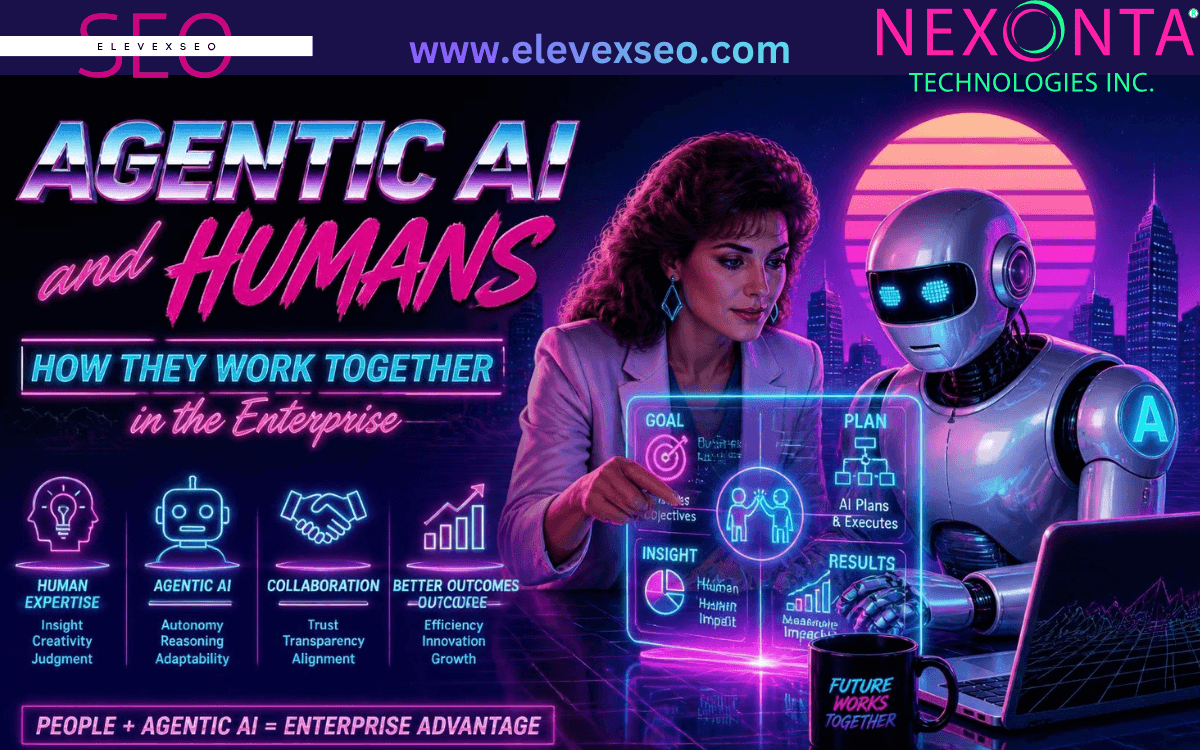
  • Agentic AI and Humans: How They Work Together in the Enterprise

    Agentic AI and Humans: How They Work Together in the Enterprise

    Lately, we have been talking a lot about Agentic AI. There is good reason for that. The technology is moving quickly, and we are already hearing about some exciting developments expected in 2027.

    But as we have become more involved in the Agentic AI conversation, we have noticed something else.

    There is still a lot of confusion about how Agentic AI and humans actually work together.

    Some people hear “AI agents” and immediately think about automation replacing people. Others imagine a business where AI simply takes over tasks and employees step aside.

    That is not the way we see it.

    At the enterprise level, Agentic AI is designed to create a working relationship between humans and AI.

    And that distinction matters.

    Agentic AI Is Not Just Another Automation Tool

    Traditional automation is generally designed to follow a specific set of instructions.

    If this happens, do that.

    That can be incredibly useful. But businesses are rarely that simple.

    Workflows change. Customers change. Priorities change. Problems appear unexpectedly. Employees have to make decisions and move information from one system to another.

    This is where Agentic AI starts to become interesting.

    Rather than simply completing one isolated task, an AI agent can be designed to work across a broader workflow. It can help interpret information, coordinate tasks, identify next steps and support people as work moves through a process.

    The human is still part of that process.

    The technology becomes another layer of intelligence within the workflow.

    The Human and AI Relationship

    Think about a business owner who spends hours every week dealing with repetitive administrative work.

    There may be emails to review, information to organize, reports to prepare, customer inquiries to respond to and internal communications to coordinate.

    None of these tasks may seem overwhelming on their own.

    Together, however, they can consume a significant amount of time.

    This is where the relationship between humans and Agentic AI can become valuable.

    The AI can help manage parts of the workflow while people remain responsible for decisions that require judgment, context, relationships and accountability.

    In simple terms:

    Humans provide direction, judgment and oversight.

    AI can help manage information, processes and repetitive work.

    That creates a very different conversation from simply asking whether AI will replace employees.

    The more useful question may be:

    Where can humans and AI work together to make the business operate better?

    Where Agentic AI Can Help Businesses

    Every organization has bottlenecks.

    Sometimes they are obvious.

    Sometimes they are hidden inside everyday work.

    A business might be dealing with:

    • Repetitive workflows
    • Operational bottlenecks
    • Excessive administrative workloads
    • Missed opportunities
    • Inefficient communication
    • Information scattered across different systems
    • Slow follow-up
    • Growing overhead
    • Employees spending valuable time on low-value tasks

    These problems can create a domino effect.

    A small delay in one part of the business can create another delay somewhere else.

    Eventually, people spend more time managing the process than actually moving the business forward.

    Agentic AI can potentially help connect these pieces.

    Instead of looking at AI as a collection of individual tools, businesses can begin looking at it as an intelligent workflow layer.

    That is an important shift.

    From Individual AI Tools to an Intelligent Workflow

    Many businesses already use AI.

    They may use ChatGPT to create content. Another tool might summarize meetings. Another might help with customer service. Someone else might use AI to analyze data.

    Each tool can be useful.

    But what happens when these tools operate as disconnected pieces?

    People still have to move information between them.

    That creates another problem.

    The opportunity with Agentic AI is to think beyond individual applications and start looking at the entire workflow.

    What happens when a customer inquiry comes in?

    Where does the information go?

    Who reviews it?

    What happens next?

    What information needs to be collected?

    Who needs to be notified?

    What happens if the customer does not respond?

    Where is the information stored?

    These are workflow questions.

    Agentic AI can potentially help coordinate parts of that process while keeping humans involved where human judgment is important.

    What About the Cost?

    This is where every business owner should slow down and look at the numbers.

    Adopting AI is not automatically a cost saving.

    There can be software costs, implementation costs, integration costs, training costs and ongoing management costs.

    There can also be a learning curve.

    So the question should not simply be:

    “How much does AI cost?”

    A better question is:

    “What does this workflow currently cost the business?”

    That means looking at the time employees spend on repetitive work, the cost of delays, missed opportunities, unnecessary administrative work and the operational cost of keeping inefficient processes in place.

    A simple cost-benefit assessment might look at four areas:

    1. Time

    How many hours are currently spent on repetitive or administrative tasks?

    2. Labour

    Could employees spend more of their working time on higher-value activities?

    3. Revenue Opportunities

    Are leads, customers or opportunities being missed because follow-up is slow or inconsistent?

    4. Operational Efficiency

    Could better coordination reduce delays, duplication or unnecessary overhead?

    This does not mean every business will see the same financial return.

    The economics will depend on the business, the workflow, the technology being implemented and how effectively it is adopted.

    But the exercise itself is important.

    Before investing in AI, understand the problem you are trying to solve.

    The Competitive Advantage May Be the Workflow

    There is another part of this conversation that businesses should consider.

    AI tools are becoming increasingly accessible.

    That means simply having access to AI may not be much of a differentiator.

    The bigger opportunity may come from how a business uses AI.

    Two companies could have access to similar AI technology.

    One might use it to generate occasional content.

    The other might integrate AI into customer communication, internal processes, research, reporting and operational workflows.

    The technology may be similar.

    The workflows are not.

    That difference could become increasingly important as businesses continue adopting AI.

    Competitive advantage may come less from owning a particular AI tool and more from building smarter ways of working.

    Humans Still Matter

    This is perhaps the most important part of the conversation.

    Agentic AI does not eliminate the need for people.

    Businesses still need people to understand customers, make strategic decisions, build relationships, handle complex situations and take responsibility for important outcomes.

    AI can process information quickly.

    That does not mean it understands the business in the same way the people inside that business do.

    This is why human oversight remains important.

    The goal is not to remove humans from the workflow.

    The goal is to give people better tools.

    Imagine an employee spending less time searching through information and more time talking to a customer.

    Imagine a business owner spending less time chasing administrative tasks and more time working on growth.

    Imagine a sales team receiving better-organized information before making a customer call.

    That is where the human-AI relationship becomes much more interesting.

    Start With the Bottleneck, Not the Technology

    One of the biggest mistakes businesses can make is starting with the technology.

    They find an exciting AI platform and then try to figure out where to use it.

    We believe the conversation should start somewhere else.

    Start with the bottleneck.

    Where is the business losing time?

    Where are employees frustrated?

    Where are customers waiting?

    Where is information getting lost?

    Where is communication breaking down?

    Where is overhead increasing?

    Where are opportunities being missed?

    Once those questions are answered, it becomes much easier to determine whether Agentic AI has a meaningful role to play.

    Technology should solve a business problem.

    It should not become another problem for the business to manage.

    Looking Ahead to 2027

    The next stage of AI is likely to be less about simply asking an AI chatbot a question and more about how AI can participate in the workflows that businesses already depend on.

    That makes the conversation around Agentic AI particularly interesting.

    The businesses exploring this technology today are not simply asking, “What can AI do?”

    They are beginning to ask better questions.

    Where can AI help us work more efficiently?

    Where can humans add the most value?

    Which workflows should be redesigned?

    What should remain human-led?

    How can we build a business that uses AI without losing the human element?

    Those questions are likely to become even more important as Agentic AI continues to develop.

    The Future Is the Relationship

    Agentic AI does not have to be a story about humans versus machines.

    It can be a story about better ways of working.

    The opportunity is to combine human experience, judgment and creativity with AI’s ability to process information, coordinate workflows and handle repetitive work.

    For business owners, that could mean fewer bottlenecks, less administrative pressure and more time focused on the work that actually moves the business forward.

    But the first step is not buying an AI system.

    It is understanding your business.

    Find the bottlenecks.

    Understand the workflows.

    Calculate where time and resources are being spent.

    Then ask where Agentic AI could create meaningful value.

    That is where the human-AI relationship really begins.

    Ready to Look at Your AI Opportunities?

    If your business is dealing with repetitive workflows, growing administrative workloads, communication challenges or operational bottlenecks, it may be time to look at where AI can actually fit into the business.

    Start with the workflow. Find the bottleneck. Then explore what Agentic AI could do.

    Explore Your AI Opportunities

    The future of business AI is not simply about using more technology.

    It is about using technology more intelligently — and keeping people at the centre of the process.

  • Agentic AI Deployment: Building the AI Infrastructure Your Organization Needs

    Agentic AI Deployment: Building the AI Infrastructure Your Organization Needs

    Agentic AI deployment is quickly becoming a serious business conversation.

    Over the past several months, we have noticed a shift in how organizations are thinking about AI. The conversation is moving beyond experimentation and individual productivity tools. It is now reaching the operations and enterprise levels, where the focus is on how AI can actually help an organization run better.

    That shift makes sense.

    Margins are tighter. Teams are being asked to do more with less. Businesses are looking for efficiencies without sacrificing service, quality, or growth.

    AI, when deployed well, can help.

    But there is an important distinction between using AI and building an organization around AI agents.

    That distinction could become one of the biggest competitive advantages of the next five years.

    From AI Tools to AI Agents

    Most organizations have already experimented with AI in some form.

    Employees use AI to write emails, summarize documents, research topics, create content, analyze information, or speed up everyday tasks.

    Those applications are useful.

    But they are only the beginning.

    The next step is moving from AI that simply responds to requests to AI agents that can carry out processes.

    An AI agent can be designed to work through a series of tasks. It can gather information, analyze it, make decisions within defined parameters, trigger another process, and report the results.

    Instead of simply asking:

    “How can AI help my employees?”

    Organizations are beginning to ask:

    “What work can AI agents actually do for us?”

    That is a much bigger question.

    What Is Agentic AI?

    Agentic AI refers to AI systems that can work toward a defined goal and take actions along the way.

    Think of it as moving from an AI assistant to an AI-powered worker within a specific business process.

    For example, an organization might have an AI agent that helps manage a customer onboarding process.

    It could:

    * Collect information
    * Check that required information is complete
    * Organize the data
    * Identify missing information
    * Trigger follow-up communications
    * Update systems
    * Notify the appropriate team member
    * Create a summary for review

    The important point is that the agent is not simply generating text.

    It is participating in a workflow.

    That is where the real opportunity starts to appear.

    Why Organizations Are Paying More Attention

    There is a practical reason for the growing interest in agentic AI.

    Businesses are under pressure to improve efficiency.

    Redundant processes cost money. Manual data entry costs money. Repetitive communication costs money. Moving information between systems costs money.

    And perhaps most importantly, employee time costs money.

    Many organizations have built layers of processes over the years. Some are necessary. Others exist simply because that is how the organization has always done things.

    AI creates an opportunity to take a fresh look at those processes.

    Instead of asking employees to spend hours completing repetitive work, an organization can begin asking:

    Can this process be automated?

    Then:

    Can an AI agent manage it?

    And finally:

    Where should a human remain in the process?

    That last question is extremely important.

    The goal should not be to remove people from every process.

    The goal should be to let people spend more of their time on work that actually requires human judgment, creativity, relationships, and accountability.

    Agentic AI Infrastructure Matters

    This is where many organizations may underestimate the challenge.

    Deploying an AI agent is not simply a matter of purchasing software and turning it on.

    The organization needs the right AI infrastructure behind it.

    That infrastructure can include:

    * Reliable business data
    * Clear workflows
    * Defined permissions
    * Secure systems
    * API and software integrations
    * Data governance
    * Human oversight
    * Monitoring
    * Performance measurement
    * Clear rules for decision-making

    In other words, an AI agent is only as useful as the environment it operates within.

    If the underlying processes are messy, the data is inconsistent, or systems cannot communicate with each other, adding AI may simply make the mess move faster.

    That is why AI deployment needs to begin with the organization itself.

    Start With the Workflow, Not the Technology

    One of the biggest mistakes organizations can make is starting with the technology.

    They find an impressive AI platform and then try to figure out where it fits.

    A better approach is the opposite.

    Start with the business.

    Look at the workflows that consume the most time.

    Look for repetitive tasks.

    Identify bottlenecks.

    Find processes where employees spend hours collecting, moving, checking, or organizing information.

    Then ask where an AI agent could create measurable value.

    This approach makes AI deployment much more strategic.

    It also makes it easier to calculate the return on investment.

    Where Could AI Agents Make the Biggest Difference?

    The opportunities will be different for every organization, but several areas stand out.

    Customer Operations

    AI agents can help manage repetitive customer interactions, organize information, route requests, and support follow-up processes.

    This can allow customer-facing employees to focus on more complex situations.

    Sales Operations

    AI agents can help research prospects, organize information, prepare reports, manage follow-ups, and keep sales systems updated.

    The objective isn’t to replace the salesperson.

    It is to remove some of the administrative work surrounding the salesperson.

    Finance and Administration

    Finance teams deal with large amounts of structured information and repetitive processes.

    AI agents may be able to help collect information, identify inconsistencies, prepare summaries, and move information between systems.

    Human oversight remains important, particularly when financial decisions are involved.

    Marketing

    Marketing is another area where AI agents can support workflows.

    Research, content planning, reporting, campaign monitoring, customer segmentation, and other repetitive activities can potentially be connected into more efficient processes.

    Internal Operations

    Perhaps the biggest opportunity is simply improving how information moves through the organization.

    An AI agent may be able to take information from one system, process it, and initiate the next step without requiring an employee to manually move the work forward.

    Multiply that across hundreds or thousands of processes and the potential becomes significant.

    The Human Element Still Matters

    There is a temptation to think that agentic AI means organizations will become completely automated.

    That is unlikely to be the best approach.

    The strongest organizations will probably be the ones that understand **where AI should act and where humans should remain firmly in control**.

    An AI agent can handle defined tasks.

    A person can handle exceptions.

    An AI agent can process information.

    A person can apply judgment.

    An AI agent can identify an opportunity.

    A person can decide whether acting on that opportunity makes sense.

    This creates a model where humans and AI work together rather than competing for the same role.

    The Next Five Years Could Be a Defining Period

    We believe the next five years will be an important period for AI adoption.

    There will be organizations that experiment with AI occasionally.

    There will be organizations that deploy a few AI tools.

    And there will be organizations that take a much bigger step.

    They will begin building AI agents directly into their operations.

    Those organizations could have a significant advantage.

    Why?

    Because the benefits of AI are not limited to saving a few minutes here and there.

    When AI becomes part of the operating structure of a business, efficiencies can compound.

    One improved workflow affects another.

    Better data movement improves decision-making.

    Less administrative work gives employees more time.

    Faster processes improve customer experiences.

    And more efficient operations can make it easier to scale.

    That is a very different proposition from simply giving employees access to an AI chatbot.

    AI Deployment Needs a Strategy

    The companies that benefit most from agentic AI will not necessarily be the companies that adopt the most AI tools.

    They will be the companies that deploy AI strategically.

    That means understanding:

    What should we automate?

    What should remain human?

    What data does the AI need?

    What systems need to connect?

    What decisions can an AI agent make?

    Where is human approval required?

    How will we measure the results?

    These questions create the foundation for responsible and effective AI deployment.

    And that foundation matters.

    Because once AI agents become embedded in an organization, changing the underlying architecture can become much more difficult.

    Don’t Wait Until Everyone Else Has Started

    There is still an opportunity for organizations to get ahead.

    The goal isn’t to rush into AI for the sake of saying you are using AI.

    The goal is to identify where AI can genuinely improve the way your organization operates.

    Start small.

    Choose a process.

    Measure the current cost in time and resources.

    Design the workflow.

    Introduce the right AI agent.

    Keep humans involved where they add the most value.

    Measure the results.

    Then expand.

    That creates a much more practical path toward enterprise AI adoption.

    The Real Competitive Advantage

    AI itself is not necessarily the competitive advantage.

    How an organization uses AI may be.

    Two companies can have access to the same AI technology and get completely different results.

    One may use AI as another productivity tool.

    The other may build AI into its operating model.

    That second organization could potentially move faster, reduce redundancies, respond to customers more quickly, and scale without increasing its workforce at the same rate.

    That is where agentic AI becomes much more than a technology trend.

    It becomes an operational strategy.

    The Time to Start Is Now

    The next five years could change how organizations operate.

    Companies that begin understanding their processes, preparing their data, connecting their systems, and deploying AI agents thoughtfully will have a head start.

    The winners won’t necessarily be the organizations with the biggest AI budgets.

    They may be the organizations that understand where AI belongs inside the business and deploy it in a way that creates measurable value.

    AI done well should not make your organization more complicated.

    It should make it more efficient, more responsive, and easier to scale.

    The opportunity is there.

    The question is whether your organization will start building for it now.

    Ready to Explore Agentic AI for Your Organization?

    The first step doesn’t have to be complicated.

    Start by identifying the repetitive processes, operational bottlenecks, and manual workflows that are slowing your organization down.

    From there, you can determine where AI agents could create the greatest impact and build a practical deployment strategy around your existing systems.

    If you are ready to explore how agentic AI could improve your organization’s operations, let’s start the conversation.

    [Explore Your AI Deployment Opportunities →]

☎ ✉
f 𝕏