Tag: data analytics

  • Companies that are data-driven, meaning they make decisions and operate based on data and analytics, can benefit in several ways.

    Companies that are data-driven, meaning they make decisions and operate based on data and analytics, can benefit in several ways.

    Here are some of the advantages of being a data-driven company:

    1. Informed Decision-Making: Data-driven companies use data to inform their decision-making processes. This leads to more accurate, fact-based decisions rather than relying on intuition or gut feeling.

    2. Competitive Advantage: Data-driven companies can gain a competitive edge by identifying trends, opportunities, and potential threats more quickly than their competitors. They can adjust their strategies in real-time to stay ahead in the market.

    3. Improved Efficiency: Data analysis can help identify inefficiencies and bottlenecks in operations. By optimizing processes based on data insights, companies can reduce costs and improve overall efficiency.

    4. Better Customer Understanding: Analyzing customer data allows companies to understand their customers’ preferences, behavior, and needs. This knowledge can be used to personalize products, services, and marketing efforts, resulting in improved customer satisfaction and loyalty.

    5. Targeted Marketing: Data-driven companies can create highly targeted marketing campaigns. They can identify specific customer segments and tailor their messaging to reach the right audience, which can lead to higher conversion rates.

    6. Risk Management: Data analysis helps in identifying and mitigating risks. Companies can proactively address issues before they become major problems and make informed decisions regarding risk management.

    7. Product Development: Data can inform the development of new products and services. By understanding market needs and customer feedback, companies can create offerings that are more likely to succeed.

    8. Predictive Analytics: Data-driven companies can leverage predictive analytics to forecast future trends, customer behavior, and demand. This allows them to plan and allocate resources more effectively.

    9. Cost Reduction: Through data analysis, companies can identify cost-saving opportunities. This may involve optimizing supply chain management, reducing unnecessary expenditures, or streamlining processes.

    10. Continuous Improvement: Data-driven companies focus on a culture of continuous improvement. They use data to measure performance, set benchmarks, and make ongoing adjustments to achieve better results.

    11. Enhanced Customer Support: Data-driven insights can be used to improve customer support and service quality. Companies can track customer issues and address them more effectively, leading to higher customer satisfaction.

    12. Employee Performance and Satisfaction: Data-driven HR practices can help identify top-performing employees, areas for skill development, and ways to improve employee satisfaction and retention.

    13. Compliance and Governance: Data-driven approaches can assist companies in ensuring compliance with regulations and industry standards, reducing the risk of legal and financial penalties.

    14. Adaptability: Data-driven companies are more adaptable to changing market conditions and customer preferences. They can quickly pivot their strategies and operations based on real-time data.

    15. Data Monetization: Companies can monetize their data assets by selling data insights or creating data-driven products and services for external customers.

    In summary, being data-driven offers numerous advantages, including improved decision-making, competitive advantage, increased efficiency, and better customer understanding. It allows companies to be more agile, reduce risks, and drive innovation across various aspects of their business. In today’s economy it gives you the edge
  • Importance of Buyer Personas

    Importance of Buyer Personas

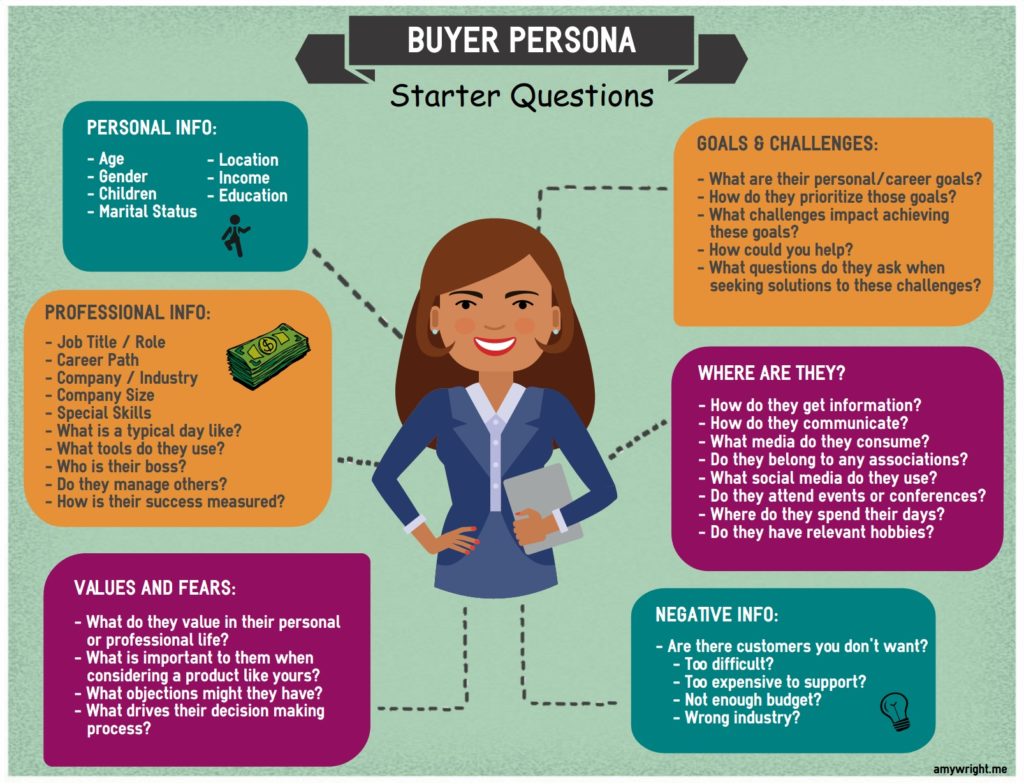
    A persona (also user persona, customer persona, buyer personal) is a semi-fictional representation of your ideal customer based on market research and real data about your existing customers. When creating your buyer persona(s), consider including customer demographics, behavior patterns, motivations, and goals. For example, if you are designing a growth driven design website your data would be largely based on your buyer personas as well as web analytics. In most cases, personas are synthesized from data collected from interviews with users. They are captured in 1–2-page descriptions that include behavioral patterns, goals, skills, attitudes, with a few fictional personal details to make the persona a realistic character.
    The more detailed you are, the better.

    Data collection
    Concerning data, personas have typically been developed from surveys, focus groups, and other ethnographic data collection techniques. Most persona designers believe that personas should be based on ethnographic or other data collection approaches concerning customers and should not be based purely on the creator’s imagination. The use of ethnographic research helps the creation of a number of archetype users that can be used to develop products that deliver positive user experiences. With the availability of large amounts of actual customer data, user data, social media data, and other web analytics data, this provides you with enough information to develop and design an Ideal Buyer Persona for your organization.

    A persona, in user-centered design and marketing is a fictional character created to represent a user type that might use a site, brand, or product in a similar way. Marketers may use personas together with market segmentation, where the qualitative personas are constructed to be representative of specific segments.

    The term persona is used widely in online and technology applications as well as in advertising. The reason that it is so important to know your persona (user persona, customer persona, buyer personal) is that when tracking your data analytics you have to know what you are looking for in terms of demographics and persona make up in order to properly design marketing campaigns, content, products and services for your specific target audience. It is only through knowing your buyer persona that you can tailor a focussed clear concise and effective marketing strategy in order to gain more users and clients.

    Personas may also be used as part of a user-centered design process for designing software and are also considered a part of interaction design (IxD), having been used in industrial design and more recently for online marketing purposes and growth driven design websites.

    Personas are said to be cognitively compelling because they put a personal human face on otherwise abstract data about customers. By thinking about the needs of a fictional persona, designers may be better able to infer what a real person might need. Such inference may assist with brainstorming, use case specification, and features definition. Pruitt and Adlin argue that personas are easy to communicate to engineering teams and thus allow engineers, developers, and others to absorb customer data in a palatable format. They present several examples of personas used for purposes of communication in various development projects.

    Personas also help prevent some common design pitfalls which may otherwise be easy to fall into. The first is designing for what Cooper calls “The Elastic User”, by which he means that while making product decisions different stakeholders may define the ‘user’ according to their convenience. Defining personas helps the team have a shared understanding of the real users in terms of their goals, capabilities, and contexts. Personas also help prevent “self-referential design” when the designer or developer may unconsciously project their own mental models on the product design which may be very different from that of the target user population.

    Personas also provide a reality check by helping designers keep the focus of the design on cases that are most likely to be encountered for the target users and not on edge cases which usually will not happen for the target population.

    The persona benefits are summarized as follows:
    • Help team members share a specific, consistent understanding of various audience groups. Data about the groups can be put in a proper context and can be understood and remembered in coherent stories.
    • Proposed solutions can be guided by how well they meet the needs of individual user personas. Features can be prioritized based on how well they address the needs of one or more personas.
    • Provide a human “face” so as to create empathy for the persons represented by the demographics.

    Today we live in a data filled world, moving at 5G speeds. The more data that we are able to harvest the better we can focus our product or services to attract our Ideal customer this is why it is so essential to not only create buyer personas but to also update them on a regular basis because things change fast today and so do customer preferences.

    Sources:
    Wikipedia
    Hubspot

☎ ✉
f 𝕏