Tag: business growth

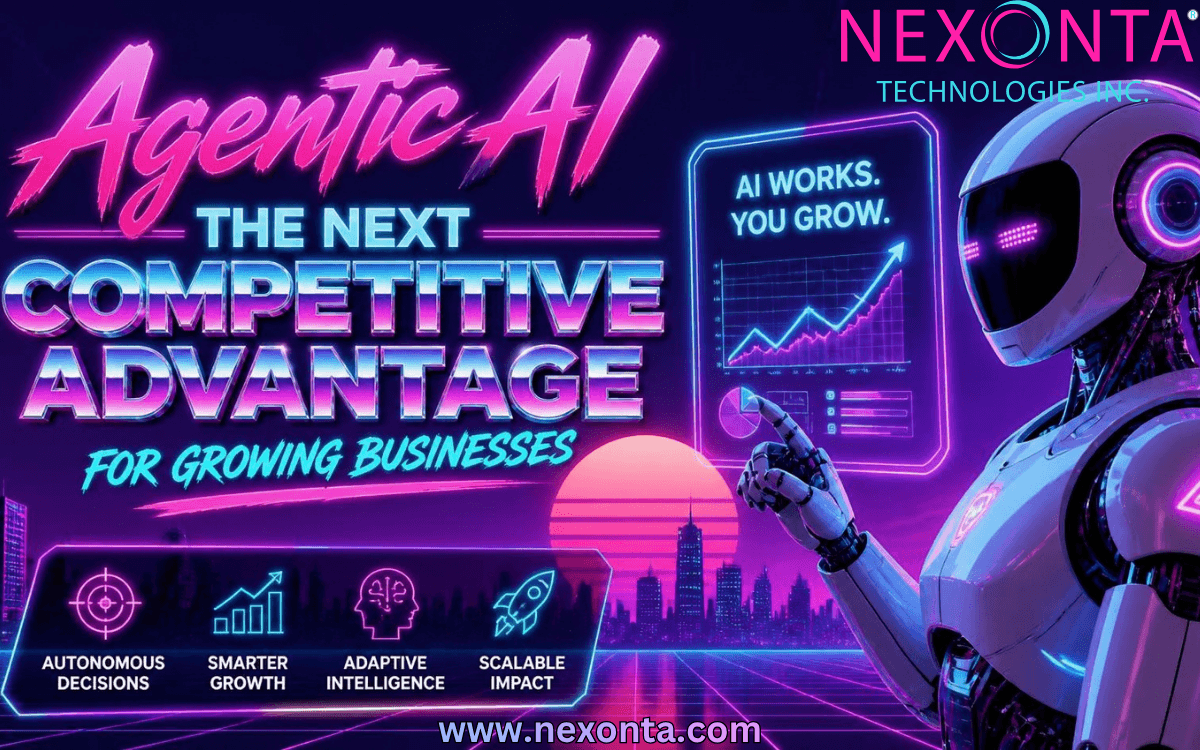
  • Agentic AI: The Next Competitive Advantage for Growing Businesses

    Agentic AI: The Next Competitive Advantage for Growing Businesses

    Agentic AI is changing the way businesses think about growth, productivity, sales, marketing, and scale. At Nexonta Technologies, we believe this is more than another technology trend. It represents a major shift in how organizations will get work done and compete in the years ahead.

    The question is no longer whether AI will become part of business.

    The bigger question is how deeply AI will become part of your business.

    AI Has Already Changed the Game

    Think about how quickly generative AI changed the way we work.

    A few years ago, if you wanted to write a research paper, you might spend hours searching for information, organizing your thoughts and writing everything yourself.

    Today, you can use a tool like ChatGPT to help research, organize, draft and refine that same work in a fraction of the time.

    That does not mean the human becomes unnecessary.

    It means the human has a much more powerful tool.

    Now imagine taking that idea much further.

    Instead of AI simply helping you complete a task, Agentic AI can help manage a series of tasks, make decisions within defined boundaries, interact with systems and move work forward.

    That is where things start to get very interesting for businesses.

    What Is Agentic AI?

    Traditional software usually waits for you to tell it what to do.

    Generative AI can respond to your questions and requests.

    Agentic AI takes another step forward.

    It is designed to work toward a goal. Depending on how it is built and governed, an AI agent can plan steps, use tools, interact with business systems and carry out parts of a workflow with less human intervention.

    In simple terms:

    Generative AI helps you do the work.

    Agentic AI can help move the work forward.

    That difference could have a major impact on how businesses operate.

    The Race Has Started

    This is where business leaders need to start paying attention.

    Organizations are already exploring and scaling AI agents across areas such as technology, knowledge management, software development, marketing, sales and operations. Recent 2026 research from McKinsey shows that larger organizations are moving from AI experimentation toward scaling AI agents, although adoption is still far from universal.

    That creates an interesting situation.

    Not every competitor is using Agentic AI.

    But some are.

    And the gap between experimenting with AI and actually building it into business processes could become increasingly important.

    The competitive advantage may not come from simply having access to AI.

    It may come from knowing how to use it as part of the way your business operates.

    What Could Agentic AI Mean for Your Business?

    Every organization is different. That means there is no single Agentic AI strategy that works for everyone.

    But there are some areas where businesses are already looking at opportunities.

    Sales

    AI agents can help organize information, support lead research, assist with follow-up processes and help sales teams spend more time on meaningful conversations.

    Marketing

    Marketing teams can use AI to support research, content development, campaign workflows, customer insights and other repetitive processes.

    Customer Service

    AI agents can help manage routine requests, find information and support customers across different stages of the customer journey.

    Operations

    Businesses can look at repetitive workflows and identify where AI could help coordinate tasks, move information between systems or reduce manual work.

    Business Intelligence

    AI can help teams work with large amounts of information and surface useful insights faster.

    The goal is not to replace every person or automate everything.

    The goal is to identify where intelligent technology can help your people work smarter and your business move faster.

    This Is Bigger Than Another AI Tool

    This is an important distinction.

    Adding another AI tool to your technology stack is not necessarily an AI strategy.

    Agentic AI becomes much more interesting when it connects with the way your business actually operates.

    That means looking at your workflows.

    Your data.

    Your systems.

    Your customers.

    Your sales process.

    Your marketing.

    Your internal operations.

    And then asking a simple question:

    Where could AI create meaningful leverage?

    That is a much better starting point than simply asking, “What AI tool should we buy?”

    Big Tech Is Moving Fast

    There is another reality businesses need to recognize.

    The biggest technology companies are investing heavily in AI infrastructure, agents, orchestration and enterprise applications.

    The technology is evolving quickly.

    And the rules of the AI ecosystem are being shaped by companies with enormous resources, data, infrastructure and development teams.

    That creates both an opportunity and a challenge for smaller and mid-sized organizations.

    You may not have the resources of a global technology company.

    But you do not necessarily need them.

    The opportunity is to understand what these technologies can do and identify where they can create value inside your own organization.

    You Don’t Need to Transform Everything at Once

    One of the biggest mistakes a business can make is thinking that adopting Agentic AI means changing everything overnight.

    It doesn’t.

    A smarter approach is to start with the business.

    Look at where your team spends time.

    Look for repetitive processes.

    Identify bottlenecks.

    Find areas where employees are spending valuable time on work that could potentially be assisted or coordinated by AI.

    Then build from there.

    This approach also gives organizations an opportunity to put the right governance and controls in place. As AI agents become more autonomous, oversight, security, data quality and accountability become increasingly important.

    The Real Question Is: Where Do You Want to Go?

    At Nexonta Technologies, we see Agentic AI as an important part of the next generation of sales and marketing technology.

    Our focus is on helping organizations understand where technology can create real business value.

    Because technology should not be adopted simply because it is new.

    It should have a purpose.

    It should solve problems.

    It should help people.

    And ultimately, it should help businesses grow and scale.

    The organizations that take the time to understand Agentic AI now will be in a much better position to make informed decisions as the technology continues to develop.

    You don’t have to know exactly what your AI strategy should look like today.

    But it is worth asking the question.

    What happens if your competitors figure it out before you do?

    The AI Race Isn’t About Being First. It’s About Being Ready.

    The AI landscape is moving quickly.

    You do not need to chase every new tool.

    You do need to understand what is changing.

    Agentic AI represents a shift from AI that simply assists people toward AI that can potentially participate more directly in business workflows.

    For small, medium and large organizations, that creates a new conversation about productivity, growth and scale.

    And that conversation is already happening.

    Ready to Explore What Agentic AI Could Mean for Your Business?

    Nexonta Technologies helps organizations explore the next generation of sales and marketing technology, including opportunities created by Agentic AI.

    Let’s look at where AI could make a meaningful difference in your business — and where it may not.

    Start the conversation with Nexonta Technologies and discover where Agentic AI could fit into your growth strategy.

  • AI Can Build the Marketing Plan. Humans Still Have to Drive

    AI Can Build the Marketing Plan. Humans Still Have to Drive

    AI marketing agencies are entering a new chapter. Tools like ChatGPT and Claude have changed the way businesses think about marketing. Today, an organization can describe its business, ideal customer and goals to an AI tool and, within seconds, receive a surprisingly detailed marketing plan.

    That is a big change.

    For years, businesses often relied on marketing agencies to tell them what they needed to do. They would sit down with an agency, explain their business and wait for a strategy to be developed.

    Now, companies can get a first look at that strategy themselves.

    So, does that mean marketing agencies are becoming obsolete?

    Not at all.

    It means their role is changing.

    And in many ways, AI may be taking a backseat while humans get back in the driver’s seat.

    Marketing Has Changed. Again.

    Marketing has always evolved with technology.

    Print advertising changed the game. Then came radio and television. The internet transformed everything again. Search engines created SEO. Social media changed how brands communicate with customers.

    Then AI arrived.

    Large language models like ChatGPT and Claude have taken things another step forward.

    A business owner can now ask:

    “How should I market my business to women between 45 and 60 who are interested in improving their health?”

    Within seconds, AI can suggest target audiences, content ideas, advertising channels, messaging, budgets, timelines and even campaign concepts.

    That is incredibly powerful.

    It also changes the conversation between businesses and marketing agencies.

    The End of One-Size-Fits-All Marketing

    One of the biggest changes AI has brought to marketing is access to information.

    Businesses no longer have to accept a generic marketing package simply because that is what an agency sells.

    The old approach might have looked something like this:

    Website + social media + Google Ads + SEO + email marketing = marketing plan.

    But what if that isn’t what the business actually needs?

    AI makes it easier to ask better questions.

    What is the company’s ideal customer?

    Where does that customer spend time?

    What problem is the company solving?

    How competitive is the market?

    How much can the business realistically spend?

    What should happen first?

    How long might it take to see results?

    These questions can now be explored before a business ever signs a marketing contract.

    That is a good thing.

    It forces everyone to become more thoughtful about marketing.

    AI Can Create the Plan. But Can It Execute It?

    This is where things get interesting.

    AI can produce a marketing strategy in seconds.

    But a strategy sitting inside a document doesn’t generate leads.

    Someone still has to build the website.

    Someone has to optimize the pages.

    Someone has to create the content.

    Someone has to set up campaigns.

    Someone has to analyze what is working.

    Someone has to make changes when something isn’t working.

    And most importantly, someone has to understand the business behind the numbers.

    This is where humans still matter.

    AI can tell you that your company should target a particular audience.

    A human has to understand whether that audience actually makes sense for the business.

    AI can recommend a content strategy.

    A human has to know whether the content sounds like the company or like something generated by a machine.

    AI can suggest keywords.

    A human still needs to understand the customer’s intent behind those searches.

    The difference is important.

    AI can help create the roadmap. Humans still have to drive the car.

    The Marketing Agency Is Becoming the Execution Partner

    This may be one of the biggest shifts we see over the next few years.

    Marketing agencies may spend less time selling businesses on what marketing they need and more time executing the marketing strategy those businesses have already researched.

    That doesn’t make agencies less valuable.

    It changes where their value comes from.

    Instead of saying:

    “Trust us. We know what you need.”

    The conversation becomes:

    “You know where you want to go. Let’s build the right system to get you there.”

    That is a very different relationship.

    And frankly, it could be a better one.

    Businesses become more informed.

    Agencies become more accountable.

    And marketing becomes more focused on execution and measurable results.

    AI Makes Marketing Budgets Easier to Understand

    Another major advantage is budgeting.

    Marketing has traditionally been difficult for businesses to forecast.

    A company might ask:

    “How much should we spend on marketing?”

    The answer has always depended on the business, the market, the competition, the customer and the goals.

    AI can’t predict the future.

    But it can help businesses build reasonable scenarios.

    A company can explore different approaches and ask questions such as:

    * What could a $2,000 monthly marketing budget support?
    * What would a $5,000 budget allow us to do?
    * Which activities should come first?
    * What could we realistically accomplish in six months?
    * Which channels should we test before investing more heavily?

    That information can make marketing conversations much more productive.

    Instead of starting with a blank sheet of paper, businesses can start with a working hypothesis.

    Then the humans take over.

    This Is Where ElevexSEO Fits In

    At ElevexSEO, we see this shift as an opportunity.

    We don’t believe businesses should have to choose between AI and human marketing expertise.

    They should use both.

    AI can help businesses research opportunities, organize ideas, identify potential strategies and make better decisions.

    Then experienced marketing professionals can take those ideas and turn them into an actual workflow.

    That could include SEO, content creation, website optimization, keyword targeting, technical improvements and ongoing performance analysis.

    The goal isn’t to replace the human.

    The goal is to give the human better tools.

    And that is where AI becomes really useful.

    The Future Isn’t AI vs. Humans

    There has been a lot of discussion about whether AI will replace marketing professionals.

    We think that is the wrong question.

    The better question is:

    How can humans use AI to become better marketers?

    The businesses that figure this out will have an advantage.

    They won’t blindly hand their marketing over to AI.

    They also won’t ignore it.

    They will use AI to research faster, think through possibilities and build better strategies.

    Then they will rely on people to bring those strategies to life.

    That is the balance.

    AI provides speed.

    Humans provide judgment.

    AI provides ideas.

    Humans provide context.

    AI can process enormous amounts of information.

    Humans understand relationships, emotions, nuance and the real-world challenges of running a business.

    Put those things together and marketing becomes much more powerful.

    Marketing Agencies Aren’t Going Away. Their Role Is Evolving.

    The marketing agency of the future may look very different from the agency of the past.

    Businesses will be more informed.

    AI will handle more of the research and planning.

    Marketing teams will have better data.

    And agencies will increasingly become execution partners, technology partners and optimization partners.

    That isn’t a step backward.

    It may actually be a step forward.

    The days of paying for a generic marketing package and hoping it works are slowly disappearing.

    Businesses want to know what they are doing, why they are doing it and what they can realistically expect.

    AI is helping make that possible.

    But someone still needs to turn the plan into action.

    That’s where humans come back into the driver’s seat.

    Ready to Put AI to Work for Your Marketing?

    You don’t have to figure out the future of marketing alone.

    At ElevexSEO, we combine AI-powered tools with human marketing expertise to help businesses turn ideas and strategies into real SEO and digital marketing workflows.

    If you’ve already used ChatGPT or another AI tool to explore your marketing options, that’s a great starting point.

    Now let’s turn those ideas into action.

    Want to see what your marketing strategy could look like?

    Talk to ElevexSEO today and let’s build a marketing plan that makes sense for your business, your budget and your ideal customer.

  • AI for Solopreneurs: Finding Your Business Voice in a Changing Economy

    AI for Solopreneurs: Finding Your Business Voice in a Changing Economy

    The global economy has changed dramatically, but one thing has stayed the same: AI for solopreneurs still comes down to something very human. People like doing business with people they know, trust, and relate to. That is why finding your business voice is so important, especially when you are just starting out.

    And this is where artificial intelligence can become a surprisingly valuable business partner.

    Not because AI should replace you.

    It shouldn’t.

    Instead, think of it as a tool that can help you find your direction, organize your thoughts, and work through some of the growing pains that come with starting a business.

    The Fundamentals of Business Have Not Changed

    Technology changes. Markets change. Consumer habits change.

    The tools we use to run businesses today would probably look completely different to a business owner from 20 years ago.

    But the basic fundamentals are still there.

    People want to do business with people they trust.

    They want to understand what you offer. They want to know why you are different. And they want to feel like there is a real person behind the business.

    This is especially important for the solopreneur.

    When you are running a business on your own, you are often the salesperson, marketer, customer service representative, strategist and content creator all at once.

    That’s a lot of hats to wear.

    AI can help take some of that pressure off.

    Your AI Assistant Can Help You Find Your Voice

    One of the biggest challenges when starting a business isn’t always knowing what you sell.

    It’s figuring out how to talk about it.

    You may understand your product or service perfectly. But when you sit down to write a website page, social media post or email, suddenly everything feels complicated.

    What should you say?

    How should you say it?

    Does it sound professional enough?

    Does it sound like you?

    This is where tools such as ChatGPT and Claude can be useful.

    You can have a conversation with the AI about your business. Explain what you are trying to accomplish. Talk about your customers. Share your ideas. Explain what you like and what you don’t like.

    Then ask it to help you organize those thoughts.

    The more you use an AI model as part of your regular workflow, the more useful the conversations can become. You can give it feedback and direction. You can tell it when something doesn’t sound like you.

    Over time, you can build a much clearer picture of your business voice and the type of communication you want to put into the world.

    That doesn’t mean AI becomes your voice.

    You are still the voice.

    AI simply gives you another set of tools to help bring that voice into focus.

    AI Can Help You Through the Growing Pains

    Starting a business can be overwhelming.

    There are websites to build. Content to create. Emails to write. Customers to find. Processes to develop. Social media to manage.

    And then there are all the questions you didn’t even know you were going to have.

    This is one of the areas where AI can be incredibly helpful.

    You can use it to brainstorm ideas, create outlines, explain unfamiliar concepts, organize information, prepare questions for professionals and help you think through different options.

    It can even help you prepare before you sit down with an accountant, lawyer or other professional.

    That preparation can be valuable.

    Instead of walking into a meeting saying, “I don’t really know what I need,” you can arrive with a list of questions and a better understanding of the issues you want to discuss.

    That can make your professional consultations much more productive.

    Use AI Before You Spend Thousands on Answers

    There is another potential benefit for a new business owner.

    Professional advice can be expensive.

    And it should be.

    Accountants, lawyers and other licensed professionals bring specialized knowledge and experience to the table. There are times when you absolutely need that expertise.

    But you may not need to pay a professional to explain every basic question that comes up during the early stages of your business.

    AI can help you do some of the preliminary work.

    For example, you might use AI to help you understand the difference between different business structures, create a list of questions for your accountant, organize your expenses or explain terminology you don’t understand.

    Then you can take that information to the appropriate professional and ask better questions.

    That’s where AI can become a money-saving tool.

    There is an important distinction, though.

    AI tools are not a replacement for licensed accounting, legal or tax advice. Their answers can also be wrong, incomplete or based on information that needs to be verified.

    When the stakes are high, get professional advice.

    The goal isn’t to replace the professional.

    The goal is to make better use of your time with them.

    Think of AI as Your Business Sounding Board

    Perhaps one of the most useful ways to use AI is simply as a sounding board.

    Have an idea?

    Talk it through.

    Not sure if your website message makes sense?

    Ask AI to look at it from a customer’s perspective.

    Writing an email?

    Ask for feedback.

    Trying to figure out your ideal customer?

    Start a conversation.

    Have five different ideas and no idea which one to pursue?

    Talk through the pros and cons.

    Sometimes, simply putting your thoughts into words helps you understand what you actually want to do.

    AI can help with that process.

    But don’t forget the most important part.

    You make the decisions.

    AI can give you ideas. It can help you organize information. It can challenge your thinking and give you different perspectives.

    But it doesn’t know your business the way you do.

    It doesn’t know your customers the way you do.

    And it doesn’t have your personal experience.

    That’s your advantage.

    Don’t Try to Sound Like Everyone Else

    This is probably one of the biggest lessons for anyone using AI to create content.

    Don’t ask AI to make you sound like a giant corporation if you are a one-person business.

    Your personality is an asset.

    If you’re friendly, be friendly.

    If you’re direct, be direct.

    If you have a sense of humour, let some of that personality show.

    People don’t necessarily want another perfectly polished corporate message.

    They want to know who they are dealing with.

    That’s why your business voice matters.

    AI can help you refine that voice, but it shouldn’t erase it.

    Find an AI Tool You Feel Comfortable Using

    If you are a solopreneur or thinking about starting a business, I would suggest finding an AI platform that you feel comfortable using on a regular basis.

    It doesn’t have to be complicated.

    Start with the questions you already have.

    Use it to brainstorm.

    Use it to learn.

    Use it to organize your ideas.

    Use it to prepare for conversations with professionals.

    And most importantly, give it feedback.

    Tell it what you like.

    Tell it what you don’t like.

    Tell it when something doesn’t sound like you.

    The more intentionally you use your AI assistant, the more valuable it can become as part of your daily business routine.

    AI Isn’t the Business. You Are.

    There is a lot of excitement around artificial intelligence right now.

    And there should be.

    The technology is changing how people work, market businesses and solve problems.

    But it’s important not to lose sight of the bigger picture.

    Successful businesses are still built around people.

    Relationships still matter.

    Trust still matters.

    Good communication still matters.

    And knowing who you are as a business still matters.

    AI can help you get there faster.

    It can help you work through questions, organize your ideas and reduce some of the friction that comes with starting something new.

    But your experience, personality and perspective are what make your business different.

    Use AI as your assistant, not your replacement.

    That may be one of the smartest ways for a new solopreneur to navigate today’s changing business world.

    Ready to Make AI Part of Your Business?

    If you’re building a business on your own, you don’t have to figure everything out from scratch.

    Start using AI as your everyday business sounding board. Ask questions, test ideas, organize your thoughts and use it to prepare before making important decisions.

    The technology is already available. The next step is learning how to make it work for you.

    Start today. Choose an AI assistant you feel comfortable with, have your first conversation about your business, and begin building your business voice one conversation at a time.

  • SEO Has Changed: Why Human Strategy Still Matters in the Age of AI

    SEO Has Changed: Why Human Strategy Still Matters in the Age of AI

    SEO has changed. The way companies approach marketing today looks very different from just a few years ago. Artificial intelligence, automation, and data-driven tools have completely changed how businesses create campaigns, manage content, and reach customers.

    But there is one important lesson many companies are discovering:

    Technology can make marketing faster, but it cannot replace human thinking.

    For years, businesses relied heavily on automated campaigns. If a company had a strong reputation, loyal customers, and a proven track record, it was often enough to create ads, launch campaigns, and let the system do the rest.

    That approach worked — until the world changed.

    Over the past five years, businesses have faced more uncertainty, changing customer expectations, increased competition, and a much noisier online environment.

    A strong history still matters.

    But today, trust needs to be earned every single day.

    The Rise of AI in Marketing

    There is no question that AI has transformed marketing.

    Businesses can now create content faster, analyze customer behaviour, automate workflows, and improve campaign performance with tools that were impossible to imagine a decade ago.

    AI can help with:

    * Content ideas
    * Keyword research
    * Data analysis
    * Customer insights
    * Campaign optimization
    * Marketing automation

    These tools are incredibly valuable.

    However, there is one thing AI cannot create on its own:

    A genuine connection with your audience.

    That still requires people.

    AI Is a Tool, Not a Strategy

    One of the biggest mistakes businesses are making today is assuming AI can replace the entire marketing process.

    It cannot.

    AI can help improve your message, but it cannot fix a weak foundation.

    Think about it this way:

    If your original marketing message is unclear, generic, or disconnected from your customers, AI will simply help you create a better version of the wrong message.

    The result?

    A polished campaign that still does not connect.

    The foundation always comes first.

    You need to understand:

    * Who your customers are
    * What problems they are trying to solve
    * Why they should trust your business
    * What makes your solution different

    Once that foundation is strong, AI becomes much more powerful.

    The Human Element Matters More Than Ever

    Today’s customers are smarter.

    They recognize when content feels robotic. They notice when a company is simply pushing a product instead of providing value.

    People want to work with businesses they understand and trust.

    That means your marketing needs:

    A real voice.

    A clear message.

    A reason for customers to care.

    The best campaigns combine technology with human experience.

    AI can help you create faster.

    But humans create meaning.

    Great Marketing Still Requires Work

    There is a common misconception that AI makes marketing effortless.

    The reality is different.

    You still need to do the work.

    You need to write the first draft.

    You need to understand your audience.

    You need to review the message.

    You need to add your company’s personality and experience.

    Yes, AI can improve your writing. It can help organize ideas, suggest improvements, and make your content stronger.

    But the best results happen when AI supports your expertise — not when it replaces it.

    SEO Has Changed Because People Have Changed

    Search engines have evolved because customers have evolved.

    People are no longer just searching for keywords.

    They are looking for answers.

    They want helpful information. They want expertise. They want businesses that understand their needs.

    This means successful SEO today is not just about adding keywords to a page.

    It is about creating valuable content that helps real people.

    The future of SEO belongs to businesses that can combine:

    * Strong strategy
    * Helpful content
    * AI-powered tools
    * Human creativity
    * Real customer understanding

    The Future of Marketing Is Human + AI

    The companies that succeed moving forward will not be the ones that rely only on automation.

    They will be the ones that know how to use AI as a competitive advantage while keeping the human connection at the centre.

    AI can help you move faster.

    But your experience, knowledge, and voice are what make your brand different.

    The question is no longer:

    “Can AI create my marketing?”

    The better question is:

    “How can I use AI to make my marketing better?”

    That is where the real opportunity is.

    Ready to Build Smarter Marketing Campaigns?

    At Nexonta Technologies, we help businesses combine powerful technology with real marketing strategy.

    From SEO and content creation to AI-powered solutions, we help companies build campaigns that connect with customers and deliver measurable results.

    AI is changing marketing. Make sure your strategy changes with it.

    Contact Nexonta Technologies today and discover how AI-powered marketing can help your business grow.


  • The New Normal: People Only Buy It If It Fits Their Life

    The New Normal: People Only Buy It If It Fits Their Life

    Remember the days when people bought things just to keep up with the neighbors? Authentic marketing is replacing those old ideas because today’s consumers only buy products that genuinely fit their lives. The new normal isn’t about impressing others. It’s about making choices that feel right for you.

    Is it just me, or have you noticed this shift too?

    For years, marketers relied on exclusivity, luxury, and the fear of missing out. If everyone else had it, people wanted it too. Owning the latest gadget, the biggest television, or the newest car became a way to measure success.

    Today, that mindset is changing.

    People are asking a different question before they make a purchase.

    “Does this actually fit my life?”

    That one question has changed everything.

    We Are No Longer Keeping Up with the Joneses

    The phrase “keeping up with the Joneses” once described how people measured themselves against others. Bigger homes, expensive vacations, luxury brands, and designer labels became symbols of success.

    Now, many people are walking away from that race.

    Instead of buying products to impress someone else, they are buying products that bring them happiness, solve real problems, or support their personal goals.

    That is a much healthier way to make decisions.

    Confidence Is the New Status Symbol

    Today’s consumers are more confident in their own choices.

    They don’t need approval from strangers.

    They don’t care as much about fitting into a social category.

    Whether someone drives a modest car, shops at a local market, wears affordable clothing, or chooses simple experiences over expensive possessions, the decision is often based on personal satisfaction instead of public opinion.

    Confidence has become more valuable than appearances.

    Value Beats Hype Every Time

    As marketers, this changes the way we communicate.

    Customers are becoming incredibly good at spotting empty promises.

    Flashy advertising and exaggerated claims don’t carry the same weight they once did.

    People want honesty.

    They want transparency.

    Most of all, they want value.

    If your product genuinely helps someone, improves their day, or solves a problem, that’s what deserves the spotlight.

    Real value creates lasting customers.

    Authenticity Builds Trust

    Authenticity has become one of the most powerful marketing tools available.

    Consumers want to know who they’re buying from.

    They appreciate businesses that admit they aren’t perfect.

    They respect brands that stay true to their mission instead of chasing every new trend.

    Trust isn’t built overnight.

    It’s earned through consistent actions, honest communication, and delivering what you promise.

    When customers trust your brand, they come back.

    Even better, they tell others.

    Marketing Has Become More Human

    The best marketing today feels less like selling and more like helping.

    Instead of asking, “How do we convince people to buy?”

    Successful businesses ask, “How can we improve someone’s life?”

    That simple shift changes everything.

    People connect with stories.

    They connect with purpose.

    They connect with businesses that understand their challenges and offer meaningful solutions.

    The Future Belongs to Brands That Fit

    Consumers aren’t necessarily buying less.

    They’re buying smarter.

    Every purchase has to earn its place.

    Does it save time?

    Does it improve health?

    Does it reduce stress?

    Does it create happiness?

    Does it fit the lifestyle they want to build?

    If the answer is yes, they’re much more likely to buy.

    If not, they’ll move on without a second thought.

    The new normal isn’t about keeping up with anyone else.

    It’s about building a life that feels authentic.

    For businesses, this is actually good news.

    You no longer need the biggest marketing budget or the loudest advertising campaign.

    You simply need to offer real value, communicate honestly, and build trust.

    When your product truly fits someone’s life, selling becomes much easier.

    Because in today’s world, people don’t buy to impress others.

    They buy because it simply fits.

    Are you building a business or promoting a product? Start by asking one simple question: How does this genuinely improve someone’s life? When you lead with authenticity, value, and trust, your customers will notice. If you’re ready to grow your business with honest marketing that connects with today’s consumers, start putting people before promotions. The results may surprise you.

  • Human Connection in Marketing: The Secret That AI Can’t Replace

    Human Connection in Marketing: The Secret That AI Can’t Replace

    The future of marketing is changing rapidly. Artificial intelligence is becoming part of almost every business strategy. Yet despite all the advances in technology, human connection in marketing remains one of the most powerful ways to reach and engage an audience.

    Businesses today have access to more data than ever before. AI can help analyze customer behavior, automate tasks, and create content at incredible speed. These tools are valuable. They can save time and improve efficiency.

    But there is one thing technology still cannot fully replace: genuine human connection.

    The Marketing World Is Evolving

    There is no question that AI is transforming marketing.

    Companies can now automate email campaigns, generate content, analyze customer trends, and even predict future buying behavior. Tasks that once took weeks can now be completed in hours.

    For many organizations, this is a game changer.

    However, as more companies adopt the same technologies, something interesting is happening.

    People are becoming overwhelmed by automation.

    Consumers are seeing more content, more messages, and more advertisements than ever before. As a result, they are becoming better at filtering out anything that feels impersonal or inauthentic.

    This creates a major opportunity for businesses willing to focus on something simple: being human.

    Social Media Is Still About People

    Many people assume social media is all about algorithms.

    While algorithms certainly play a role, they are designed to reward one thing above all else: engagement.

    And engagement happens when people connect with people.

    Recently, we attended a webinar focused on marketing through LinkedIn. As our team plans to become more active on the platform, we wanted to better understand how the platform works and what drives visibility.

    One of the biggest takeaways surprised us.

    LinkedIn tracks countless data points. It analyzes interactions, engagement patterns, content performance, and user behavior.

    Yet despite all of this sophisticated technology, one clear message stood out.

    Human connection continues to reign supreme.

    The platform rewards meaningful conversations, authentic interactions, and genuine engagement between people.

    In other words, the algorithm is looking for signs that humans are connecting with other humans.

    There Is No Secret Sauce

    Many marketers spend years searching for the perfect strategy.

    They look for hacks.

    They chase trends.

    They try to outsmart algorithms.

    The reality is often much simpler.

    People want to do business with people they know, like, and trust.

    They want authenticity.

    They want honesty.

    They want real conversations.

    The businesses that consistently succeed are often the ones that focus less on gaming the system and more on building relationships.

    That means responding to comments.

    It means asking thoughtful questions.

    It means sharing experiences.

    It means listening as much as talking.

    Most importantly, it means showing up as a real person rather than a faceless company.

    Why Human Connection Matters More Than Ever

    Ironically, the more technology advances, the more valuable human interaction becomes.

    As AI-generated content becomes increasingly common, authenticity becomes easier to recognize.

    People can tell when a message feels genuine.

    They can also tell when it feels automated.

    This does not mean businesses should avoid AI.

    Quite the opposite.

    AI can be an incredible tool for improving productivity and efficiency.

    The key is understanding its role.

    AI should support human relationships, not replace them.

    Use technology to save time.

    Use technology to improve processes.

    But never lose sight of the human being on the other side of the screen.

    The Future Belongs to Businesses That Connect

    The companies that will thrive in the coming years will not necessarily be the ones with the most advanced technology.

    They will be the ones that combine technology with authentic communication.

    They will use AI to work smarter while continuing to build trust, relationships, and community.

    Technology may continue to evolve at lightning speed.

    Algorithms will change.

    Platforms will change.

    Marketing tactics will change.

    But one thing is unlikely to change anytime soon.

    People will always want to connect with people.

    Final Thoughts

    If there is one lesson we took away from our recent LinkedIn marketing webinar, it is this:

    There is no secret sauce.

    There is no magic formula.

    There is no shortcut around building real relationships.

    Whether you are posting on LinkedIn, creating content, running a business, or building a brand, the winning strategy remains remarkably simple.

    Be helpful.

    Be authentic.

    Be consistent.

    Most importantly, connect with people on a human level.

    Because in a world increasingly powered by AI, human connection may become your greatest competitive advantage.

    Ready to Build Stronger Connections?

    At the end of the day, people do business with people they trust. If you’re looking to grow your brand, increase engagement, and create meaningful relationships with your audience, focus on connection before promotion.

    Start more conversations. Share your story. Engage with your community. The results may surprise you.

    The future of marketing is not just artificial intelligence.

    It’s authentic intelligence powered by genuine human connection.

  • Why Trust Matters More Than Price in Today’s Business World

    Why Trust Matters More Than Price in Today’s Business World

    Let’s be honest — in today’s business landscape, trust in business matters more than ever. In fact, it often matters more than price.

    People don’t just buy products anymore.
    They buy experiences.
    They buy feelings.
    And most importantly — they buy confidence.

    If they don’t trust you, they won’t buy from you. It’s that simple.

    We’re Not Just Comparing Prices Anymore

    There was a time when customers chased the lowest price. That’s no longer the full story.

    Today, people ask different questions:

    * Can I trust this company?
    * Will they deliver what they promise?
    * Will they treat me right if something goes wrong?

    Price still matters — of course it does.
    But trust is what closes the deal.

    People will gladly pay more if they feel safe, respected, and valued.

    Trust Is Your Real Competitive Advantage

    Here’s the truth most businesses overlook:

    Your competitors can copy your pricing.
    They can copy your product.
    They can even copy your marketing.

    But they can’t copy your reputation.

    That’s where trust becomes your biggest asset.

    When customers trust you:

    * They come back
    * They refer others
    * They stop shopping around

    That’s how real businesses grow.

    Social Media Changed Everything

    Social media didn’t just change marketing — it changed accountability.

    Now, every interaction matters.

    One bad experience? It gets shared.
    One great experience? It gets amplified.

    People are watching.
    They’re reading reviews.
    They’re judging your brand before they even talk to you.

    That means your business practices matter more than ever.

    Transparency isn’t optional anymore — it’s expected.

    What Builds Trust Today?

    Trust isn’t built with one big move.
    It’s built in small moments, over time.

    Here’s what actually makes a difference:

    1. Do What You Say You’ll Do

    Sounds simple. But most businesses fail here.

    If you promise something — deliver it.
    If you can’t — communicate early.

    2. Be Easy to Deal With

    People remember how you made them feel.

    Were you responsive?
    Helpful?
    Respectful?

    That sticks.

    3. Own Your Mistakes

    No business is perfect.

    But the best businesses:

    * Admit mistakes quickly
    * Fix them properly
    * Learn from them

    That builds more trust than pretending nothing happened.

    4. Be Consistent

    Trust doesn’t come from one great experience.

    It comes from the same good experience… every time.

    Why People Pay a Premium for Trust

    Let’s flip the perspective.

    Think about the last time you paid more for something.

    Chances are:

    * You trusted the brand
    * You expected a better experience
    * You didn’t want the risk of going cheaper

    That’s exactly how your customers think too.

    When trust is high:

    * Price becomes less sensitive
    * Loyalty increases
    * Your business becomes more stable

    Your Reputation Is Your Real Currency

    At the end of the day, your reputation is what people say about you when you’re not in the room.

    And in today’s digital world — that conversation is happening all the time.

    You’re either building trust…
    Or slowly losing it.

    There’s no neutral.

    Final Thought

    If you focus only on price, you’ll always be competing.

    If you focus on trust, you start leading.

    Because people don’t just want a supplier.

    They want someone they feel good doing business with.

    If you’re serious about growing your business, start here:

    Take a step back and ask yourself:

    * Where can I improve the customer experience?
    * Am I delivering on every promise I make?
    * Would I trust my own business?

    Then take one action today to improve it.

    Because trust isn’t built overnight — but it does start with one decision.

    Start building a business people believe in.

  • Don’t Be Afraid to Pivot: Why Your 2-Year Plan Needs a Reset Every 6 Months

    Don’t Be Afraid to Pivot: Why Your 2-Year Plan Needs a Reset Every 6 Months

    Let’s be honest.
    Business doesn’t move the way it used to.

    What worked two years ago feels outdated.
    What worked six months ago might already feel shaky.
    And what works today? That could change tomorrow.

    This isn’t a failure of planning.
    It’s the reality of the world we’re operating in.

    We’re living through a massive global restructuring.
    Industries are shifting.
    Technology is rewriting the rules.
    Consumer behavior is changing fast.
    And businesses that stay rigid are the ones getting left behind.

    The real skill right now isn’t sticking to the plan.
    It’s knowing when to adjust it.

    The Old Way of Planning Is Too Slow

    Traditional business advice loves long-term certainty.

    Create a five-year plan.
    Lock it in.
    Follow it no matter what.

    That approach worked when the world moved slower.

    Today?
    It’s a liability.

    Markets shift in months, not years.
    Platforms rise and fall overnight.
    Customer expectations evolve constantly.

    If your plan can’t bend, it will eventually break.

    That’s why a two-year plan is still useful — but only if it’s flexible.

    Think of Your Business Like a Ship

    You still need a destination.
    You still need a map.
    But pretending the ocean won’t change is dangerous.

    Winds shift.
    Storms show up unexpectedly.
    New routes open.

    Smart captains don’t panic.
    They adjust the sails.

    The goal stays the same.
    The path changes.

    Business works the same way.

    Pivoting doesn’t mean you’re lost.
    It means you’re paying attention.

    Why You Should Revisit Your Plan Every 6 Months

    Six months is the sweet spot.

    It’s long enough to gather real data.
    But short enough to course-correct before damage is done.

    Every six months, ask yourself:

    * What’s working better than expected?
    * What’s clearly not working anymore?
    * Where are customers paying more attention?
    * What feels harder than it should?
    * What opportunities didn’t exist before?

    This isn’t about tearing everything down.
    It’s about refining.

    Small adjustments early prevent massive overhauls later.

    Pivoting Is a Strength, Not a Weakness

    Some people associate pivoting with failure.

    That mindset is outdated.

    The strongest businesses today pivot often.
    They test.
    They listen.
    They adapt.

    They don’t cling to ideas just because they invested time in them.

    They ask a simple question instead:
    Does this still make sense right now?

    If the answer is no, they move.

    No drama.
    No ego.
    Just smart decision-making.

    Global Restructuring Is Creating New Rules

    We’re not just dealing with market trends.
    We’re dealing with systemic change.

    Remote work.
    AI and automation.
    New buying habits.
    Different definitions of value and trust.

    This isn’t a temporary phase.
    It’s a reset.

    Trying to run today’s business with yesterday’s rules will exhaust you.

    The businesses that thrive are the ones willing to let go of “how it’s always been done” and experiment with what works *now*.

    What Staying Flexible Actually Looks Like

    Flexibility doesn’t mean chaos.

    It means clarity.

    * Clear values, even if tactics change
    * Clear goals, even if timelines shift
    * Clear priorities, even if platforms evolve

    Your core stays steady.
    Your execution adapts.

    That’s the balance.

    You’re not chasing every trend.
    You’re responding to real signals.

    The Path Forward Isn’t Straight — And That’s Okay

    We’re taught to believe success follows a straight line.

    It doesn’t.

    It curves.
    It detours.
    It doubles back.

    The businesses that survive this era aren’t the most stubborn.
    They’re the most responsive.

    They know when to push forward.
    And when to pivot sideways.

    That’s not giving up.
    That’s leadership.

    Final Thought

    If your business feels like it needs adjusting right now, you’re not behind.

    You’re right on time.

    This moment isn’t about perfect plans.
    It’s about staying awake, aware, and willing to change course.

    The path forward isn’t fixed.
    It’s responsive.

    And the sooner you embrace that, the stronger your business becomes.

    If you haven’t reviewed your two-year plan in the last six months, now is the time.
    Step back. Look honestly. Adjust the sails.

    The businesses that win next aren’t afraid to pivot — they expect to.

    If you want help rethinking your strategy, refining your direction, or building a plan that can actually adapt to change, let’s start that conversation today.

    The future belongs to the flexible.

  • 2026 Is Finally Warming Up — Here’s How to Grow Without Overstretching

    2026 Is Finally Warming Up — Here’s How to Grow Without Overstretching

    Let’s be honest.
    2026 didn’t exactly come out of the gate on fire.

    For a lot of businesses, the year started slowly. Budgets were tight. Decisions took longer. Many companies stayed cautious instead of charging ahead.

    But here’s the good news:
    Momentum is starting to build.

    We’re seeing businesses ease back into growth mode. Sales conversations are picking up. Marketing plans are getting dusted off. And companies are once again asking the big question:

    “How do we grow — without blowing the budget?”

    That’s where smart SEO comes in.

    Growth Doesn’t Have to Mean Big Spending

    One of the biggest misconceptions about marketing is that growth requires a massive upfront investment.

    It doesn’t.

    SEO is one of the few strategies that lets you start small, stay in control, and build over time.

    Instead of chasing quick wins that disappear when the ad spend stops, SEO focuses on creating long-term visibility. The kind that keeps working for you day after day.

    Think of it as planting seeds rather than buying fireworks.

    Why SEO Makes Sense Right Now

    As businesses re-enter the sales and marketing cycle, SEO becomes especially powerful.

    Here’s why:

    * Customers are actively searching again
    * Decision-makers are researching before buying
    * Trust matters more than hype
    * Visibility beats volume

    If your business shows up when people are already looking for what you offer, you’re not interrupting them — you’re helping them.

    That’s a much better place to be.

    You Don’t Need to Do Everything at Once

    This is where many businesses get stuck.

    They think SEO means:

    * Rebuilding their entire website
    * Writing hundreds of blog posts
    * Spending thousands every month

    Not true.

    The smartest approach is to start small and build momentum.

    That might look like:

    * Fixing the basics on your website
    * Targeting a few high-intent search terms
    * Creating helpful content instead of generic noise
    * Improving what you already have before adding more

    Small, focused actions add up faster than you think.

    How ElevexSEO Helps You Get Started

    At ElevexSEO, we meet businesses where they are — not where a textbook says they should be.

    We understand that:

    * 2026 is still a recovery year for many
    * Budgets matter
    * Results need to make sense, not just look good on paper

    Our approach is simple:

    * Clear strategy
    * Affordable entry points
    * Steady, measurable growth

    No pressure. No overwhelm. Just progress.

    Ready to Turn Momentum Into Growth?

    You don’t need a massive budget or a complicated strategy to get started with SEO.

    You just need a smart plan and the right partner.

    At ElevexSEO, we help businesses start where they are, focus on what matters, and grow at a pace that makes sense. Whether you’re just easing back into marketing or looking to build steady momentum in 2026, we’ll guide you every step of the way.

    Let’s talk about:

    * Where your website stands today
    * What people are already searching for
    * How to start small and scale affordably

    No pressure. No long-term lock-ins. Just clear direction and real growth.

    Reach out to ElevexSEO today and let’s get your SEO working for you.

  • It’s No Secret: Business Has Changed, But Technology Can Be Your Secret Weapon

    It’s No Secret: Business Has Changed, But Technology Can Be Your Secret Weapon

    It’s no secret that business today looks very different than it did just a few years ago. Processes, customer expectations, and even the way we market ourselves have shifted. And let’s be honest—it’s a lot to keep up with.

    But here’s the good news: you don’t have to navigate this alone. Technology, especially AI, isn’t here to replace you—it’s here to empower you. Smart tools can help you work faster, smarter, and more strategically.

    At ElevexSEO, we specialize in helping businesses like yours harness AI to grow. From streamlining operations to supercharging your marketing efforts, AI can make a real difference.

    Imagine this: instead of spending hours analyzing data, AI can provide insights in minutes. Instead of guessing what your customers want, you can use AI to predict trends and make smarter decisions. This isn’t the future—it’s here now, and it’s ready for you.

    But technology alone isn’t enough. You need the right guidance to integrate it into your business strategy. That’s where we come in. ElevexSEO doesn’t just give you tools; we show you how to use them effectively to position your business for growth.

    Don’t let the pace of change leave you behind. Embrace technology, leverage AI, and take the steps today to set your business up for tomorrow’s success.

    Ready to harness AI for growth? Let ElevexSEO help you get there.

☎ ✉
f 𝕏
error: Content is protected !!