Tag: business efficiency

  • The Friday 4 PM Rule: Finding the High-Friction Tasks AI Agents Should Own First

    The Friday 4 PM Rule: Finding the High-Friction Tasks AI Agents Should Own First

    What if the best place to start with Agentic AI isn’t your biggest business challenge, but the task your team dreads doing every Friday afternoon?

    When exploring AI agents for business, it’s tempting to look for the most impressive opportunities. Business owners often think about automating major processes, transforming customer experiences, or introducing advanced AI technology.

    But there’s another place worth looking.

    Think about Friday afternoon.

    It’s 4 PM. Your team is ready to wrap up the week. Yet someone still needs to reconcile spreadsheets, chase missing invoice information, sort through incoming inquiries, or update records in multiple systems.

    Nobody particularly enjoys these jobs. They’re repetitive, time-consuming, and often frustrating.

    And here’s the interesting part: they could be exactly where your business should start with Agentic AI.

    We call this the Friday 4 PM Rule.

    The idea is simple. Find the tasks your team would be happiest to hand over. Then explore whether an AI agent can take responsibility for handling them.

    Let’s look at how this works.

    Why Start With the Tasks Nobody Wants to Do?

    Most businesses have processes that keep everything moving behind the scenes.

    They aren’t always complicated. In fact, many are surprisingly ordinary.

    For example:

    • Chasing customers for missing invoice details.
    • Matching payments against spreadsheets.
    • Sorting incoming emails and customer inquiries.
    • Updating information across different software platforms.
    • Preparing weekly reports from several data sources.
    • Following up on outstanding tasks or requests.
    • Checking records for missing or inconsistent information.

    Individually, these jobs might only take a few minutes.

    However, those minutes add up.

    More importantly, these tasks interrupt the work people were actually hired to do.

    Your sales team should be building relationships and closing business. Your administrative team should be supporting operations, not spending hours moving information between systems. And your managers should be making decisions, not constantly chasing updates.

    The problem isn’t that these tasks don’t matter. They do.

    The problem is that they consume valuable time without necessarily creating additional value for your business.

    That’s why they’re such good candidates for automation.

    The Friday 4 PM Test: Five Questions to Find Your First AI Project

    Before investing in AI technology, take a closer look at how work actually gets done inside your business.

    You don’t need a complicated assessment to get started.

    Begin by asking five simple questions.

    1. What Does Your Team Complain About Doing?

    This is probably the easiest place to start.

    Ask your employees which tasks they would gladly hand over if they could.

    Pay attention to the answers.

    You might hear about repetitive data entry, endless follow-up emails, checking spreadsheets, or sorting through customer requests.

    These frustrations are useful information.

    Your employees know where the bottlenecks are because they deal with them every day.

    2. Which Tasks Happen Over and Over Again?

    Repetition is another important clue.

    If someone performs the same process dozens of times every week, there’s a good chance an AI agent could help.

    For example, imagine your business receives 100 customer inquiries every week.

    Someone has to read each inquiry, identify what the customer needs, determine where it belongs, and send it to the right person.

    An AI agent could review incoming messages, categorize them, extract important details, and route them to the appropriate team member.

    Instead of manually sorting every inquiry, your employee can focus on responding to customers and handling more important conversations.

    3. Where Does Information Get Stuck?

    Many business delays happen because information is scattered across different systems.

    An invoice might be missing a purchase order number. A customer inquiry might be sitting in an inbox. A spreadsheet might contain information that hasn’t been entered into the CRM.

    Someone has to find the missing information, contact the right person, and make sure everything gets updated.

    These small delays can create surprisingly large administrative bottlenecks.

    An AI agent can help identify missing information, request clarification, update connected systems, and flag anything that needs human attention.

    4. How Much Time Does the Task Actually Consume?

    This is where things get interesting.

    Don’t just look at how long one task takes. Look at how often it happens and how many people are involved.

    Consider this example:

    A team of 10 employees spends 30 minutes every working day on repetitive administrative tasks.

    That’s:

    • 5 hours per day across the team.
    • 25 hours every week.
    • 1,250 hours every year.

    That’s a lot of time spent on work that may not require someone’s full attention.

    Now imagine redirecting even part of those hours toward customer service, sales, business development, or improving operations.

    The potential value becomes much easier to understand.

    5. Does the Task Need Human Judgment?

    This is an important question.

    Not every repetitive task should be fully automated.

    Some processes require experience, context, approval, or a personal conversation.

    The goal isn’t to remove people from every process. It’s to let AI agents handle the repetitive work while people remain involved where their judgment matters.

    For example, an AI agent might prepare an invoice, identify missing information, and send a reminder.

    However, if there’s a billing dispute or an unusual customer request, it can flag the issue for an employee to review.

    That’s a much smarter approach than trying to automate everything.

    Not All Automation Is the Same: Where Agentic AI Makes a Difference

    You might be wondering how Agentic AI differs from traditional automation.

    Traditional automation generally follows predefined rules.

    If something happens, the system performs a specific action.

    Agentic AI takes things further.

    An AI agent can work toward a defined goal, gather information, make decisions within its assigned boundaries, interact with connected systems, and complete multiple steps in a process.

    For example, let’s look at a common administrative problem.

    The old way:

    1. An employee receives an invoice.
    2. They check the details.
    3. They look for missing information.
    4. They email the customer.
    5. They wait for a response.
    6. They update the spreadsheet.
    7. They notify the appropriate person.

    The Agentic AI approach:

    1. The AI agent reviews the incoming invoice.
    2. It checks the required information.
    3. It identifies missing details.
    4. It sends an appropriate request for clarification.
    5. It updates the relevant records when information is received.
    6. It notifies the employee when the process is complete or requires attention.

    Instead of someone managing every step, the AI agent coordinates much of the workflow.

    Of course, the agent needs appropriate access, clear instructions, safeguards, and defined approval limits.

    But the opportunity is significant.

    You’re not simply automating one action. You’re improving how an entire process gets completed.

    How to Choose Your First Agentic AI Project

    Here’s where we recommend keeping things simple.

    Don’t start with a massive transformation project.

    Start with one process that is repetitive, time-consuming, and relatively straightforward to measure.

    A useful starting framework is to score each potential project against four criteria:

    1. Frequency: How often does this task happen?

    2. Time: How many employee hours does it consume?

    3. Friction: How frustrating or disruptive is it for the people doing it?

    4. Feasibility: Can the task be handled using available information, connected systems, and clearly defined rules?

    The strongest first project is usually one that scores well across all four areas.

    Here’s an example:

    Potential AI projectFrequencyBusiness opportunity
    Sorting incoming inquiriesHighFaster response and better lead routing
    Chasing missing invoice detailsHighLess administrative follow-up
    Updating CRM recordsHighCleaner customer information
    Preparing weekly reportsMediumLess manual data gathering
    Handling unusual customer disputesVariableHuman judgment remains important

    The point isn’t to automate everything at once.

    It’s to identify one meaningful opportunity, implement it properly, and measure the results.

    Once your team sees the difference, you have a much stronger foundation for the next project.

    What Could Your Business Gain?

    Let’s return to our Friday afternoon example.

    Imagine your employees no longer have to spend the last few hours of the week reconciling spreadsheets, chasing missing details, or sorting through routine inquiries.

    Instead, those processes are being handled by AI agents working within your business systems.

    What changes?

    Your employees have more time for meaningful work.

    Customers can receive faster responses.

    Information becomes easier to track.

    Managers spend less time chasing updates.

    And your business can potentially handle more activity without adding the same level of administrative workload.

    This is where Agentic AI becomes more than an interesting technology.

    It becomes a practical business tool.

    The real value isn’t simply that AI can complete tasks. It’s that your people can spend more time doing the work that moves your business forward.

    Start With the Work Your Team Wants to Leave Behind

    One of the biggest mistakes businesses can make when exploring AI is starting with the technology instead of the problem.

    It’s easy to get caught up in what AI can do.

    But a better question is:

    Where is your business losing time, and what would happen if that time could be put to better use?

    Look at the tasks your team dreads. Look at the processes that slow everyone down. Look at the administrative work that keeps getting pushed to Friday afternoon.

    Those are your clues.

    You don’t need to automate your entire business to start seeing the benefits of Agentic AI.

    You need to find the right first opportunity.

    And sometimes, that opportunity is hiding in the very task everyone wishes they didn’t have to do.


    Ready to Find Your Business’s First AI Opportunity?

    At Nexonta, we believe successful Agentic AI starts with understanding how your business actually works.

    We look at your people, processes, software, and everyday challenges to identify where intelligent automation can make a meaningful difference.

    Our goal isn’t to introduce AI just for the sake of using new technology.

    It’s to help your business reduce administrative friction, improve efficiency, and give your team more time to focus on what matters.

    Let’s find your Friday 4 PM task.

    Visit www.nexonta.com and connect with our team to explore where Agentic AI could make a difference in your business.

    Because your team has better things to do than spend every Friday afternoon chasing spreadsheets.

  • The Competitive Advantage of AI Adoption: 8 Ways AI Can Help Your Business Get Ahead

    The Competitive Advantage of AI Adoption: 8 Ways AI Can Help Your Business Get Ahead

    Artificial intelligence is changing the way businesses operate. But the real competitive advantage of AI adoption isn’t simply having access to the latest technology. It’s knowing how to use it to make your business more responsive, efficient, informed, and adaptable.

    For many businesses, everyday operations still involve a surprising amount of repetitive work. Responding to routine inquiries, updating records, preparing reports, managing information, and coordinating internal processes all take time.

    AI can help reduce some of that workload. When it’s properly integrated into business operations, it can give employees more time to focus on customers, relationships, problem-solving, and the work that moves a business forward.

    So, what does this actually look like in practice?

    Here are eight ways AI adoption can create a meaningful competitive advantage for your business.

    1. Faster Response Times

    Customers expect timely responses. Whether they’re asking about a product, requesting a quote, or looking for support, waiting too long can affect their experience and potentially cost a business an opportunity.

    AI-assisted workflows can help businesses respond more quickly by automating routine communications, directing inquiries, and helping employees access relevant information.

    For example, an AI-enabled system could help identify incoming customer requests, provide an initial response, or route the inquiry to the right person.

    The goal isn’t to remove the human element. It’s to make sure customers aren’t left waiting unnecessarily.

    Why it matters: Faster responses can improve customer satisfaction, reduce missed opportunities, and help businesses stay ahead of competitors.

    2. Greater Consistency Across Business Operations

    Even well-run businesses can struggle with consistency.

    Different employees may follow different procedures. Important information may be recorded in different formats. Routine tasks may be completed differently depending on who’s handling them.

    Over time, these small differences can create unnecessary complications.

    AI-assisted workflows can help standardize routine activities. They can guide employees through established processes, organize information, and help ensure that important steps aren’t overlooked.

    This doesn’t mean every situation should be handled exactly the same way. Employees still need room to use their judgment.

    But when routine processes are more consistent, businesses can reduce errors and create a more reliable way of working.

    Why it matters: Consistent processes make it easier to maintain quality, train employees, and deliver a dependable customer experience.

    3. Better Use of Employee Time and Talent

    One of the biggest opportunities with AI is giving employees more time to do the work that actually requires their expertise.

    Think about how much time people spend on repetitive administrative activities.

    Updating spreadsheets. Entering information. Preparing routine reports. Following up on requests. Searching for documents. Moving information between different systems.

    These tasks may be necessary, but they don’t always make the best use of an employee’s skills.

    AI can help automate or simplify some of these activities.

    That gives employees more time to focus on work that requires human judgment, creativity, relationship-building, experience, and problem-solving.

    And that’s an important distinction.

    The goal of AI adoption shouldn’t simply be to reduce the amount of human involvement. It should be to make better use of the people you already have.

    Why it matters: When employees spend less time on repetitive administration, they have more capacity to contribute meaningful value to the business.

    4. Improved Business Visibility

    You can’t make good business decisions if you don’t have a clear picture of what’s happening inside your organization.

    Unfortunately, important information is often spread across emails, spreadsheets, CRM systems, documents, and individual employee records.

    This makes it difficult to see the bigger picture.

    AI-enabled workflows can help businesses collect, organize, and summarize information more consistently.

    For example, customer inquiries, sales activities, project updates, and service requests can be recorded in a more structured way.

    With better information available, managers can gain a clearer understanding of business activities, identify potential problems, and spot opportunities that might otherwise go unnoticed.

    Of course, the quality of the information still matters. AI can only provide useful insights when the underlying data is accurate and up to date.

    Why it matters: Better visibility helps business owners understand what’s happening, identify gaps, and make more informed decisions.

    5. Greater Scalability Without Proportionally Increasing Administrative Work

    Growth is exciting, but it also creates challenges.

    More customers mean more inquiries. More sales mean more follow-ups. More projects mean more coordination, documentation, and reporting.

    In many organizations, administrative work grows alongside the business.

    Eventually, the systems and processes that worked when the company was smaller may no longer be enough.

    AI can help businesses manage increasing workloads by automating repetitive processes and reducing the amount of manual administration required.

    For example, an organization may be able to handle more customer inquiries, process more information, or manage additional internal requests without having to increase every administrative activity at the same rate.

    This doesn’t mean businesses can grow without adding people or resources. It means they may be able to use their existing resources more effectively.

    Why it matters: Better workflows can help businesses grow while keeping operations more manageable and efficient.

    6. Faster Access to Information and Decision Support

    Business owners and managers make decisions every day.

    Some are straightforward. Others require reviewing reports, comparing information, understanding trends, or considering several different factors.

    The challenge is that finding and organizing the information needed to make those decisions can take considerable time.

    AI can help by summarizing documents, organizing information, identifying patterns, and bringing relevant data together more quickly.

    For example, instead of manually reviewing a lengthy report, an employee may be able to use AI to produce a summary highlighting key findings and areas that deserve further attention.

    This can help people spend less time gathering information and more time evaluating what it means.

    However, AI-generated information still needs to be checked. Important decisions should involve human judgment, especially when accuracy and business risk are involved.

    Why it matters: Faster access to relevant information can help decision-makers evaluate situations more efficiently and respond with greater confidence.

    7. An Improved Customer Experience

    Customer experience is one of the areas where businesses can see the benefits of well-designed AI workflows.

    Customers want to feel heard. They want timely answers, clear communication, and confidence that someone understands their needs.

    But communication gaps happen.

    An inquiry gets overlooked. A follow-up is delayed. A customer has to repeat information because the person handling their request doesn’t have access to the previous conversation.

    AI-enabled systems can help reduce some of these problems.

    By organizing customer information, assisting with follow-ups, and connecting communication across business processes, AI can help create a more consistent customer experience.

    Employees can also spend more time building relationships rather than searching for information or managing administrative tasks.

    And that’s important because technology should support better customer relationships, not replace them.

    Why it matters: Better communication, faster responses, and improved continuity can help businesses build stronger customer relationships and earn long-term loyalty.

    8. Greater Organizational Agility

    Business conditions change. Customer expectations evolve. New competitors enter the market. Technology creates new opportunities, while existing processes sometimes become outdated.

    Businesses that rely heavily on manual processes and disconnected systems can find it difficult to adapt.

    AI adoption can help organizations become more agile by making workflows easier to review, improve, and redesign.

    For example, a business might initially use AI to automate customer inquiries. Over time, it may expand that process to include lead qualification, CRM updates, appointment coordination, and follow-up communications.

    The important thing is that businesses don’t have to transform everything at once.

    They can start with one process, learn what works, make improvements, and gradually expand their use of AI.

    Organizations that build this capability may be better positioned to respond when business requirements change.

    Why it matters: The ability to adapt quickly can become a significant competitive advantage in a business environment that never stands still.

    The Real Competitive Advantage Isn’t AI. It’s How You Use It.

    It’s easy to get caught up in the excitement surrounding artificial intelligence.

    New tools are introduced almost daily. Businesses are hearing about automation, AI agents, intelligent assistants, and increasingly sophisticated ways to use technology.

    But adopting AI just because everyone else is doing it isn’t a strategy.

    The real opportunity comes from identifying where your business spends too much time on repetitive work, where communication breaks down, where information gets lost, and where existing processes could work better.

    Then you can start looking at how AI might help.

    And you don’t need to automate everything overnight.

    A good starting point is to look at the everyday activities that consume the most time and ask a simple question:

    Could this process be handled more efficiently with the right combination of people, technology, and AI?

    Sometimes the answer will be automation. Sometimes it will be improving how existing systems communicate. And sometimes it will be redesigning the process altogether.

    The businesses that approach AI this way are more likely to achieve practical improvements rather than simply adding another technology tool to their operations.

    Ultimately, AI is not about replacing good people or removing the human side of business.

    It’s about giving people better tools, improving how work gets done, and creating an organization that’s ready for what’s next.

    Ready to Explore the Competitive Advantage of AI?

    You don’t need to be a large corporation to benefit from AI. Small and medium-sized businesses can also find meaningful opportunities to improve efficiency, customer communication, and day-to-day operations.

    At Nexonta, we believe the best approach starts with understanding your business.

    We look at how your people, processes, software, and communication work together. From there, we help identify opportunities where automation, AI-enabled workflows, and smarter technology integration can make a real difference.

    Want to discover where AI could make the biggest difference in your business?

    Connect with Nexonta and let’s explore how your organization can work smarter, improve efficiency, and build a competitive advantage for the future.

    Nexonta – Connecting People, Processes, and Technology.

  • The Cost of Doing Business: All About the Benjamins

    The Cost of Doing Business: All About the Benjamins

    What is your business really spending on its day-to-day processes? And what could you achieve if you improved them?

    The cost of doing business goes beyond salaries, rent, software, and office expenses. It also includes the time your team spends on repetitive tasks, manual processes, and work that could be done more efficiently.

    Think about it. How many hours does your team spend every week copying information, updating records, preparing reports, answering routine questions, or following up on tasks?

    Now imagine putting some of that time back into your business.

    That’s where things get interesting. And yes, it really is all about the Benjamins!

    At Nexonta, we believe businesses should look beyond the cost of implementing new technology. The bigger question is this: What business value could you create by improving the way you work?

    Let’s break it down.

    1. Start With the Cost of Your Current Process

    Before investing in new technology, you need to understand what your current processes are costing you.

    You don’t need a complicated financial model to get started. Sometimes, a simple calculation can reveal a surprising opportunity.

    Let’s look at an example.

    Company A: The Cost of Repetitive Work

    Imagine a company with 10 employees who each spend 30 minutes a day completing the same repetitive process.

    That might involve entering data, updating customer records, processing requests, or preparing information for another department.

    Here’s what that time adds up to:

    • Employees involved: 10
    • Time spent per employee: 30 minutes per day
    • Working days per year: 250
    • Total time spent annually: 1,250 hours
    • Estimated fully loaded labour cost: $35 per hour

    Let’s do the math.

    10 employees × 0.5 hours per day × 250 working days = 1,250 hours per year.

    Now multiply those hours by the estimated labour cost.

    1,250 hours × $35 per hour = $43,750 per year.

    That’s right. One repetitive process could account for $43,750 in annual labour capacity.

    And that’s just one process.

    What happens if your business has five, ten, or twenty processes that consume valuable employee time?

    Suddenly, the opportunity becomes much more interesting.

    The question isn’t simply how much a process costs. It’s what your business could accomplish if that time were put to better use.

    2. Five Categories Every Agentic AI Business Proposal Should Consider

    A good Agentic AI business proposal shouldn’t focus only on the technology or the initial investment.

    It should look at the bigger picture.

    Where can improvements create measurable value? How will those improvements affect your people, your customers, and your bottom line?

    Here are five important categories to consider.

    Category 1: Labour Efficiency and Productivity

    Let’s start with the example we just explored.

    When employees spend hours on repetitive work, they have less time available for other responsibilities.

    Improving that process could give some of those hours back.

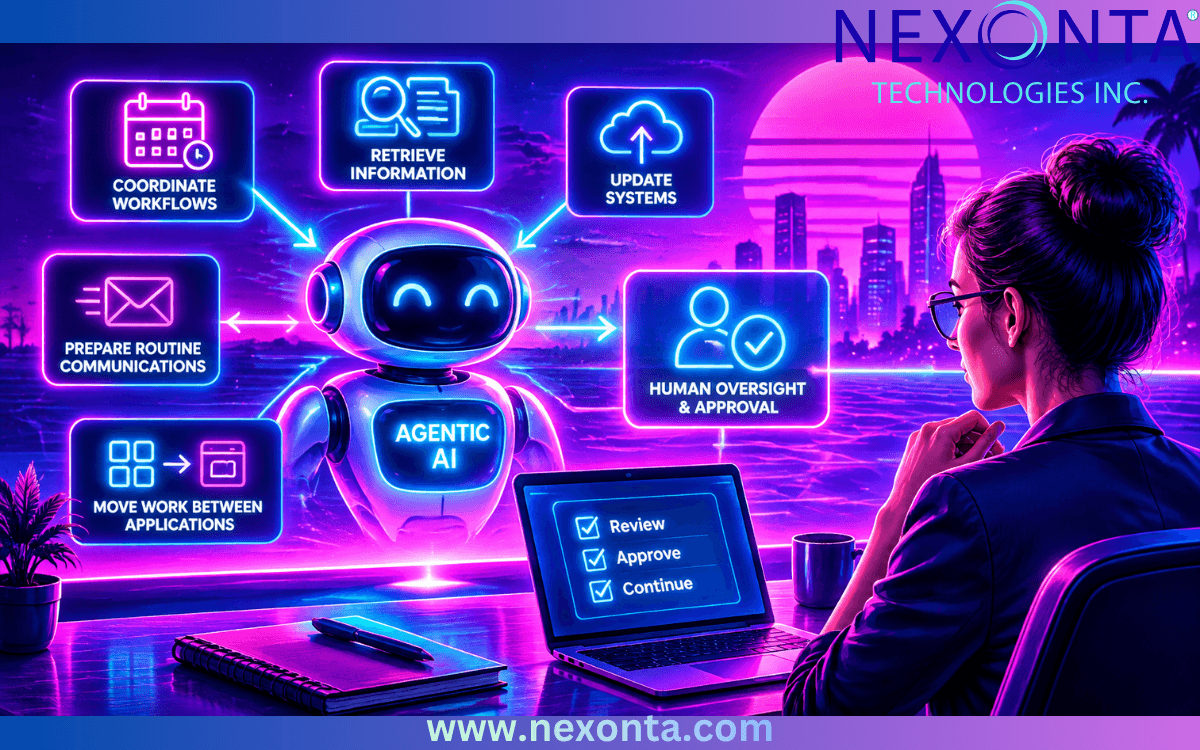
    Depending on the task, Agentic AI may help coordinate workflows, retrieve information, update systems, prepare routine communications, or move work between applications. Appropriate human oversight and approval can remain part of the process.

    The potential benefit goes beyond completing tasks faster.

    Your team could redirect its time towards higher-value activities, such as:

    • Providing better customer service.
    • Following up with sales prospects.
    • Increasing production capacity.
    • Supporting management and operations.
    • Developing new business opportunities.
    • Completing higher-value professional work.

    Think about what your business could do with an additional 1,250 hours of employee capacity each year.

    That could mean more customer conversations, faster turnaround times, or more time for work that directly supports business growth.

    The key is to identify where that time can make the greatest difference.

    Remember: Recovered employee time doesn’t automatically equal cash savings. It creates capacity that your business can use to improve productivity, increase output, reduce overtime, or potentially lower costs. The actual financial benefit depends on how the business uses that capacity.

    Category 2: Revenue Growth and Sales Opportunities

    Time is valuable. But what happens when your team has more time to focus on generating revenue?

    Consider how much time salespeople spend on administrative tasks.

    They may be updating customer relationship management (CRM) systems, researching prospects, preparing follow-up emails, scheduling meetings, or tracking opportunities.

    Those tasks matter. But they aren’t all the same as having a meaningful conversation with a potential customer.

    Agentic AI can help coordinate parts of the sales process, prepare information, support follow-ups, and move tasks forward according to defined rules and permissions.

    Your sales team can then spend more time building relationships, understanding customer needs, and pursuing qualified opportunities.

    The business value might come from:

    • More time available for prospecting.
    • Faster follow-up with potential customers.
    • Fewer missed opportunities.
    • Better visibility into the sales pipeline.
    • More consistent communication.

    Of course, more activity doesn’t guarantee more sales.

    The opportunity is to remove unnecessary friction from the sales process so your people can focus on the activities most likely to generate revenue.

    Category 3: Customer Experience and Retention

    Customers expect timely responses, clear communication, and a smooth experience.

    When internal processes are slow, customers often feel the effects.

    A request may sit in someone’s inbox. A follow-up may be missed. Information may need to be entered into multiple systems before a customer receives an answer.

    These delays can create frustration for customers and extra work for employees.

    Agentic AI can help coordinate customer-related workflows, retrieve relevant information, route requests, and support timely follow-ups.

    With the right systems and safeguards, businesses may be able to improve response times and deliver a more consistent customer experience.

    Consider the potential value of:

    • Responding to routine enquiries faster.
    • Keeping customer information organized.
    • Following up on outstanding requests.
    • Identifying issues that need human attention.
    • Helping employees access the information they need.

    Better customer experiences can support customer loyalty and retention.

    And keeping an existing customer can be just as important as winning a new one.

    The goal isn’t to remove the human element from customer service. It’s to give your people better tools and more time to provide it.

    Category 4: Operational Efficiency and Business Throughput

    Every business has processes that affect how much work it can complete.

    These might include processing orders, preparing quotes, scheduling jobs, managing documents, coordinating departments, or moving information between systems.

    When one step slows down, the entire process can suffer.

    A delayed approval might hold up a project. Missing information might require several follow-up emails. A manual handoff might leave a task waiting until someone has time to deal with it.

    These small delays can add up.

    Agentic AI can help coordinate connected tasks, identify the next step in a workflow, and move information between supported systems.

    This may help businesses reduce delays and improve the flow of work.

    Potential benefits include:

    • Faster processing times.
    • Fewer unnecessary handoffs.
    • Better coordination between departments.
    • Less time spent chasing information.
    • Greater capacity to handle existing workloads.

    For a growing business, this matters.

    You may be able to serve more customers or complete more work without increasing administrative effort at the same rate.

    That’s an important opportunity to explore before assuming that growth requires more people, more software, or more overhead.

    Category 5: Quality, Accuracy, and Risk Reduction

    Let’s talk about another hidden cost of doing business: mistakes.

    Manual processes can create opportunities for errors, inconsistent information, missed steps, and incomplete records.

    When something goes wrong, the cost often extends beyond fixing the original problem.

    Employees may need to investigate, correct information, contact customers, repeat work, or explain what happened.

    In some industries, mistakes can also create compliance, security, or financial risks.

    Agentic AI may help by following defined workflows, checking information against established rules, flagging exceptions, and maintaining records of completed actions.

    Depending on the application, this could support:

    • More consistent processes.
    • Earlier identification of missing information.
    • Fewer avoidable errors.
    • Better documentation.
    • More reliable handoffs between systems.

    Of course, AI isn’t error-free. It can introduce new risks if it’s poorly designed or implemented.

    That’s why an effective proposal should consider data quality, security, access permissions, testing, and human approval where appropriate.

    The objective is to improve the process while keeping the right controls in place.

    3. Add Up the Business Value

    Now let’s return to Company A.

    We’ve identified a process that consumes 1,250 hours each year, representing an estimated $43,750 in annual labour capacity.

    What if an improved process reduced the time required by 50%?

    The potential result would be:

    MeasureAnnual result
    Current time spent1,250 hours
    Potential time recovered625 hours
    Estimated labour capacity released$21,875

    That’s 625 hours that could potentially be redirected to other business activities.

    But let’s be clear about what the numbers mean.

    The $21,875 represents the estimated value of the labour capacity released. It isn’t automatically a $21,875 reduction in payroll or a guaranteed financial saving.

    To determine the actual return on investment, the business would also need to consider implementation costs, ongoing technology expenses, employee time required for oversight, and the measurable benefits achieved.

    For example, if the recovered hours allow employees to handle more customer requests, pursue additional sales, or increase production, the company should estimate the financial value of those improvements.

    If the process reduces overtime or eliminates an external service expense, the company may be able to identify more direct savings.

    The goal is to build a business case based on realistic assumptions, measurable outcomes, and the company’s actual priorities.

    Good business decisions start with understanding the numbers. Great ones connect those numbers to an opportunity.

    4. Why Agentic AI Should Start With the Business Problem

    It’s easy to get caught up in the excitement around AI.

    There are new tools, new platforms, and new possibilities appearing all the time.

    But choosing a technology before understanding the problem can lead to unnecessary expense and disappointing results.

    A better approach is to start with a few straightforward questions:

    • Which business processes consume the most time?
    • Where are employees doing repetitive work?
    • Which delays affect customers or revenue?
    • Where do errors create additional costs?
    • Which activities limit your ability to grow?
    • What would improving these processes be worth to your business?

    Once you understand the answers, you can assess whether Agentic AI is an appropriate solution.

    Some problems may be solved by improving an existing workflow. Others may require better integration between systems, process redesign, conventional automation, or a combination of technologies.

    Not every problem needs AI.

    The right solution is the one that delivers meaningful business value.

    At Nexonta, we believe the starting point should always be the business objective, not the technology.

    5. Your Next Business Advantage Could Already Be Inside Your Company

    Here’s something worth thinking about.

    You may not need to hire more people to make progress on every business priority.

    You may not need another software subscription.

    And you may not need to work longer hours.

    You may need to take a closer look at how work gets done today.

    The time your employees spend on repetitive tasks, the delays between departments, and the manual steps that slow down your operations could reveal opportunities to improve productivity and create more value.

    Agentic AI offers new ways to address some of these challenges. But the real opportunity comes from identifying the right processes, setting clear objectives, and measuring the results.

    Start with one process.

    Understand its current cost. Identify what could be improved. Estimate the potential value. Then determine whether the expected benefits justify the investment.

    You don’t need to transform your entire business overnight.

    You need to find the right opportunity and build from there.

    Let’s Talk About Your Bottom Line

    At Nexonta, we help businesses explore how Agentic AI and connected business systems can improve the way work gets done.

    Our approach starts with understanding your business, your existing processes, and the challenges you want to solve.

    Together, we can identify opportunities to reduce repetitive work, improve operational efficiency, support your team, and create more room for growth.

    The first step is understanding what your current processes are costing you — and what improving them could be worth.

    Ready to discover where your business could create more value?

    Contact Nexonta to discuss an Agentic AI opportunity assessment.

    Let’s look at the numbers, identify the opportunities, and build a practical plan focused on business results.

    Because when it comes to the cost of doing business, every hour counts.

    And yes, it’s all about the Benjamins!

  • AI and Machine Learning Are Compressing Business Timelines: Is Your Company Ready?

    AI and Machine Learning Are Compressing Business Timelines: Is Your Company Ready?

    AI and machine learning are changing business faster than most organizations realize. What once took years of planning, testing, and execution can now happen in a matter of months. This is not science fiction. It is happening right now. Businesses that embrace AI and machine learning are accelerating their growth, while those that hesitate risk being left behind.

    This article is a public service announcement for businesses of all sizes.

    The real conversation about AI should not be centered around whether it will replace people. The bigger issue is how quickly it is speeding up business lifecycles.

    The Real Power of AI Is Speed

    For years, businesses operated on relatively predictable timelines.

    A company might spend:

    * One year researching a market
    * Another year developing a product
    * One year building marketing systems
    * One year testing and optimizing
    * One year scaling operations

    That five-year journey was considered normal.

    Today, AI is dramatically shortening that timeline.

    Tasks that once required large teams can now be completed by smaller groups equipped with the right AI tools. Research can be performed in hours instead of weeks. Marketing campaigns can be created in days instead of months. Customer insights can be generated almost instantly.

    The result?

    What once took five years can often be accomplished in six months.

    AI Is Not Creating the Change—It Is Accelerating It

    Many people view AI as a disruptive force that is creating entirely new business models.

    In some cases, that is true.

    However, the larger impact is that AI is accelerating existing processes.

    Think of AI as a business accelerator.

    The strategies that worked before still matter:

    * Innovation
    * Customer service
    * Product quality
    * Leadership
    * Execution

    The difference is that AI helps organizations move through these stages much faster.

    Companies are reaching milestones in months that previously took years.

    That changes everything.

    The Competitive Gap Is Growing

    One of the biggest dangers facing businesses today is not using AI while competitors are.

    Imagine two companies entering the same market.

    Both have talented teams.

    Both have quality products.

    Both have strong leadership.

    The difference is that one company uses AI to automate repetitive tasks, analyze customer behavior, generate content, streamline operations, and identify new opportunities.

    The other company relies entirely on traditional methods.

    Who wins?

    In most cases, the AI-enabled company gains an advantage through speed, efficiency, and decision-making.

    The gap between these businesses can become significant in a very short period of time.

    Small Businesses Have a Unique Opportunity

    Perhaps the most exciting aspect of AI is that it is not reserved for large corporations.

    In the past, only enterprise-level organizations could afford advanced technology and extensive teams.

    Today, a small business owner can access powerful AI tools at a fraction of the cost.

    This levels the playing field.

    A startup with the right strategy and AI integration can compete with companies many times its size.

    That is an opportunity we have never seen before.

    The Cost of Waiting

    Many business leaders are taking a “wait and see” approach.

    While caution can be wise, waiting too long can become expensive.

    Technology adoption has always rewarded early movers.

    The companies that learned how to use the internet effectively gained an advantage.

    The companies that embraced social media early gained an advantage.

    The companies that adopted digital marketing early gained an advantage.

    AI is following the same pattern.

    Organizations that begin learning, testing, and implementing AI today are building skills and systems that may become difficult for competitors to catch up with later.

    Start Small but Start Now

    The good news is that businesses do not need to transform overnight.

    The smartest approach is often to start small.

    Identify one area where AI can create immediate value:

    * Customer service
    * Content creation
    * Marketing automation
    * Data analysis
    * Sales support
    * Process optimization

    Learn from the results.

    Build confidence.

    Expand gradually.

    The goal is not to replace people.

    The goal is to empower people to do more valuable work.

    The real threat of AI is not that machines are taking over. The real threat is that AI and machine learning are dramatically compressing business timelines.

    The organizations that understand this shift will be positioned to grow faster, innovate more effectively, and adapt to changing markets.

    Those that ignore it may discover that their competitors have moved years ahead in a matter of months.

    The future belongs to businesses that can learn, adapt, and execute quickly.

    AI is helping make that future arrive much sooner than anyone expected.

    Ready to Future-Proof Your Business?

    Now is the time to evaluate how AI and machine learning can strengthen your organization.

    Start by identifying one process that can be improved through automation or intelligent analysis. Test, learn, and build from there.

    The businesses that thrive over the next decade will not necessarily be the largest. They will be the ones that adapt the fastest.

    Don’t wait for the future to arrive.

    Start building it today.

  • AI in Business Consulting: Why the Future Belongs to Businesses That Embrace It

    AI in Business Consulting: Why the Future Belongs to Businesses That Embrace It

    AI in Business Consulting has completely changed the way companies make decisions, solve problems, and grow. Not long ago, hiring a business consultant was a luxury that only larger organizations could afford. Consultants often charged thousands of dollars for strategic advice, operational reviews, and growth plans. For many small businesses, startups, and entrepreneurs, that level of expertise was simply out of reach.

    Today, things look very different.

    The rise of artificial intelligence tools such as ChatGPT and Claude has made powerful business insights available to almost everyone. What was once reserved for large corporations is now accessible to small business owners, solo entrepreneurs, and growing companies at a fraction of the cost.

    This shift is creating one of the biggest transformations the consulting industry has ever seen.

    The Old Consulting Model

    For decades, business consulting followed a familiar pattern.

    A company would hire outside experts to analyze operations, identify weaknesses, and recommend improvements. These consultants often brought years of experience and valuable industry knowledge. Their services could deliver tremendous value, but they also came with a significant price tag.

    The result was a gap between companies that could afford expert guidance and those that could not.

    Many smaller businesses had to rely on trial and error. They made decisions based on instinct rather than data because professional consulting services were often beyond their budget.

    AI Has Changed the Playing Field

    Artificial intelligence has dramatically lowered the barrier to accessing business intelligence.

    Today, business owners can use AI tools to:

    * Create strategic business plans
    * Analyze customer feedback
    * Improve marketing campaigns
    * Streamline workflows
    * Generate reports
    * Forecast trends
    * Develop training materials
    * Create standard operating procedures
    * Identify inefficiencies in operations

    Tasks that once required hours of consulting time can now be completed in minutes.

    That does not mean AI replaces expertise. It means expertise has become more accessible than ever before.

    Speed Creates Opportunity

    One of AI’s greatest strengths is speed.

    Businesses operate in an environment where conditions can change quickly. Consumer preferences shift. Competitors enter the market. Technology evolves.

    Waiting weeks for recommendations is no longer practical in many situations.

    AI can process large amounts of information almost instantly. This allows business owners to evaluate options, explore scenarios, and make informed decisions faster than ever before.

    The companies that adapt quickly often gain a significant advantage.

    Efficiency Is the New Competitive Advantage

    Every business wants to reduce waste and improve productivity.

    AI helps organizations identify repetitive tasks that can be automated. It can simplify administrative work, improve communication, and help teams focus on activities that create real value.

    Instead of spending hours organizing data or preparing reports, employees can spend more time building relationships, serving customers, and driving innovation.

    This creates a more efficient business without necessarily increasing costs.

    AI Does Not Replace Human Judgment

    One of the biggest fears surrounding artificial intelligence is that it will replace people.

    The reality is much more practical.

    AI is a tool. Like any tool, its effectiveness depends on how it is used.

    Artificial intelligence can provide recommendations, analyze data, and identify patterns. However, it cannot fully replace human experience, creativity, leadership, and emotional intelligence.

    Successful businesses will combine the strengths of AI with the strengths of people.

    The future belongs to organizations that learn how to use both.

    The Democratization of Business Consulting

    Perhaps the most exciting aspect of AI is that it is democratizing access to knowledge.

    A startup founder working from a home office now has access to resources that were once available only to major corporations. Small business owners can gain strategic insights without spending a fortune on consulting fees.

    This creates more opportunities for innovation, competition, and entrepreneurship.

    In many ways, AI is leveling the playing field.

    The Businesses That Thrive Will Be the Ones That Adapt

    History has shown that technological change rewards those who embrace it.

    The internet transformed commerce.

    Smartphones transformed communication.

    Artificial intelligence is now transforming business consulting and operational management.

    The question is no longer whether AI will influence business. It already is.

    The real question is whether businesses will learn to use it effectively.

    Companies that embrace AI as a partner rather than a threat will be better positioned to grow, innovate, and compete in an increasingly fast-moving marketplace.

    Artificial intelligence is not something businesses should fear. It is something they should learn to harness.

    When used properly, AI can improve efficiency, reduce costs, accelerate decision-making, and unlock new opportunities for growth. It gives businesses of all sizes access to tools and insights that were once reserved for large organizations with deep pockets.

    The future of consulting is no longer limited to expensive boardrooms and high-priced advisors.

    It is becoming faster, smarter, and more accessible for everyone.

    Are you using AI to improve your business operations yet?

    Start small. Identify one repetitive task, one process bottleneck, or one area where better insights could help your business grow. Then explore how AI can help solve that challenge.

    The businesses that thrive tomorrow are the ones willing to learn, adapt, and innovate today.

    Don’t wait for the future to arrive. Start building a smarter business now.

☎ ✉
f 𝕏