Tag: analytics

  • Growth Driven Design Websites

    Growth Driven Design Websites

    As you are reading this, someone is probably googling your business website.

    Traditional Web Design is Broken
    The headaches, challenges, unreliable and inconsistent results we experience during a website redesign are the product of an outdated and broken playbook.

    The New Playbook: Growth-Driven Design
    Growth-Driven Design is a smarter approach to web design that eliminates all of the headaches and drives optimal results using data.

    Your website is your biggest marketing asset and is the centerpiece of all your marketing activities. Your website is the first place, people go when looking for more information on your products or services. All of our marketing efforts and the first-place prospects come looking for information is the website.

    Your best salesperson is your website. Did you know a prospect has already moved through 70% of the sales process before even reaching out to your sales team? How do you think they find the information before talking to someone? – Your website. Unfortunately, the way we approach building and improving our websites is fundamentally broken.

    Traditional Web Design is a Large Time & Resource Commitment: The average Small to Medium sized business (SMB) website takes three months to complete and requires a great deal of resources and energy from your team. Not Set in Stone: Large projects can fluctuate in cost and time, which makes accurate quotes difficult. Project delays and increased budgets happen sometimes. No Prototype: The Traditional method launches a website that should succeed in theory. However, this method lacks a “trial and error” run with viewers. Trial and error helps determine what works for viewers and what does not, which is beneficial in the design process.

    After launch, a website has no major updates for 1.5 to 2 years. Our #1 marketing asset and best salesperson, our website, now sits unchanged for years, which is not conducive to maximize website performance. Some small updates or improvements may happen, along with adding blogs or landing pages to the site, but the vast majority of the site remains untouched.

    The Three Pillars of Growth-Driven Design

    01) Minimize risks associated with traditional web design. We work to avoid the risks of traditional web design by taking a systematic approach to shorten the time to launch, focusing on real impact and continuous learning and improvement.

    02) Continuously learn and improve. We are constantly researching, testing and learning about our visitors to improve on-going website improvements. Through continuous improvements we can reach peak performance.

    03) As you learn, inform marketing and sales (and vice versa). Growth-Driven Design is tightly integrated with marketing & sales. What we learn about visitors helps inform and improve marketing & sales strategies and tactics (and vice versa).

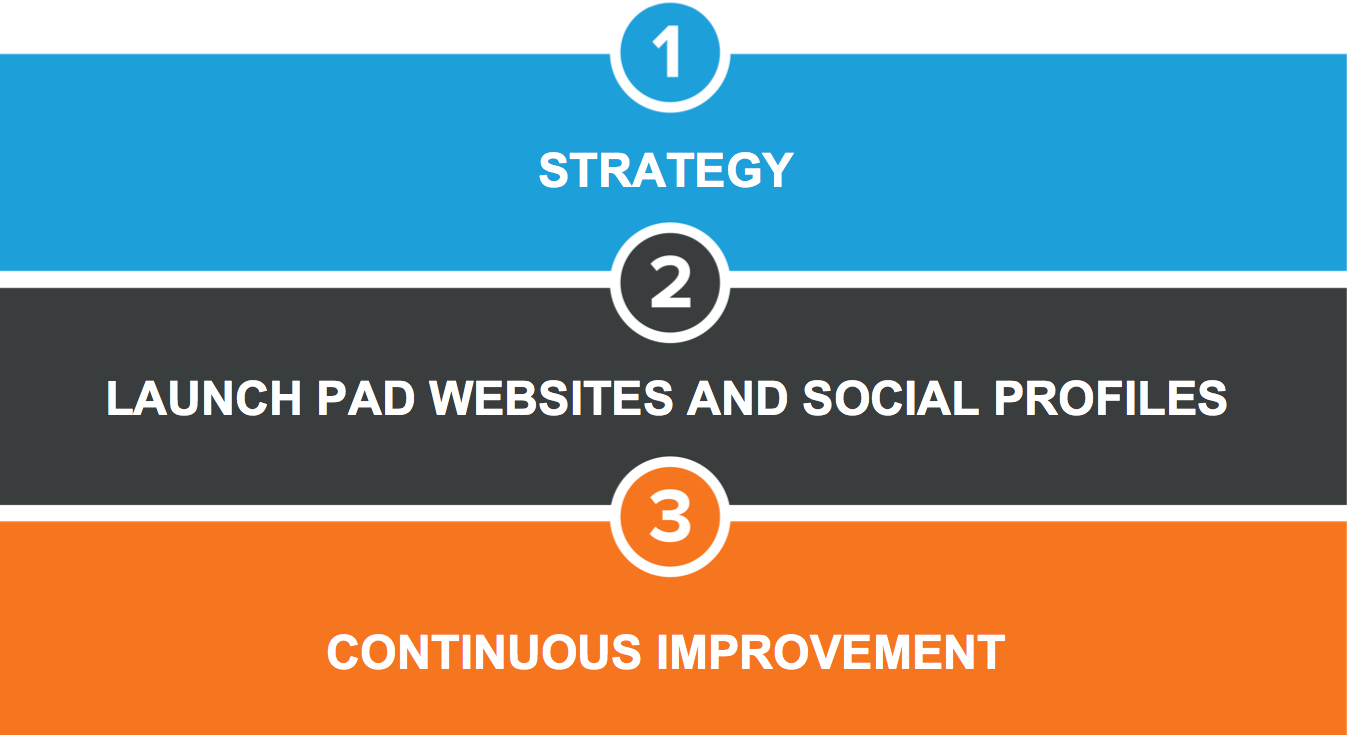
    THREE MAJOR PHASES OF GROWTH-DRIVEN DESIGN:

    PHASE 1: STRATEGY, PHASE 2: WISHLIST, and PHASE 3: LAUNCH PAD WEBSITE


    First phase: Strategy.

    Similar to the traditional website design process, the first stage of Growth-Driven Design is the strategy stage. In this stage we’ll develop a rock-solid foundation that we can build our Growth- Driven Design process upon using the following steps: Goals: What are the performance goals that we are trying to achieve with our website? How have we historically performed, where would we like to improve and how will this impact the overall marketing department’s goal?
    Personas: Next you will develop detailed persona profiles for the different types of groups visiting the site. A persona is a fictional representation of your ideal customer. You can create different groups of personas based on common characteristics your audience shares. This could be a point of pain, industry, job title, etc. As you’ll learn later in the book, Growth- Driven Design centers around the user, so it is critically important to fully research and develop your persona profiles in the beginning, as they will set the stage for all future activities.

    The second phase in the Growth-Driven Design process is to create a wishlist.

    Taking what you’ve learned in your strategy planning, gather your team together and brainstorm every impactful, creative and innovative idea that you’d like to include on the site. Go into your brainstorming session with a “clean slate” – don’t get hung up on the existing website. What items do you need on your list to achieve your goals?
    Answer this disregarding the issues of money, time, and development skill. Include brainstorming ideas such as: Key impactful website sections and pages Marketing assets, tools and resources Specific features, modules and functionality Design elements Changes in experience based on devices, country, etc.

    After a few hours of brainstorming, you and the team should have a list of 50-150+ ideas for the new website. Not all of these items will be implemented right away, but start to think of as many ideas as possible. Your wishlist determines both the initial action items to implement on the new site, and the agile and flexible list that continuously changes. Adding to and subtracting from the agile and flexible list re-prioritizes action items over time.

    Third Phase in the Growth Drive Design is Launch Pad Website

    Web Process Steps: Once you have identified the most critical action items to include on your Launch Pad site, you can run those items through the standard website implementation process, including: Messaging & Content User Experience (UX) & Site Architecture, Inbound Marketing Strategy, Alignment Wireframes Designs, Development Quality Assurance and Testing Set Up Data Collection. The last step of the Launch Pad website sets up qualitative and quantitative data collection around: Your goals defined in the strategy phase. Each of your fundamental assumptions …AND Each hypothesis statement of your action items implemented in the Launch Pad website. Also, set up data collection. It allows you to start learning about your visitors once your Launch Pad site is live.

    In the traditional web design process we launch websites at the finish. In Growth-Driven Design we launch websites right away. In this stage, we build and launch what we call a “Launch Pad website”. All of your other Growth-Driven Design activities and improvements start from this Launch Pad website. Launch the imperfect Launch Pad website quickly. We want to avoid getting stuck on analysis, features or content while building our launch pad website. No one launches a perfect website on the first go. However, your launch improves your current website and gives a starting point on which to continuously improve. The size and complexity of the Launch Pad website varies depending on what you have on your wishlist and what type of website you have. Shorten your list to 20% of the original. This short list makes an impact and launches quickly so you can continue to learn about your users and improve the site.

    Fundamental Assumptions of the Growth-Driven Design Process: Using what you’ve learned in all of the previous steps, you can now start forming some fundamental assumptions about your users. Some examples of fundamental assumptions include: Value propositions for each product, service and offer. The various locations and devices users will be accessing your website from. What information your users are looking for. These fundamental assumptions help you explain the behavior and motivations of your users. They influence both the global and page strategy, and also future Growth-Driven Design cycles. Global & Page Strategy: The last step in the strategy phase develops both a global strategy for the website as a whole and a specific page-by-page strategy for each major page on the site. Both the global and individual page strategies should incorporate all of the previous steps. Also, they should lay out a detailed strategy of exactly how to best engage and influence the user to best attain your goals.

    The Growth-Driven Design Process Quantitative Research – Website & Analytics Audit: Time to start digging into the data. Analyze the current website’s performance and perform a quantitative audit of the good and the bad. As you do this, identify where the website can improve.
    Qualitative Research – User Research: After proactively reaching out to your existing users to learn more about them, use the data to better understanding of who they are and find ways to improve. As you’re collecting new user research, validate the assumptions you put in your original persona profiles.

    Continuous Improvement now that you Launch Pad website is live. Time to start your on-going cycles to continuously experiment, learn, and improve on your website. You still have a long wishlist of impactful items that you’d like to implement on the site. This agile list should be updated on a regular basis. This revolves around the Persona. This entire cycle starts with and revolves around the personas who are coming to your website. At each stage of the cycle, continuously ask yourself how this relates and provides value to the personas visiting your website. If at any point it becomes unclear how an action item provides value to, or relates to the persona, take a step back and re-evaluate what you’re working on.

    Source:
    https://cdn2.hubspot.net/hubfs/124445/docs/ebook-growth.pdf?t=1488562926580
  • Content Analysis and Marketing Blog

    Content Analysis and Marketing Blog

    Web analytics is the measurement, collection, analysis and reporting of web data for purposes of understanding and optimizing web usage. However, Web analytics is not just a process for measuring web traffic but can be used as a tool for business and market research, and to assess and improve the effectiveness of a website. Web analytics applications can also help companies measure the results of traditional print or broadcast advertising campaigns. It helps one to estimate how traffic to a website changes after the launch of a new advertising campaign. Web analytics provides information about the number of visitors to a website and the number of page views. It helps gauge traffic and popularity trends which is useful for market research.

    Most web analytics processes come down to four essential stages or steps, which are:
    • Collection of data: This stage is the collection of the basic, elementary data. Usually, these data are counts of things. The objective of this stage is to gather the data.
    • Processing of data into information: This stage usually take counts and make them ratios, although there still may be some counts. The objective of this stage is to take the data and conform it into information, specifically metrics.
    • Developing KPI: This stage focuses on using the ratios (and counts) and infusing them with business strategies, referred to as key performance indicators (KPI). Many times, KPIs deal with conversion aspects, but not always. It depends on the organization.
    • Formulating online strategy: This stage is concerned with the online goals, objectives, and standards for the organization or business. These strategies are usually related to making money, saving money, or increasing marketshare.

    Another essential function developed by the analysts for the optimization of the websites are the experiments
    • Experiments and testings: A/B testing is a controlled experiment with two variants, in online settings, such as web development. The goal of A/B testing is to identify and suggest changes to web pages that increase or maximize the effect of a statistically tested result of interest. Each stage impacts or can impact (i.e., drives) the stage preceding or following it. So, sometimes the data that is available for collection impacts the online strategy. Other times, the online strategy affects the data collected.

    Web analytics technologies
    There are at least two categories of web analytics, off-site and on-site web analytics.
    • Off-site web analytics refers to web measurement and analysis regardless of whether you own or maintain a website. It includes the measurement of a website’s potential audience (opportunity), share of voice (visibility), and buzz (comments) that is happening on the Internet as a whole.
    • On-site web analytics, the more common of the two, measure a visitor’s behavior once on your website. This includes its drivers and conversions; for example, the degree to which different landing pages are associated with online purchases. On-site web analytics measures the performance of your website in a commercial context. This data is typically compared against key performance indicators for performance and is used to improve a website or marketing campaign’s audience response. Google Analytics and Adobe Analytics are the most widely used on-site web analytics service; although new tools are emerging that provide additional layers of information, including heat maps and session replay.
    Historically, web analytics has been used to refer to on-site visitor measurement. However, this meaning has become blurred, mainly because vendors are producing tools that span both categories. Many different vendors provide on-site web analytics software and services. There are two main technical ways of collecting the data. The first and traditional method, server log file analysis, reads the logfiles in which the web server records file requests by browsers. The second method, page tagging, uses JavaScript embedded in the webpage to make image requests to a third-party analytics-dedicated server, whenever a webpage is rendered by a web browser or, if desired, when a mouse click occurs. Both collect data that can be processed to produce web traffic reports.

    Marketing automation refers to software platforms and technologies designed for marketing departments and organizations to more effectively market on multiple channels online (such as email, social media, websites, etc.) and automate repetitive tasks.

    Marketing departments, consultants and part-time marketing employees benefit by specifying criteria and outcomes for tasks and processes which are then interpreted, stored and executed by software, which increases efficiency and reduces human error. Originally focused on email marketing automation, marketing automation refers to a broad range of automation and analytic tools for marketing especially inbound marketing. Marketing Automation platforms are used as a hosted or web-based solution, and no software installation is required by a customer.

    The use of a marketing automation platform is to streamline sales and marketing organizations by replacing high-touch, repetitive manual processes with automated solutions.
    Marketing automation is a platform that marketers use to plan, coordinate, manage and measure all of their marketing campaigns, both online and offline. It is often used along with lifecycle marketing strategy to closely manage and nurture generated leads, aiming to convert leads into customers.[ci

    Marketing Automation is a subset of customer relationship management (CRM) or customer experience management (CXM) that focuses on the definition, segmentation, scheduling and tracking of marketing campaigns. The use of marketing automation makes processes that would otherwise have been performed manually much more efficient and makes new processes possible. Marketing Automation can be defined as a process where technology is used to automate several repetitive tasks that are undertaken on a regular basis in a marketing campaign. A tool that allows an individual to design, execute and automate a time-bound marketing workflow can be called a Marketing Automation platform.

    Marketing Automation platforms allow marketers to automate and simplify client communication by managing complex omni-channel marketing strategies from a single tool. Marketing Automation assists greatly in areas like Lead Generation, Segmentation, Lead nurturing and lead scoring, Relationship marketing, Cross-sell and upsell, Retention, Marketing ROI measurement. There are three categories of marketing automation software:

    Marketing intelligence
    Uses tracking codes in social media, email, and webpages to track the behavior of anyone interested in a product or service to gain a measure of intent. It can record which social media group or thread they followed, which link was clicked on in an email or which search term was used to access a website. Multiple link analysis can then track buyer behavior – following links and multiple threads related to product A but not B will show an interest only in A. This allows more accurately targeted response and the development of a nurturing program specifically targeted towards their interest and vertical market. This allows businesses to more efficiently and effectively reach target consumers who show, through their internet history behavior, that they will be interested in the company’s products.[4] Due to its interactive nature this has been described as Marketing Automation 2.0.
    Marketing automation
    Has a focus on moving leads from the top of the marketing funnel through to becoming sales-ready leads at the bottom of the funnel. Prospects are scored, based on their activities, and receive targeted content and messaging, thus nurturing them from first interest through to sale. Commonly used in business-to-business (B2B), business-to-government (B2G), or longer sales cycle business-to-consumer (B2C) sales cycles, Marketing Automation involves multiple areas of marketing and is really the marriage of email marketing technology coupled with a structured sales process.
    Advanced workflow automation
    Encompasses automation of internal marketing processes. These include budgeting and planning, workflow and approvals, the marketing calendar, internal collaboration, digital asset creation, and management and essentially everything that supports the operational efficiency of the internal marketing function. Typically these systems require a CRM or COM administrator to set up a complex series of rules to trigger action items for internal sales and marketing professionals to manually process (designing files, sending letters, sending email campaigns). This type of system increases the marketer’s ability to deliver relevant content to relevant individuals at relevant times. Limitations may apply, based on the human resource capacity of an organization and their level of commitment to the tasks as they are assigned.

    Over the past, 8 or so years organizations and businesses have increasingly been seeing the need to invest in websites as well as social media campaigns to reach their target audience but also to share their Why as well as to branding identity for what their business or organization reason for being is. However, recently we have seen these tools become more and more streamlined to track views, likes, shares, bounce rates, conversion rates, and even revenue generation if your marketing efforts are not tracking all of these different metrics then chances are you are wasting ad spend. 2020 and beyond are all about analyzing the data for every post, blog or share and learning what resonates with your audience so that you can provide them with a wonderful user experience and education.

    Source: Wikipedia

☎ ✉
f 𝕏