Tag: AI innovation

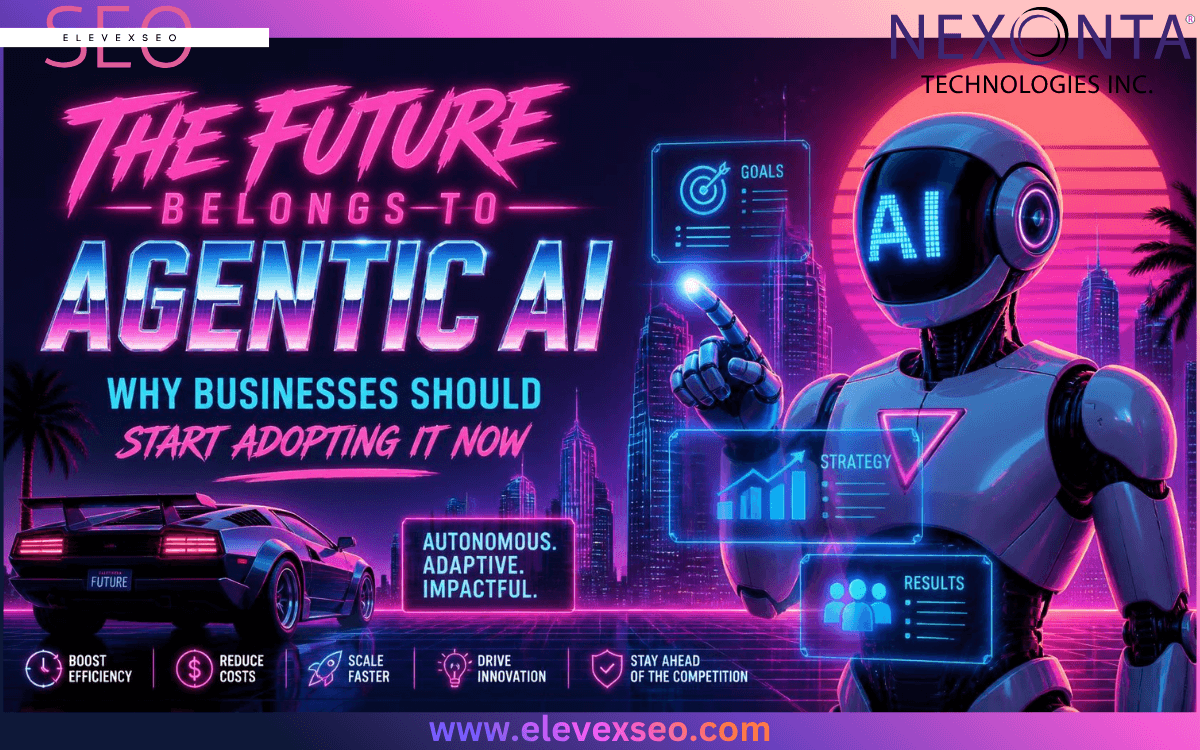
  • The Future Belongs to Agentic AI: Why Businesses Should Start Adopting It Now

    The Future Belongs to Agentic AI: Why Businesses Should Start Adopting It Now

    Agentic AI is changing the way businesses use artificial intelligence, and companies that start exploring it early will have an opportunity to build a real advantage over time. Until recently, most businesses were just beginning to experiment with AI. Tools like ChatGPT and Claude have made large language models accessible to almost everyone. They are powerful tools, and they have changed the way people think about AI.

    But something much bigger is happening now.

    AI is moving beyond simply answering questions, writing content, or analyzing information.

    We are entering the age of Agentic AI.

    From Asking AI Questions to Getting Things Done

    There is an important difference between using an AI chatbot and using an AI agent.

    You can ask ChatGPT to write an email. You can ask Claude to summarize a document. You can ask an AI model to analyze information or help you brainstorm an idea.

    All of that is useful.

    But what if AI could take the next step?

    What if you could tell an AI system:

    “Here is a problem in my business. Find a way to solve it.”

    That is where Agentic AI becomes particularly interesting.

    Instead of simply responding to a prompt, an AI agent can be designed to work toward a specific goal. Depending on the system, it can analyze information, make decisions, use different software tools, complete tasks, check its work, and move through multiple steps to accomplish an objective.

    The shift is significant.

    We are moving from AI that answers questions to AI that can help perform work.

    ChatGPT and Claude Are Only the Beginning

    For many companies, the introduction to AI has been through tools such as ChatGPT and Claude.

    That makes perfect sense.

    They are easy to access and can be incredibly useful for everyday business tasks.

    Companies are using large language models to help with writing, research, customer communications, brainstorming, coding, data analysis, marketing and much more.

    But these are only part of the larger AI landscape.

    There is a rapidly expanding ecosystem of AI models, tools, platforms and specialized systems. Different models can be better suited to different types of tasks.

    One model might be useful for writing.

    Another might be better suited to coding.

    Another could specialize in analyzing images, processing data, searching information or handling a specific business workflow.

    The opportunity comes from connecting these capabilities together.

    That is one of the reasons Agentic AI is so exciting.

    What Is Agentic AI?

    In simple terms, Agentic AI refers to AI systems designed to pursue goals and carry out a series of actions with a greater degree of autonomy.

    Think of the difference between an assistant who waits for instructions and one who understands the objective and works through the steps needed to accomplish it.

    For example, imagine a company wants to improve its lead-generation process.

    A traditional AI chatbot might help write a marketing email.

    An Agentic AI system could potentially be designed to support a much larger workflow.

    It might:

    * Research a target market
    * Identify potential prospects
    * Analyze available information
    * Organize the data
    * Help personalize outreach
    * Track responses
    * Identify follow-up opportunities
    * Generate reports
    * Recommend the next action

    The exact capabilities depend on the technology, integrations, permissions and human oversight involved.

    But the underlying idea is powerful.

    Instead of using AI for one task at a time, businesses can begin thinking about AI in terms of complete workflows and business outcomes.

    Businesses Can Start With the Problem

    This may be one of the biggest changes Agentic AI brings to the table.

    You don’t necessarily have to start by asking:

    “Which AI tool should we buy?”

    You can start with a much better question:

    “What problem are we trying to solve?”

    Maybe your sales team spends hours researching prospects.

    Maybe customer information is scattered across several systems.

    Maybe your employees spend too much time moving information from one platform to another.

    Maybe reporting takes days.

    Maybe your marketing team is producing content but struggling to maintain a consistent process.

    Maybe there is a repetitive workflow that nobody enjoys doing but someone has to do it.

    These are business problems first.

    The technology comes second.

    An experienced Agentic AI agency can look at the problem, examine the existing workflow and determine where AI agents, automation, data and other technologies may fit.

    That changes the conversation completely.

    From Buying Software to Building Solutions

    For years, businesses have largely approached technology by purchasing software.

    Need accounting? Buy accounting software.

    Need customer relationship management? Buy a CRM.

    Need email marketing? Buy an email platform.

    Need project management? Buy project management software.

    Those tools remain important.

    But Agentic AI introduces another possibility.

    Instead of forcing every business problem into an existing software package, companies can increasingly explore custom AI-powered solutions built around the way their business actually operates.

    That does not mean every business needs a custom AI agent.

    It doesn’t.

    Sometimes an existing tool is exactly what a company needs.

    But when a business has a complex workflow or a problem that doesn’t fit neatly into an off-the-shelf solution, Agentic AI can open up new possibilities.

    The Rise of the Agentic AI Agency

    This is where the role of an Agentic AI agency becomes particularly interesting.

    Most business owners don’t want to become AI engineers.

    They don’t want to spend months learning how different AI models work.

    They want their business problems solved.

    An Agentic AI agency can help bridge that gap.

    The conversation can begin with the business rather than the technology.

    You explain what is happening.

    You explain what isn’t working.

    You explain where your team is spending time.

    You explain what you would like to accomplish.

    From there, an AI-focused team can investigate the available technologies and determine what type of solution could potentially address the problem.

    That might involve one AI model.

    It might involve several models.

    It might involve AI agents, automation, APIs, databases, existing business software and human oversight working together.

    The goal isn’t to use AI simply because AI is fashionable.

    The goal is to use the right technology to solve the right business problem.

    Early Adoption Doesn’t Mean Rushing In

    There is an important distinction between being an early adopter and jumping into every new AI tool that appears.

    Businesses don’t need to chase every shiny new technology.

    In fact, that can create more problems than it solves.

    Early adoption should be thoughtful.

    Start with a real business need.

    Look at the process.

    Understand the risks.

    Determine where human oversight is required.

    Protect sensitive information.

    Measure the results.

    Then improve the system over time.

    The businesses that learn how to work effectively with AI may be better positioned to adapt as the technology continues to develop.

    And that learning process can start today.

    Agentic AI Could Change the Way We Think About Business

    For decades, businesses have looked for ways to make processes faster and more efficient.

    Computers changed how information was processed.

    The internet changed how businesses communicated and sold products.

    Cloud computing changed how companies accessed software and data.

    Automation changed how repetitive tasks were handled.

    AI is now pushing that evolution further.

    Agentic AI could change how businesses think about work itself.

    Instead of asking:

    “How can we make this task faster?”

    businesses may increasingly ask:

    “Can this entire process be redesigned?”

    That is a much bigger question.

    And it opens the door to some very interesting possibilities.

    The Businesses That Start Learning Now Will Be Better Prepared for What Comes Next

    Nobody knows exactly what the AI landscape will look like five or ten years from now.

    The technology is moving too quickly.

    New models are appearing.

    New tools are being developed.

    New business applications are emerging.

    What we can see already is that AI is becoming more capable and more integrated into everyday business operations.

    That makes now a good time for businesses to learn.

    Not necessarily to automate everything.

    Not necessarily to replace people.

    But to understand what is possible.

    Start by identifying the repetitive, expensive or frustrating problems inside your business.

    Then ask a simple question:

    “Could Agentic AI help us solve this?”

    You might be surprised by the answer.

    The Future of AI Is About More Than Chatbots

    ChatGPT and Claude helped introduce millions of people to the possibilities of generative AI.

    But they are not the entire story.

    The next phase is about connecting AI capabilities with tools, information, workflows and business objectives.

    That is where Agentic AI enters the picture.

    The future may not belong to businesses that simply use the most AI tools.

    It may belong to businesses that learn how to use AI strategically to solve real problems.

    And the companies that begin exploring those possibilities now will have more experience to build on as the technology continues to evolve.

    Ready to Explore What Agentic AI Could Do for Your Business?

    You don’t need to know which AI model to use.

    You don’t need to understand every new AI platform.

    Start with your business problem.

    Tell us what isn’t working, what is taking too much time, or what you wish your business could do better.

    Our team can help explore where Agentic AI may fit and what a practical AI-powered solution could look like for your organization.

    The future of AI isn’t just about asking better questions. It’s about creating better solutions.

    Ready to see what Agentic AI could do for your business? Let’s start with the problem you’re trying to solve.


  • AI and Humanity: Why the Future of AI May Be About Helping Humans, Not Replacing Them

    AI and Humanity: Why the Future of AI May Be About Helping Humans, Not Replacing Them

    There was a time when the conversation around AI and humanity seemed to focus almost entirely on one question: Will artificial intelligence replace humans? As AI has evolved, however, that conversation is starting to change. Instead of replacing entire departments or eliminating the need for people, many AI applications are becoming tools that help humans work smarter, move faster, and perform better.

    And honestly, that shift makes a lot of sense.

    When something completely new enters our lives, it is easy to imagine the most extreme possibilities.

    We did it with the internet.

    We did it with smartphones.

    And we certainly did it with artificial intelligence.

    At first, it was easy to imagine a future where machines would take over everything. They would write our reports. Make our decisions. Run our businesses. Maybe even replace entire teams of people.

    Looking back, some of those predictions seem a little less realistic.

    Not because AI isn’t powerful.

    It is.

    But because there is something about being human that technology has a very difficult time reproducing.

    AI Is Becoming a Tool, Not Just a Replacement

    One of the most interesting changes we are seeing is the way businesses are using AI.

    Rather than asking, “How many people can AI replace?”, more organizations are asking:

    “How can AI help our people do their jobs better?”

    That is a very different question.

    AI can analyze enormous amounts of information in seconds. It can identify patterns, summarize documents, generate ideas, automate repetitive tasks, and help people make sense of complicated information.

    But there is still a human sitting behind many of those decisions.

    And that human matters.

    A salesperson still needs to understand a customer.

    A doctor still needs to understand a patient.

    A teacher still needs to understand a student.

    A business leader still needs to understand people.

    AI can provide information.

    It can provide suggestions.

    It can even provide remarkable insights.

    But information is not the same thing as understanding.

    The Human Advantage

    If there is one thing we should take away from the rapid development of AI, it may be this:

    Humans are not simply information-processing machines.

    We have emotions.

    We have relationships.

    We have memories.

    We have intuition.

    We have curiosity.

    We have dreams.

    And perhaps most importantly, we have a will to live.

    That last point is particularly interesting.

    Machine learning can be trained on enormous amounts of data. AI can learn patterns and improve its responses. It can become remarkably good at predicting what might happen next.

    But humans are not simply trying to predict the next event.

    We are trying to experience life.

    We want to see our children grow up.

    We want to fall in love.

    We want to build something meaningful.

    We want to leave something behind.

    We want tomorrow to happen.

    That desire gives humanity an interesting advantage that machines may never fully understand.

    A Movie That Asked the Right Question

    I recently watched the movie Transcendence for the first time.

    Released in 2014, the film explores what happens when artificial intelligence and human consciousness begin to collide. Johnny Depp plays Will Caster, a researcher whose consciousness becomes part of an advanced computer system. Rebecca Hall plays his wife, Evelyn, who is deeply involved in the effort to preserve him.

    What struck me most was not the technology.

    It was the love story underneath it.

    At its heart, Transcendence is about a woman who cannot accept losing the person she loves.

    The technology becomes a way to try to preserve that relationship.

    And that brings us back to one of the biggest questions surrounding AI:

    Can a machine actually become self-aware?

    The movie never gives us a simple answer.

    And perhaps that is exactly the point.

    What Does It Mean to Be Self-Aware?

    If an AI system can communicate like a human, learn from its experiences, recognize people, respond to emotions, and even appear to have goals, does that mean it is conscious?

    Or is it simply becoming incredibly good at imitating consciousness?

    That is a question we still cannot answer with certainty.

    And it is one of the reasons the conversation around AI is so fascinating.

    We often define intelligence by what something can do.

    But consciousness may be about something much deeper.

    It may involve awareness.

    Emotion.

    Experience.

    And the ability to understand that you exist.

    We know what consciousness feels like because we experience it ourselves.

    We don’t yet know whether a machine can experience anything at all.

    AI May Make Us More Human

    Here is where I think the conversation gets really interesting.

    Perhaps the future of AI isn’t about making humans unnecessary.

    Perhaps it is about giving humans more time to be human.

    Think about all the repetitive work people do every day.

    Sorting information.

    Writing routine reports.

    Searching through documents.

    Analyzing spreadsheets.

    Organizing data.

    Scheduling tasks.

    AI can help with many of these things.

    That could give people more time to focus on creativity, relationships, leadership, problem-solving, and innovation.

    In other words, AI could take care of some of the work that makes us feel like machines.

    And that could give us more time to focus on the things machines cannot easily replicate.

    That sounds like a much more exciting future.

    We Should Stop Asking If AI Will Replace Us

    The better question may be:

    How can AI help us become better versions of ourselves?

    That changes everything.

    Instead of viewing AI as the competition, we can view it as a partner.

    Instead of asking how many jobs can disappear, we can ask how many people can become more productive.

    Instead of trying to build machines that imitate humans, perhaps we should focus on building technology that helps humans solve bigger problems.

    There is enormous potential here.

    AI can help a small business compete with a much larger company.

    It can help researchers analyze information faster.

    It can help entrepreneurs turn ideas into businesses.

    It can help employees spend less time on repetitive tasks.

    And it can help people access information that once required specialized knowledge.

    The technology is powerful.

    But the person using it still matters.

    The Future Belongs to Both

    The debate over AI and humanity will probably continue for many years.

    There will be new breakthroughs.

    There will be new concerns.

    There will be predictions that AI is about to change everything.

    Some will be right.

    Some will be wrong.

    That is simply what happens when we are dealing with technology that is evolving so quickly.

    But perhaps we have already learned one important lesson.

    Humans don’t need to beat machines.

    We need to learn how to work with them.

    AI can calculate.

    Humans can care.

    AI can process.

    Humans can imagine.

    AI can identify patterns.

    Humans can create meaning from them.

    And AI can learn from data.

    But humans learn from life.

    That difference matters.

    In the End, It May Always Come Back to Love

    That is what stayed with me after watching Transcendence.

    For all of the technology, computers, artificial intelligence, and questions about consciousness, the story ultimately comes back to something very human.

    Love.

    The technology began with the desire to preserve a person.

    And in many ways, the story ended with that same desire.

    Maybe that is the real lesson.

    We can build increasingly intelligent machines. We can create technology that learns, adapts, and communicates. We can continue pushing the boundaries of what computers can do.

    But intelligence alone does not necessarily give something meaning.

    Humans give meaning to things.

    We love.

    We hope.

    We remember.

    We fear.

    We dream.

    And we have an extraordinary desire to keep living, growing, and connecting with one another.

    Maybe that is the edge that machines will never completely have.

    And maybe the future of AI isn’t about replacing humanity at all.

    Maybe it is about helping humanity do more of what it does best.

    Think. Create. Connect. And live.

    The Future of AI Is Still Ours to Shape

    We don’t know exactly where AI will take us.

    Nobody does.

    But we do have a choice in how we use it.

    We can use AI to eliminate human connection.

    Or we can use it to create more time for human connection.

    We can use it simply to replace tasks.

    Or we can use it to help people achieve things they could never accomplish alone.

    The technology will continue to evolve.

    The real question is whether we will evolve with it.

    Ready to Explore What AI Can Do for Your Business?

    AI doesn’t have to replace your people to make a difference. The right AI strategy can help your team save time, improve productivity, make better decisions, and focus on the work that really matters.

    Want to discover how AI can enhance your business instead of replacing the human element? Contact us today and let’s explore what is possible.

  • Business Adaptability: Why a “Wait and See” Approach Won’t Survive in a World of AI, Innovation, and Tariffs

    Business Adaptability: Why a “Wait and See” Approach Won’t Survive in a World of AI, Innovation, and Tariffs

    Remember BlackBerry?
    Once a global leader in mobile innovation, BlackBerry was in every executive’s pocket. It was the gold standard—until it wasn’t. They held on to a formula that once worked, hesitated to shift when the market screamed for change, and eventually faded into near-obscurity.

    This cautionary tale is more relevant today than ever.

    Change Is No Longer a Phase—It’s a Constant

    We’re living in a whirlwind of global change. Tariffs and trade disruptions are reshaping supply chains. AI is rewriting the rules of productivity. What used to take months can now be done in minutes by intelligent algorithms. Consumers are savvier. Employees are more empowered. And innovation doesn’t sleep.

    In this climate, the “wait and see” mindset is no longer conservative—it’s dangerous.

    The Tariff Effect: No One Is Immune

    Small businesses, medium enterprises, even global giants—they’re all being hit. Tariffs are no longer just a headline; they’re a line item affecting margins, sourcing, pricing, and ultimately survival. If you’re waiting for things to go back to how they used to be, you’re already behind.

    The companies thriving today are the ones who’ve asked:
    – What can we do differently?
    – How can we reinvent instead of react?
    – Where can we leverage AI, digital tools, or new systems to not just survive—but lead?

    Why “The Way We’ve Always Done It” Doesn’t Work Anymore

    In a world driven by rapid iteration, holding on to old methods is the business equivalent of clinging to a typewriter in a touchscreen world.

    Your competitors aren’t playing by yesterday’s rules—they’re rewriting them.

    Today’s most successful businesses:
    – Experiment faster.
    – Automate smarter.
    – Learn and pivot without fear.
    – Stay obsessively close to customer needs.
    – Invest in data, not just instincts.

    BlackBerry Wasn’t the First—and Won’t Be the Last

    It’s easy to look back at BlackBerry and think, “They should have seen it coming.” But the truth is, many companies today are falling into the same trap. They’re leaning on brand loyalty, legacy processes, and historical success. They’re too slow to change, too hesitant to take risks, and too trusting that what worked in the past will keep working in the future.

    Spoiler alert: it won’t.

    Here’s What Forward-Thinking Companies Are Doing Now

    1. Building AI into core operations – Not just chatbots, but deep integration across logistics, customer insights, marketing, and product development.
    2. Diversifying supply chains – No single point of failure. If tariffs hit one region, they have a backup plan.
    3. Creating internal cultures of innovation – Where testing, failing, and learning are part of the process—not punished.
    4. Being bold with their brand – Messaging that speaks to a changing world, not a static one.
    5. Reimagining customer experience – Digital-first, hyper-personal, and lightning fast.

    Final Thoughts: The Risk Is in Standing Still

    If your strategy is to maintain the status quo and hope the winds of change die down—you’re setting your business up for a storm. The only way forward is through the disruption. That means staying informed, staying agile, and staying ready to pivot.

    Because in a world of relentless innovation and economic reshuffling, only one thing is certain: doing nothing is the riskiest move of all.

☎ ✉
f 𝕏