Tag: AI in Business

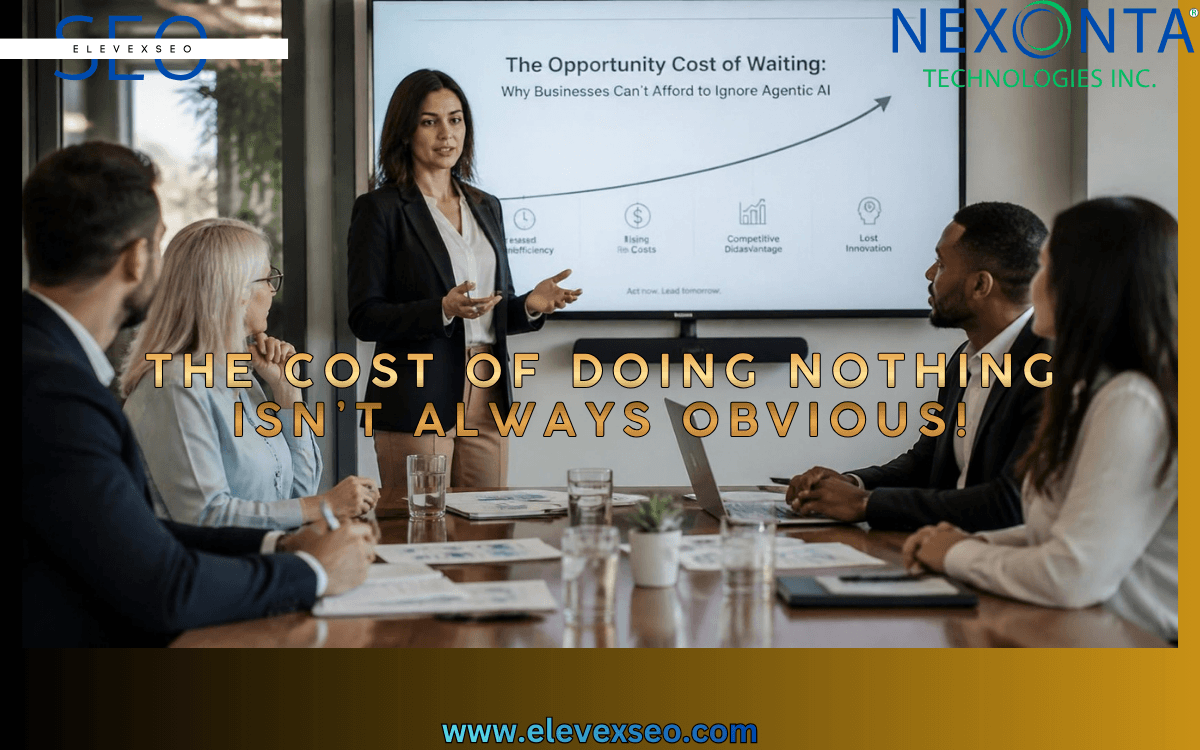
  • The Opportunity Cost of Waiting: Why Businesses Can’t Afford to Ignore Agentic AI

    The Opportunity Cost of Waiting: Why Businesses Can’t Afford to Ignore Agentic AI

    Opportunity cost is the value of what you give up when you choose one option over another.

    In business, that can be a difficult concept to see when the decision involves new technology. If you decide not to embrace Agentic AI, there may be no immediate cost on your balance sheet. But that doesn’t mean the decision is free. The real cost may be what your business misses while others move forward.

    We’ve seen something similar before.

    Remember What Happened With the Internet?

    Go back to the early days of the internet.

    When the dot-com bubble burst in 2000 and 2001, confidence in the internet economy took a major hit. Companies failed. Investments disappeared. Many people became cautious about the technology and questioned whether the internet had been overhyped.

    It was understandable.

    The technology was still developing. The business models were changing. And there was plenty of uncertainty.

    But the internet itself wasn’t going away.

    Businesses that continued investing in websites, e-commerce, digital communication and online services helped shape what came next. Over time, the internet became part of the basic infrastructure of modern business.

    The lesson wasn’t that every early internet investment was a winner.

    The lesson was that a technology can go through a period of volatility without disappearing.

    And that distinction matters when we look at AI today.

    AI Isn’t Going Away

    Artificial intelligence has already moved beyond being a futuristic idea.

    It is becoming part of how businesses research, communicate, analyze information, create content, support customers and automate repetitive work.

    Now we are seeing another step forward: Agentic AI.

    Unlike a traditional AI tool that simply responds to a prompt, Agentic AI can be designed to work through a series of tasks toward a specific goal.

    It can help research information, make decisions within defined parameters, use connected tools and complete multi-step workflows.

    That changes the conversation.

    The question is no longer simply:

    “Should we use AI?”

    A better question may be:

    “What is the opportunity cost of waiting?”

    The Cost of Doing Nothing Isn’t Always Obvious

    When a company decides not to adopt a new technology, the decision can feel safe.

    There is no new software to implement.

    No employees need to be trained.

    No processes need to change.

    No budget needs to be allocated.

    For the moment, everything stays the same.

    But your competitors may not be staying the same.

    They may be using AI to respond to customers faster. They may be automating administrative work. They may be analyzing data more efficiently. They may be finding new ways to reach customers and improve their internal processes.

    None of this means AI automatically makes one company better than another.

    It does mean that the technology can change the economics of how work gets done.

    And that creates an opportunity cost for businesses that wait too long.

    Waiting Has a Cost

    Imagine two businesses operating in the same industry.

    Both have capable employees. Both have good products. Both have loyal customers.

    One begins experimenting with Agentic AI.

    It starts small.

    The company identifies repetitive tasks. It tests AI-assisted workflows. It learns what works and what doesn’t. Employees become more comfortable working alongside AI.

    The other company decides to wait.

    Maybe it wants to see what happens first.

    That sounds reasonable.

    But six months later, the first company has six months of experience that the second company doesn’t have.

    A year later, it may have redesigned several workflows.

    Its employees may understand how to use AI effectively.

    Its leadership may have a clearer idea of where AI creates value and where it doesn’t.

    That experience itself has value.

    And it is part of the opportunity cost of waiting.

    You Don’t Have to Bet the Company on AI

    Embracing Agentic AI doesn’t mean handing your business over to a machine.

    It doesn’t mean replacing every employee.

    And it certainly doesn’t mean adopting every new AI product that comes along.

    Smart adoption can start much smaller.

    Look at your business and ask:

    * What tasks take too much employee time?
    * Where are people repeatedly doing the same work?
    * Where are customers waiting for answers?
    * What information takes too long to find?
    * Which processes involve too many manual steps?
    * Where could better automation improve the customer or employee experience?

    Those questions can reveal opportunities.

    You may discover that Agentic AI has a role to play in one small area of the business.

    That’s often a better place to start than trying to transform everything at once.

    The Biggest Risk May Be Standing Still

    Every new technology brings uncertainty.

    There will be companies that adopt AI badly.

    There will be tools that disappear.

    There will be products that fail to deliver what they promise.

    There will also be companies that find practical ways to use AI to improve how they work.

    That is why the goal shouldn’t be to chase the latest AI trend.

    The goal should be to understand the technology well enough to make informed decisions.

    Because there is a difference between being cautious and standing still.

    The internet taught businesses that a technology can be messy in its early stages and still become incredibly important.

    Agentic AI may be following a similar path.

    We don’t know exactly what the next five or ten years will look like.

    But we do know that AI is continuing to develop.

    The question for business leaders is what they choose to do with that reality.

    The Opportunity Cost Question Every Business Should Ask

    Instead of asking only:

    “What will it cost us to adopt Agentic AI?”

    Ask another question:

    “What could it cost us if we don’t?”

    That doesn’t mean every business needs to adopt Agentic AI immediately.

    It means every business should understand the opportunity before deciding.

    Research it.

    Test it.

    Start with one workflow.

    Measure the results.

    Learn from the experience.

    Then decide where it makes sense to go next.

    Because the biggest cost may not be the money spent experimenting with AI.

    It may be the opportunities, efficiencies and experience your business misses while waiting for everyone else to figure it out.

    AI Is Moving Forward. Is Your Business?

    The businesses that navigated the early internet era successfully weren’t necessarily the ones that predicted everything correctly.

    They were the ones willing to learn, adapt and figure out where the technology could create real value.

    Agentic AI gives businesses another opportunity to do exactly that.

    You don’t have to predict the future.

    You just have to be willing to explore it.

    Ready to Explore the Opportunity?

    Don’t wait until Agentic AI becomes something your competitors already understand.

    Start by identifying one process in your business that could be improved through AI.

    Learn what is possible. Ask the right questions. Test a practical use case. And build your AI strategy from there.

    The first step isn’t adopting everything. It’s understanding what’s possible.

    Explore how Agentic AI could work for your business today.
  • AI and the Future of Business: Why Humans Still Matter

    AI and the Future of Business: Why Humans Still Matter

    AI and the future of business are closely connected. But if there is one thing we have learned over the past few years, it is that building the future is not as simple as plugging AI into every part of a business and expecting everything to run better.

    In some ways, writing a book is a lot like restoring a vintage car.

    You find an old car with incredible potential. You can see what it could become. But then the real work begins.

    You start chasing down parts.

    Some parts are easy to find. Others take weeks, months, or even years. Some have to be restored. Others need to be replaced completely. And sometimes, the part you thought would solve everything turns out not to fit at all.

    Writing a book can feel exactly the same.

    You have an idea. You have a vision. You know there is something worth building.

    But getting from the original idea to the finished product takes time, patience, research, creativity, and a lot of pieces coming together.

    And that is not all that different from what we have seen happening with artificial intelligence.

    The AI Rush

    Over the past several years, we have watched companies of all sizes rush to bring AI into their everyday operations.

    The goal made perfect sense.

    Work faster. Reduce costs. Automate repetitive tasks. Improve efficiency. Make better decisions.

    Billions of dollars have been invested into AI systems, software, infrastructure, and custom solutions designed to help businesses operate more efficiently.

    And there is no question that AI can be incredibly powerful.

    But then something interesting started to happen.

    Some companies discovered that building a completely customized AI operating system for their organization was not the simple solution they expected.

    The technology was moving too quickly.

    The costs could be enormous.

    And in some cases, the systems being built did not deliver the return companies had hoped for.

    That does not mean AI failed.

    Far from it.

    It may simply mean we are still in the early stages of understanding what AI is really going to become.

    We’ve Seen This Before

    If that sounds familiar, there is a reason.

    Think back to the late 1990s and early 2000s.

    The internet was changing everything.

    Companies knew it was going to be important. Investors knew it was going to be important. Consumers were beginning to understand that the internet was going to change the way we lived and worked.

    The excitement was enormous.

    So was the investment.

    Then came the dot-com crash.

    Many companies disappeared. Billions of dollars were lost. Businesses that looked unstoppable suddenly weren’t.

    It would have been easy to look at the situation and conclude that the internet had been overhyped.

    But that wasn’t what happened.

    The internet kept growing.

    The technology improved. Businesses learned how to use it. Consumers became more comfortable with it.

    And eventually, the internet became something we could hardly imagine living without.

    AI may follow a similar path.

    AI Isn’t Going Away

    The current AI boom may eventually go through a period of correction.

    Some companies will fail.

    Some investments will not work out.

    Some AI projects will be abandoned.

    And some of the ideas that seem revolutionary today may not be around five years from now.

    That is part of how technology evolves.

    But that does not mean AI is going away.

    Over the next five to seven years, we may see a significant transition in the way businesses use AI.

    Instead of trying to make AI responsible for everything, companies may become much more selective.

    They will figure out where AI actually creates value.

    They will use it where it makes sense.

    And they will leave the things that require human judgment, creativity, relationships, and emotional intelligence to people.

    That could ultimately be a much better model.

    The Human Element Cannot Be Automated

    This is where things get really interesting.

    AI can help you write.

    It can help you research.

    It can analyze enormous amounts of information in seconds.

    It can identify patterns humans might miss.

    It can automate repetitive work.

    But AI does not replace the person behind the idea.

    Think about writing a book.

    AI can help you organize your thoughts. It can help you research a topic. It can help you rewrite a paragraph or find a better way to explain something.

    But it doesn’t have your memories.

    It doesn’t have the experiences that shaped you.

    It doesn’t know why a particular story matters to you.

    It doesn’t have the personal connection behind the words.

    Those things come from you.

    And that is what makes the finished work yours.

    Technology Is the Tool. Humans Are the Builders.

    This may be one of the most important lessons we can take from the current AI revolution.

    We should not be asking whether AI can replace humans.

    We should be asking how humans can use AI to become better at what they already do.

    That is a very different question.

    A carpenter doesn’t become less important because power tools exist.

    A photographer doesn’t become less creative because editing software exists.

    And a writer doesn’t become less valuable because AI can help with words.

    The tools have changed.

    The human still creates the vision.

    Back to That Vintage Car

    Let’s go back to the vintage car for a moment.

    Imagine finding a classic car sitting in a garage.

    The engine needs work.

    The paint is faded.

    The interior needs to be rebuilt.

    Some parts are missing.

    You could walk away because the project looks too difficult.

    Or you could start restoring it one piece at a time.

    That is what building something meaningful often looks like.

    Whether you’re writing a book, building a business, developing a new product, or figuring out how to use AI, there will always be pieces that don’t fit perfectly the first time.

    You adjust.

    You learn.

    You find another part.

    You try again.

    Eventually, something starts to take shape.

    The People Who Stick With It Will Benefit

    The next five to seven years could be an important period for AI.

    There will likely be plenty of hype.

    There will also be failures.

    There will be companies that spend too much, build the wrong systems, or move too quickly.

    But there will also be companies that learn.

    They will experiment.

    They will find practical ways to use AI.

    They will keep the human element at the centre of their business.

    And over time, those companies may be the ones that benefit most from the technology.

    We saw something similar happen with the internet.

    The companies that survived the early chaos learned how to use the technology rather than simply chase the hype.

    AI may require the same kind of patience.

    We Don’t Need to Fear the Future

    Technology has always changed the way we work.

    The printing press changed publishing.

    The automobile changed transportation.

    The telephone changed communication.

    The internet changed almost everything.

    AI will change things too.

    The question isn’t whether change is coming.

    It’s how we choose to respond to it.

    We can chase every new trend.

    Or we can slow down, learn, experiment, and figure out where these tools genuinely make our lives and businesses better.

    That may be the smarter approach.

    Because the future of AI isn’t really about humans versus machines.

    It’s about what happens when humans and technology work together.

    And just like restoring a vintage car, the finished product may take longer than we expected.

    But that doesn’t mean the project isn’t worth doing.

    Sometimes the best things are built one part at a time.

    Ready to Explore What AI Can Actually Do for Your Business?

    Don’t get caught up in the hype.

    Start by looking at where AI can genuinely help your business save time, improve efficiency, and make better use of the resources you already have.

    Start exploring practical AI solutions today and discover where AI can work alongside your team — not replace it.

  • AI and Machine Learning Are Compressing Business Timelines: Is Your Company Ready?

    AI and Machine Learning Are Compressing Business Timelines: Is Your Company Ready?

    AI and machine learning are changing business faster than most organizations realize. What once took years of planning, testing, and execution can now happen in a matter of months. This is not science fiction. It is happening right now. Businesses that embrace AI and machine learning are accelerating their growth, while those that hesitate risk being left behind.

    This article is a public service announcement for businesses of all sizes.

    The real conversation about AI should not be centered around whether it will replace people. The bigger issue is how quickly it is speeding up business lifecycles.

    The Real Power of AI Is Speed

    For years, businesses operated on relatively predictable timelines.

    A company might spend:

    * One year researching a market
    * Another year developing a product
    * One year building marketing systems
    * One year testing and optimizing
    * One year scaling operations

    That five-year journey was considered normal.

    Today, AI is dramatically shortening that timeline.

    Tasks that once required large teams can now be completed by smaller groups equipped with the right AI tools. Research can be performed in hours instead of weeks. Marketing campaigns can be created in days instead of months. Customer insights can be generated almost instantly.

    The result?

    What once took five years can often be accomplished in six months.

    AI Is Not Creating the Change—It Is Accelerating It

    Many people view AI as a disruptive force that is creating entirely new business models.

    In some cases, that is true.

    However, the larger impact is that AI is accelerating existing processes.

    Think of AI as a business accelerator.

    The strategies that worked before still matter:

    * Innovation
    * Customer service
    * Product quality
    * Leadership
    * Execution

    The difference is that AI helps organizations move through these stages much faster.

    Companies are reaching milestones in months that previously took years.

    That changes everything.

    The Competitive Gap Is Growing

    One of the biggest dangers facing businesses today is not using AI while competitors are.

    Imagine two companies entering the same market.

    Both have talented teams.

    Both have quality products.

    Both have strong leadership.

    The difference is that one company uses AI to automate repetitive tasks, analyze customer behavior, generate content, streamline operations, and identify new opportunities.

    The other company relies entirely on traditional methods.

    Who wins?

    In most cases, the AI-enabled company gains an advantage through speed, efficiency, and decision-making.

    The gap between these businesses can become significant in a very short period of time.

    Small Businesses Have a Unique Opportunity

    Perhaps the most exciting aspect of AI is that it is not reserved for large corporations.

    In the past, only enterprise-level organizations could afford advanced technology and extensive teams.

    Today, a small business owner can access powerful AI tools at a fraction of the cost.

    This levels the playing field.

    A startup with the right strategy and AI integration can compete with companies many times its size.

    That is an opportunity we have never seen before.

    The Cost of Waiting

    Many business leaders are taking a “wait and see” approach.

    While caution can be wise, waiting too long can become expensive.

    Technology adoption has always rewarded early movers.

    The companies that learned how to use the internet effectively gained an advantage.

    The companies that embraced social media early gained an advantage.

    The companies that adopted digital marketing early gained an advantage.

    AI is following the same pattern.

    Organizations that begin learning, testing, and implementing AI today are building skills and systems that may become difficult for competitors to catch up with later.

    Start Small but Start Now

    The good news is that businesses do not need to transform overnight.

    The smartest approach is often to start small.

    Identify one area where AI can create immediate value:

    * Customer service
    * Content creation
    * Marketing automation
    * Data analysis
    * Sales support
    * Process optimization

    Learn from the results.

    Build confidence.

    Expand gradually.

    The goal is not to replace people.

    The goal is to empower people to do more valuable work.

    The real threat of AI is not that machines are taking over. The real threat is that AI and machine learning are dramatically compressing business timelines.

    The organizations that understand this shift will be positioned to grow faster, innovate more effectively, and adapt to changing markets.

    Those that ignore it may discover that their competitors have moved years ahead in a matter of months.

    The future belongs to businesses that can learn, adapt, and execute quickly.

    AI is helping make that future arrive much sooner than anyone expected.

    Ready to Future-Proof Your Business?

    Now is the time to evaluate how AI and machine learning can strengthen your organization.

    Start by identifying one process that can be improved through automation or intelligent analysis. Test, learn, and build from there.

    The businesses that thrive over the next decade will not necessarily be the largest. They will be the ones that adapt the fastest.

    Don’t wait for the future to arrive.

    Start building it today.

  • Spot the Trend: How AI Is Shaping the Future of Business Growth

    Spot the Trend: How AI Is Shaping the Future of Business Growth

    The business world has always been about spotting trends before everyone else does. Think about it—every major shift in history, from the rise of the internet to the boom of social media, rewarded the people who paid attention early. Today, that “next big thing” is AI. And it’s not just hype. It’s reshaping how we search, how customers find what they need, and ultimately, how businesses grow.

    The Search Game Has Changed

    Search used to be simple. Type a few words into Google, scroll, click, and repeat until you found what you wanted. Now? Not so much. AI-driven search is changing the rules. People are talking to search engines the same way they talk to a friend. They’re asking for recommendations, solutions, and explanations in full sentences. And guess what? AI doesn’t just give back links anymore—it gives answers.

    If your business isn’t thinking about this shift, you risk being invisible.

    Why This Matters for Growth

    Here’s the thing: scale comes when your customers can find you easily. If AI is the new “gatekeeper” of information, then being positioned correctly in AI-driven search results will either skyrocket your visibility or bury you in digital noise.

    Think of it like this—ten years ago, businesses scrambled to figure out SEO. Today, they need to figure out how AI tools like ChatGPT, Perplexity, or Google’s Gemini decide what content to recommend.

    Spotting Where AI Is Headed

    So how do you actually spot the trend? Start by watching how AI is shaping customer behavior. Are people asking questions instead of typing keywords? Are they looking for faster, summarized answers instead of long blog posts? Are they trusting AI to make recommendations? (Spoiler: they are.)

    The companies that lean into these shifts—by creating helpful, human-centered content that AI can “understand” and pull from—will be the ones who win.

    The Real Opportunity

    This isn’t just about staying relevant in search. It’s about anticipating how your customers will shop, learn, and make decisions in the future. Businesses that spot where AI is going can pivot faster. They’ll know when to double down on personalization, when to use AI to boost customer support, and when to experiment with new channels before competitors even notice them.

    In short: if you want your business to scale, you can’t just react to AI trends—you need to spot them early and ride the wave.

    Final Thought

    Trends aren’t random. They’re signals. Right now, AI is sending out the clearest signal we’ve seen in years: adapt or get left behind. The businesses that pay attention, experiment, and evolve with AI won’t just grow. They’ll lead.

  • AI as Your Teammate, Not Your Threat

    AI as Your Teammate, Not Your Threat

    This week on the podcast, we tackled a topic that’s been on a lot of people’s minds lately: AI. And not in a “robots are coming for our jobs” way, but in a “how do we make this work for us?” kind of way.

    Here’s the truth—AI is here to stay. It’s not a passing fad like fidget spinners or low-rise jeans (thankfully). It’s becoming part of how business is done, and the companies that figure out how to work with it are the ones that will still be around five years from now.

    The shift isn’t about replacing humans. It’s about freeing people up to do the high-value, creative, strategic stuff that only humans can do. AI can crunch numbers in seconds, summarize mountains of data, and handle repetitive tasks without getting tired or cranky. But it can’t bring your unique experience, empathy, or creativity to the table. That’s still all you.

    The challenge—and opportunity—right now is learning where AI can slot into your workflow. Maybe it’s speeding up customer support. Maybe it’s giving your marketing team a head start on content ideas. Maybe it’s analyzing market trends while you focus on relationship building. The point is to stop seeing it as a rival and start seeing it as the ultimate “get things done” teammate.

    If you wait until you “have time” to look into AI, you’re already behind. The time is now to experiment, test, and figure out where it fits in your business. Think of it like adding a Swiss Army knife to your toolkit—you don’t have to use every blade at once, but having it there could save you in a pinch.

    The companies that will win in the AI era are the ones that learn fast, stay curious, and aren’t afraid to adapt. AI isn’t the enemy. The real threat is refusing to evolve while everyone else moves ahead.

  • The Future of Business: Scale Big with AI and Advancing Technologies

    The Future of Business: Scale Big with AI and Advancing Technologies

    We’re living in an era where the unimaginable is becoming standard business practice. Thanks to AI and rapidly advancing technologies, the playing field has never been more level for small and medium-sized businesses (SMBs). What used to take years of global expansion, hefty investments, and entire departments of strategists can now be accelerated with the right tools—and the right mindset. Today, a boutique brand in Toronto can reach customers in Tokyo, Berlin, or Buenos Aires with just a few clicks, all powered by intelligent automation, predictive analytics, and next-generation digital platforms.

    AI: The Great Business Equalizer

    Artificial Intelligence is no longer reserved for tech giants and Fortune 500s. AI tools are now affordable, intuitive, and scalable for businesses of all sizes. From automating customer service with AI chatbots to predicting market trends using machine learning, businesses can now act faster, smarter, and more efficiently than ever.

    AI doesn’t just streamline operations—it empowers vision. Want to create content, write ad copy, analyze customer sentiment, or launch a multilingual campaign overnight? There’s AI for that. And it’s turning ambitious startups into global players at lightning speed.

    Technological Advancements Opening New Frontiers

    Beyond AI, the entire tech ecosystem is evolving to support rapid scaling:

    • Cloud computing lets companies deploy software and store data securely without massive infrastructure.
    • AR/VR is revolutionizing retail, training, and customer engagement by creating immersive brand experiences.
    • Blockchain is transforming supply chains and ensuring transparent, secure transactions.
    • IoT (Internet of Things) is allowing businesses to track, monitor, and improve operations in real time, from anywhere in the world.

    These technologies are no longer “futuristic.” They are business-critical and readily available to those who dare to adapt.

    Global Reach is No Longer a Dream—It’s a Strategy

    Once upon a time, “going global” meant hiring foreign consultants, renting office space in other countries, and spending a small fortune on international marketing campaigns. Today, with platforms like Shopify, Stripe, Meta, X (Twitter), LinkedIn, TikTok, and localized SEO, businesses can launch in multiple markets simultaneously with tailored messaging and targeted ads—powered by data.

    AI-driven analytics can tell you who your customer is in Australia, how they behave, what they buy, and even when they are most likely to engage with your content. This insight used to cost millions. Now it’s available through monthly subscriptions or open-source platforms.

    Success Is Now About Strategy, Not Size

    In this new era, size is no longer the gatekeeper of success—vision is. Businesses that embrace change, remain agile, and invest in smart technologies are the ones that will thrive. Those that resist will quickly be left behind. The gap between “big business” and “small business” is shrinking fast.

    It’s not about having a hundred employees—it’s about having the right technology stack. It’s not about legacy systems—it’s about future-ready systems. It’s not about competing locally—it’s about winning globally.

    Final Thought: The Future Is Already Here

    Small and medium-sized businesses are now the frontrunners of innovation. The question is no longer if you can scale globally using AI and tech—it’s how fast you’re willing to move. The future of business isn’t coming. It’s already here. And it’s intelligent, automated, and infinitely scalable.

    So, whether you’re an entrepreneur, founder, or forward-thinking business leader, the time to scale big isn’t next year—it’s now. AI is your passport. Technology is your vehicle. And the world is wide open.

  • Business Today Requires a New Kind of Thinking: Why Boldly Adopting AI Is the Key to Prosperity

    Business Today Requires a New Kind of Thinking: Why Boldly Adopting AI Is the Key to Prosperity

    In business, 30 years might as well be 300. The tools, the pace, the competition — everything has changed. Once upon a time, a sharp business plan, a good location, and word-of-mouth could build a thriving company. Today? That formula won’t even get you out of the gate. The business world now belongs to those who dare to think differently, who embrace innovation, and most importantly — who are bold enough to fully leverage AI.

    The Massive Shift: From Gut Instinct to Data-Driven Precision

    In the past, experience, intuition, and “gut feel” were heavily relied upon. Business leaders made decisions based on years of accumulated knowledge and patterns they had personally observed. But today’s world generates more data in 24 hours than a CEO could analyze in a lifetime. AI doesn’t just handle this data — it transforms it into actionable insights instantly.

    The companies that succeed today are the ones who use AI to:

    * Predict customer behavior
    * Personalize marketing at scale
    * Optimize supply chains in real-time
    * Enhance customer support with 24/7 intelligent chatbots
    * Innovate product development based on predictive trends

    The Bold Divide: Early Adopters vs. The Hesitant Majority

    Every technological revolution has had its dividing line. When the internet emerged, some companies jumped in early — and many of them are today’s global giants. Others hesitated, unsure whether it was a fad or a passing trend. We all know how that story ended.

    AI is following the same trajectory — only faster.

    The bold adopters of AI are already:

    * Slashing costs while increasing productivity
    * Gaining unparalleled insights into customer needs
    * Launching products and services faster than ever before
    * Creating hyper-efficient operations that leave competitors in the dust

    The companies that wait? They risk becoming obsolete as competitors gain exponential advantages.

    It’s Not Just About Technology — It’s About Mindset

    The real shift isn’t only technological — it’s cultural. Leaders who thrive in today’s business environment foster a culture of curiosity, experimentation, and continuous learning. They empower their teams to test, fail, learn, and improve using AI tools that make these processes faster and more affordable than ever.

    AI doesn’t replace people. It makes people exponentially more effective.

    The Cost of Fear: Why Waiting Is the Most Dangerous Strategy

    For many, the natural instinct is to be cautious. “Let’s wait and see how this plays out.” But AI is not a wait-and-see moment. Every day that passes without AI integration is a day where competitors are moving further ahead — gathering data, building smarter systems, and gaining deeper insights.

    The longer companies wait, the harder it will be to catch up.

    Bold Action Leads to Great Prosperity

    Those who embrace AI with confidence and vision will build companies that are leaner, faster, smarter, and vastly more profitable. They will capture markets while others are still deliberating. They will unlock opportunities that never existed before.

    The question every business leader must ask today isn’t if they should adopt AI — it’s how fast they can start.

    The future is not coming — it’s already here. Boldly adopt AI now, and secure your place at the front of the pack. The businesses of tomorrow are being built today — by those who dare to think differently.

☎ ✉
f 𝕏
error: Content is protected !!