



19 October 2026
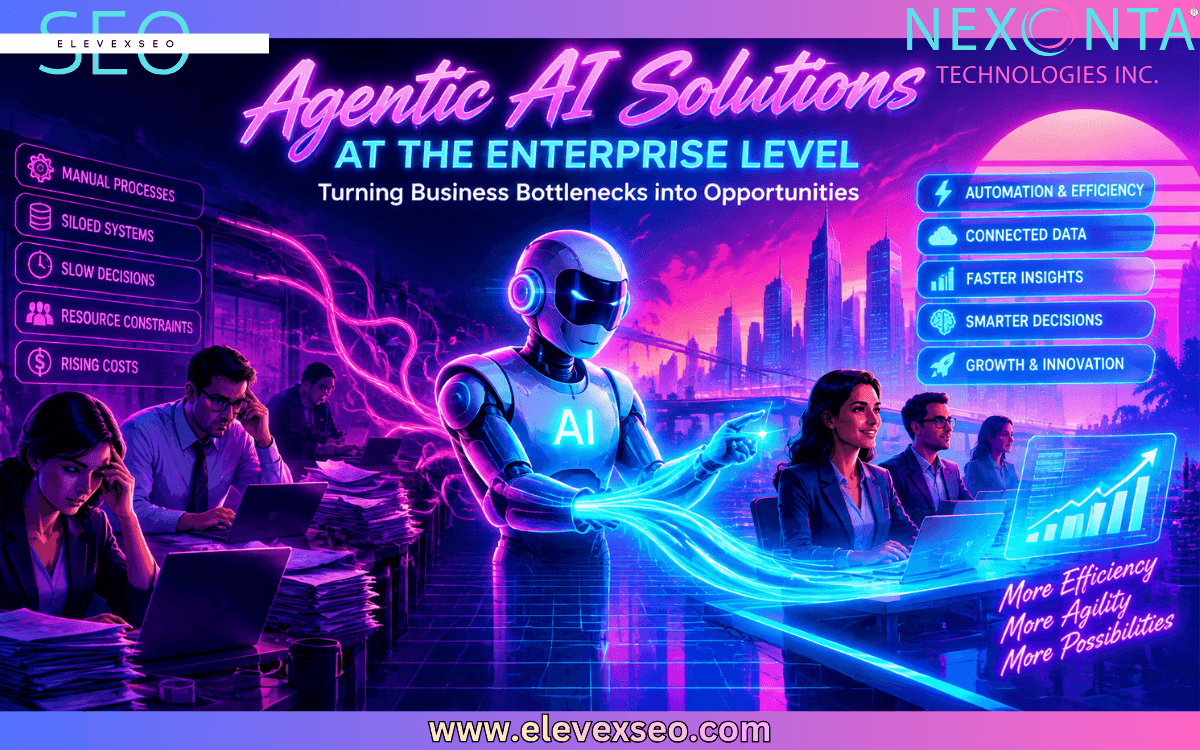
Agentic AI Solutions at the Enterprise Level: Turning Business Bottlenecks into Opportunities
Your business may not need more software. It may need a smarter way to make everything work together.
Agentic AI Solutions at the Enterprise Level help businesses identify operational inefficiencies, reduce repetitive work, and uncover opportunities to improve performance. Instead of adding another tool to an already crowded technology environment, Agentic AI can help connect people, processes, software, and communication in more intelligent ways.
The goal is simple. Help businesses spend less time managing work and more time growing the business.
The Hidden Cost of Everyday Business Processes
Most businesses don’t become inefficient overnight. It happens gradually.
A team adds a new software platform. Another department creates a spreadsheet to track information. Employees spend hours moving data between systems. Important updates get buried in emails. Managers follow up on tasks that should already be moving forward.
Before long, people are spending more time managing the work than actually doing it.
Sound familiar?
These challenges are common in growing businesses and large enterprises alike. They can affect productivity, customer service, employee satisfaction, and profitability.
Some of the most common operational challenges include:
– Repetitive tasks: Employees spend valuable time on routine activities that could be automated.
– Disconnected systems: Software platforms hold useful information but don’t communicate effectively with one another.
– Manual processes: Teams copy information, update records, prepare reports, and complete tasks by hand.
– Communication gaps: Important information gets lost between departments, teams, or individual employees.
– Administrative overload: Employees spend too much time coordinating activities, chasing updates, and managing paperwork.
Individually, these problems may seem manageable. Together, they can create significant operational friction.
And that friction comes at a cost.
Why Adding More Software Isn’t Always the Answer
Businesses have already invested heavily in technology.
They may use CRM platforms, accounting systems, email, calendars, project management tools, spreadsheets, communication platforms, websites, databases, and industry-specific applications.
Each system may serve a useful purpose. The challenge is that they don’t necessarily work together as one intelligent operating environment.
For example, a sales team might update a CRM after speaking with a prospect. Someone else may need to transfer that information into another system. A manager then checks a spreadsheet to see whether the next step has been completed.
Every handoff creates another opportunity for delays, duplication, or mistakes.
Adding another standalone application may solve one problem while creating another.
The real opportunity is to understand how work flows through the entire business.
Where does information get stuck? Which tasks require unnecessary manual effort? Which systems could share information more effectively? Where are employees spending time on work that delivers little value?
These are the questions businesses should ask before deciding where to introduce AI.
What Makes Agentic AI Different?
Traditional automation generally follows predefined rules. It works well when a task is predictable and the steps are clearly established.
Agentic AI can go further.
Depending on how it is designed and deployed, an AI agent can work toward a defined goal, gather information, use approved tools, carry out a sequence of tasks, evaluate results, and determine what action should come next within its assigned boundaries.
This creates opportunities to improve workflows that involve more than one step or system.
For example, an Agentic AI workflow could help a sales team by:
– Gathering information from approved business systems.
– Identifying missing details in a customer record.
– Preparing a summary for a sales representative.
– Drafting a follow-up message for review.
– Updating an approved system after the required checks are complete.
– Flagging an issue that requires human attention.
The exact capabilities depend on the available integrations, permissions, business rules, and level of human oversight.
The objective isn’t to remove people from the process. It’s to reduce unnecessary work while helping employees make better use of their time and expertise.
How Agentic AI Can Identify Operational Inefficiencies
One of the most important steps is understanding where the business is losing time, money, and momentum.
This starts with an operational assessment.
Rather than immediately recommending an AI solution, businesses should examine how work gets done today.
1. Map the Current Workflow
Start with a process that regularly causes delays or requires significant administrative effort.
It could be lead management, customer onboarding, invoice processing, reporting, scheduling, or internal approvals.
Map each step. Identify who is involved, which systems are used, and where information moves between people and platforms.
This creates a clearer picture of the process and helps reveal unnecessary handoffs.
2. Identify Repetitive and Manual Work
Look for tasks that follow similar patterns every day.
Employees may be entering the same information into multiple systems, preparing routine reports, sorting incoming requests, or chasing updates from other departments.
These tasks may be good candidates for automation or AI-assisted workflows.
However, not every task should be automated. Some require professional judgment, personal interaction, or careful decision-making.
The key is to identify where technology can genuinely help.
3. Find Communication and System Gaps
A process may be slow because the software itself is not the problem. The problem may be how information moves between systems.
For instance, a customer request might arrive by email, be entered manually into a CRM, and then be forwarded to another department.
An intelligent workflow could potentially capture the request, organize the relevant information, and route it to the right team.
With appropriate integrations and controls, Agentic AI can help reduce unnecessary handoffs and improve visibility across the process.
4. Measure the Business Impact
Identifying an inefficiency is only the beginning. Businesses also need to understand its financial and operational impact.
Useful measurements include:
– Hours spent on repetitive administrative work.
– Average time required to complete a process.
– Number of manual handoffs.
– Error rates and duplicated work.
– Customer response and resolution times.
– Cost per transaction or completed task.
These measurements establish a baseline.
Once a solution is implemented, the business can compare the results against that baseline and determine whether the improvement justifies the investment.
This is how an AI initiative becomes a business case rather than simply another technology project.
From Operational Friction to Measurable Business Value
Let’s consider a practical example.
Imagine an enterprise sales department receiving hundreds of enquiries each week.
Employees must review incoming messages, identify the type of enquiry, enter information into the CRM, assign leads, notify the appropriate team, and follow up when information is missing.
Each step takes time. Across hundreds of enquiries, those small tasks add up.
An Agentic AI workflow could potentially assist with classifying enquiries, extracting relevant information, preparing CRM updates, recommending assignments, and drafting follow-ups.
The team would still define the rules, review sensitive decisions, and maintain control over important customer interactions.
The potential benefits could include faster response times, fewer manual data-entry tasks, and more time for salespeople to build relationships and close business.
But the real value needs to be measured.
For example, a business might calculate how many employee hours are spent on the existing process, what those hours cost, and how much time could reasonably be saved after implementation.
It could then compare the expected savings and operational improvements against implementation, integration, maintenance, and oversight costs.
That is a more meaningful conversation than simply asking what an AI tool can do.
The right question is: What measurable business problem can Agentic AI help us solve?
Why Enterprise-Level Agentic AI Requires a Strategic Approach
At the enterprise level, implementing Agentic AI involves more than choosing a platform and connecting a few applications.
Businesses must consider how AI will operate within their existing environment.
That includes data quality, system integration, access permissions, privacy, security, governance, and accountability.
It also means deciding which tasks AI can perform independently, which require employee approval, and which must remain under direct human control.
A sensible approach starts small enough to manage risk but focuses on a problem important enough to justify the effort.
The process typically involves five stages:
1. Assess: Understand the current workflow, business challenges, and technology environment.
2. Prioritize: Identify opportunities based on business value, feasibility, cost, and risk.
3. Design: Define the workflow, integrations, permissions, and human approval points.
4. Pilot: Test the solution against clear performance measures.
5. Improve and expand: Review the results, address problems, and extend successful workflows where appropriate.
This approach helps organizations avoid investing in AI simply because it is available.
Instead, they can build a practical business case around specific operational needs.
The Bigger Opportunity: Helping Businesses Work More Intelligently
The ultimate goal of Agentic AI is not to introduce technology for technology’s sake.
It is to help businesses work more intelligently.
When people, processes, software, and communication work together effectively, employees can spend less time navigating administrative obstacles and more time on activities that move the business forward.
That might mean improving customer experiences, supporting sales teams, speeding up internal processes, reducing operational costs, or giving managers better information for decision-making.
It also means making better use of the technology a business already owns.
Not every organization needs a complex network of AI agents. Some may benefit most from improving one workflow. Others may need a broader strategy that connects several departments and systems.
The right starting point depends on the business, its goals, and the problems it needs to solve.
What matters is having a clear understanding of the opportunity before investing in the solution.
Is Your Business Ready to Explore Agentic AI?
If your employees are spending too much time on repetitive tasks, your systems aren’t communicating effectively, or your processes rely on endless emails and manual updates, it may be time to look more closely at how work gets done.
You don’t need to automate everything at once.
Start by identifying one process that creates unnecessary work, slows down employees, or affects the customer experience.
Understand the problem. Measure its impact. Then explore whether Agentic AI can help improve the process in a practical and measurable way.
The best AI strategy isn’t necessarily the one with the most advanced technology. It’s the one that solves the right problems and delivers meaningful business results.
Ready to Discover Where Agentic AI Could Make a Difference?
At Nexonta, we believe the first step toward intelligent automation is understanding your business.
Our approach begins with identifying operational inefficiencies, evaluating how your existing systems work together, and exploring where Agentic AI could create measurable value.
Let’s identify the opportunities hiding in your everyday business processes.
Contact Nexonta to discuss an Agentic AI opportunity assessment and discover where your organization could reduce operational friction, improve workflows, and free your team to focus on higher-value work.
Nexonta — helping businesses turn AI opportunities into practical business outcomes.