




19 October 2026
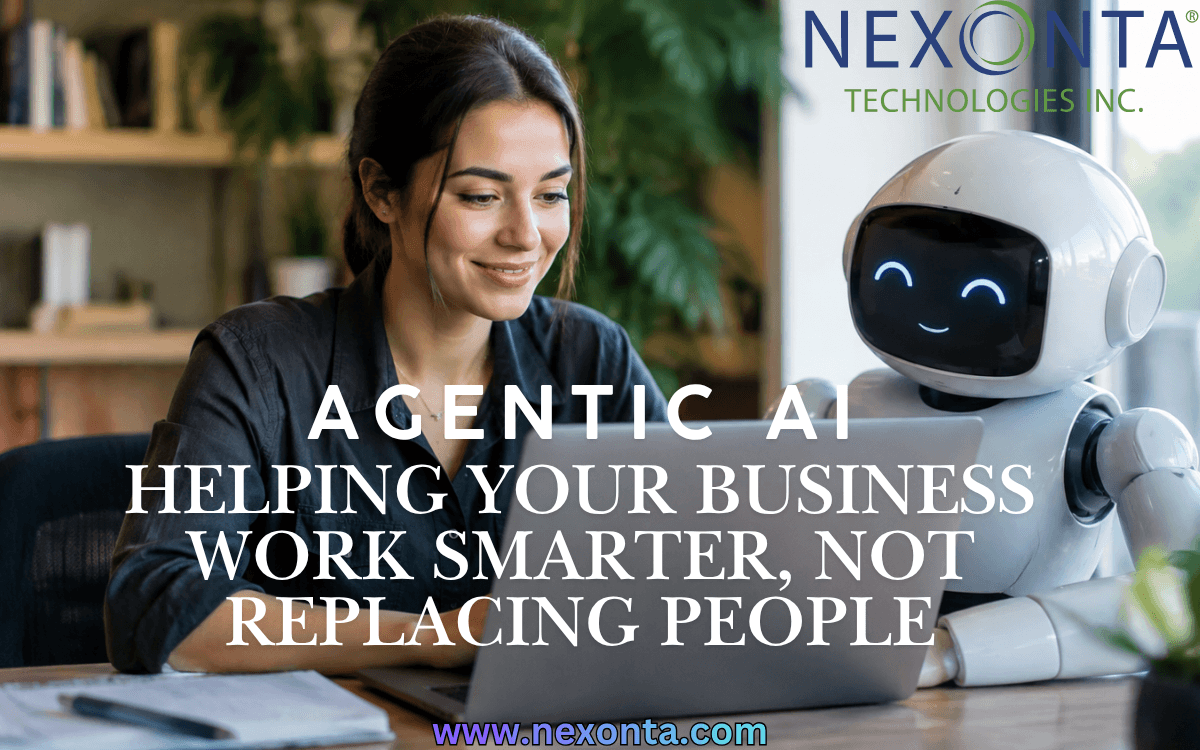
Agentic AI: Making Your Business Work Smarter, Not Replacing People
Agentic AI is changing how businesses approach operational efficiency. But the goal isn’t to replace people with technology. It’s to help people do their jobs better by connecting the four areas that keep a business running: people, processes, software, and communication.
Think about how much time your team spends on administrative work. Updating records. Chasing information. Correcting errors. Scheduling meetings. Following up with customers. Moving data from one system to another.
These tasks are part of running a business. But they can also take time away from the work that really matters.
What if your existing operation could work more intelligently, without adding unnecessary complexity?
That’s where Agentic AI comes in.
The Real Goal of Agentic AI Is Better Workflows
There’s a lot of discussion about artificial intelligence replacing jobs. But that’s not the only way to look at it.
A better question is this:
How can we make your existing operation work more intelligently?
This question changes the conversation. Instead of looking for ways to eliminate employees, we start by looking at the unnecessary steps surrounding their work.
Your employees bring experience, judgment, creativity, and relationships to the business. Those things matter. The goal is to give them more time to use those strengths.
Agentic AI can help by connecting tasks, systems, and information that might otherwise remain disconnected.
Rather than simply answering questions, an AI agent can help carry out a workflow. Depending on how it’s designed and authorized, it might gather information, update records, coordinate steps, flag problems, or prepare actions for an employee to approve.
The result? Less time spent managing administrative tasks and more time spent moving the business forward.
Four Areas That Need to Work Together
Most businesses already have people, processes, software, and communication tools. The problem is that these four areas don’t always work together as well as they should.
Let’s look at each one.
1. People: Let Your Team Focus on What Matters
Your employees are often the ones who understand your customers, recognize problems, and make important decisions.
But how much of their day is spent doing repetitive administrative work?
An employee might spend hours updating spreadsheets, entering the same information into different systems, or searching for documents needed to complete a task.
Agentic AI can help reduce this burden by handling suitable routine steps and bringing relevant information together.
People remain involved where their knowledge, judgment, and approval are needed.
The objective is simple: help employees spend less time managing tasks and more time creating value.
2. Processes: Find the Steps That Slow Everything Down
Every business has processes. Some work well. Others have developed over time without anyone stepping back to ask whether they still make sense.
Consider a customer renewal.
Someone must identify the upcoming renewal, check the account details, prepare the necessary information, contact the customer, and record the outcome.
If these steps depend on manual reminders and disconnected systems, things can easily fall through the cracks.
An appropriately designed AI workflow could identify upcoming renewals, gather the relevant information, prepare a reminder, and notify the right employee when action is required.
The employee can then review the situation and handle the customer relationship.
Before introducing AI, it’s important to understand the existing process. Automating a poor process doesn’t necessarily make it better. It may simply help the same problems happen faster.
The first step is to improve the workflow. The next step is to determine where AI can help.
3. Software: Connect the Tools You Already Use
Businesses often invest in software for different departments and purposes.
Sales has its CRM. Accounting has its financial system. Customer service has its ticketing platform. Operations may rely on spreadsheets, scheduling tools, and project management software.
Each system may work perfectly well on its own.
The challenge comes when employees must move information between them manually.
This creates extra work, delays, and opportunities for mistakes.
Agentic AI can help connect supported systems and coordinate tasks across them, where suitable integrations and permissions are available.
For example, information from a customer inquiry might be used to prepare a CRM update, notify a sales representative, and create a follow-up task.
Instead of asking employees to manage every step manually, the workflow can help move information to where it needs to go.
The goal isn’t necessarily to replace your existing software. It’s to make better use of the systems you already have.
4. Communication: Get the Right Information to the Right Person
Communication problems can be expensive.
A customer waits too long for a response. A sales representative doesn’t receive an important update. A manager misses a deadline because information was buried in an email.
These issues may seem small individually. Over time, they can affect customer satisfaction, productivity, and revenue.
Agentic AI can help by organizing information, preparing responses, routing requests, and alerting the right people when something needs attention.
For example, a customer request could be categorized, matched with the relevant account information, and directed to the appropriate team member.
More routine requests may be handled automatically when the business has approved the workflow. Sensitive or complex situations can be escalated to a person.
This is what a human-in-the-loop approach looks like. AI helps move the work forward, while people remain involved where oversight, judgment, or approval is important.
The Hidden Cost of Operational Inefficiency
Here’s a question every business leader should ask:
What does it cost your business when a process goes wrong?
It’s easy to measure the cost of software, salaries, and equipment. It’s much harder to see the cumulative cost of everyday inefficiencies.
Consider these common problems:
– Duplicated data entry: Employees spend time entering the same information into multiple systems.
– Incorrect information: Errors create rework, confusion, and poor decisions.
– Missed deadlines: Important tasks slip through because reminders or handoffs fail.
– Delayed customer responses: Customers wait longer than they should for answers.
– Missed renewals: Opportunities are lost because nobody followed up at the right time.
– Incorrect scheduling: Double bookings and scheduling conflicts disrupt the workday.
– Lost documentation: Employees waste time searching for information or recreating missing records.
One problem might only cost a few minutes. But what happens when it occurs dozens or hundreds of times each month?
The cost can add up through wasted employee hours, slower service, missed opportunities, and avoidable mistakes.
There is also an opportunity cost. Every hour spent correcting preventable errors is an hour that could have been spent serving customers, supporting sales, improving operations, or developing the business.
This is why operational efficiency deserves more attention.
The real question isn’t simply how much AI costs. It’s also how much your current processes cost you.
What Can a Well-Designed Agentic AI Solution Deliver?
The value of Agentic AI should be measured by what improves in the business, not by how advanced the technology sounds.
A well-designed solution may help deliver several practical benefits.
Time: Reduce the hours employees spend on repetitive administrative tasks.
Capacity: Help your existing team handle more work without increasing administrative demands at the same rate.
Responsiveness: Get information and follow-ups to the right people sooner.
Consistency: Apply agreed procedures more reliably and reduce avoidable variations.
Scalability: Support growing workloads without requiring every task to be handled manually.
Operational visibility: Make it easier to see where tasks stand, where delays occur, and what needs attention.
Better workflows: Coordinate activities across people, processes, and connected systems.
Reduced administrative friction: Cut down on unnecessary handoffs, duplicate entry, and repetitive follow-up.
Improved customer experiences: Give employees more time to respond thoughtfully and help customers.
These benefits aren’t automatic. They depend on the quality of the workflow, the systems involved, the data available, and the controls built into the solution.
That’s why the starting point should always be a real business problem.
Humans in the Loop: A Smarter Way to Work
The most effective approach isn’t to remove people from every process. It’s to decide which tasks need human involvement and which can be supported or completed by AI.
Some tasks are repetitive and follow clear rules. Others require experience, empathy, judgment, or accountability.
A practical Agentic AI solution recognizes the difference.
For example, AI might gather customer information, prepare a report, identify an overdue action, or draft a response. An employee can then review the result, make a decision, and approve the next step when necessary.
As the workflow becomes more established, certain low-risk tasks may be suitable for greater automation, subject to appropriate permissions and safeguards.
This creates a working relationship between people and technology.
AI helps coordinate the work. People provide direction, judgment, and oversight.
The aim is not to make people less important. It’s to remove unnecessary administrative steps so they can focus on the work that needs them most.
Start With the Business Problem, Not the Technology
It’s tempting to begin an AI project by asking which tool to buy or which tasks to automate.
A better starting point is to understand how the business operates today.
Where does work slow down? Which tasks require repeated manual effort? Where do employees have to enter the same information twice? Which customer requests take too long to resolve? Where do missed handoffs create problems?
These questions help identify opportunities that matter.
From there, the business can assess which workflows would benefit from better coordination, what systems need to connect, where human approval is required, and how success will be measured.
Useful measures might include time saved, fewer errors, faster response times, fewer missed follow-ups, and improved visibility into outstanding work.
This approach also helps avoid investing in technology without a clear business purpose.
AI is the mechanism. A better workflow is the goal.
When businesses keep that distinction in mind, the conversation becomes much more practical.
It moves away from technology for technology’s sake and toward measurable improvements in the way work gets done.
Is Your Business Ready to Work More Intelligently?
Your business may not need another disconnected tool. It may need a better way for the people, processes, software, and communication systems you already have to work together.
Agentic AI offers an opportunity to rethink how everyday work gets done. Not by removing the human element, but by giving people better support and reducing the administrative friction that slows them down.
The first step is identifying where that friction exists.
At Nexonta, we believe AI should serve a clear business purpose. That means understanding your operation, identifying inefficiencies, and finding practical opportunities to improve how work flows through your organization.
Let’s Find the Opportunities in Your Business
Ready to discover where Agentic AI could make a difference in your operation?
Contact Nexonta to discuss your current workflows, identify areas of unnecessary administrative work, and explore where a practical AI solution could help your team work more intelligently.
Let’s start with your business challenges and build from there