




5 October 2026
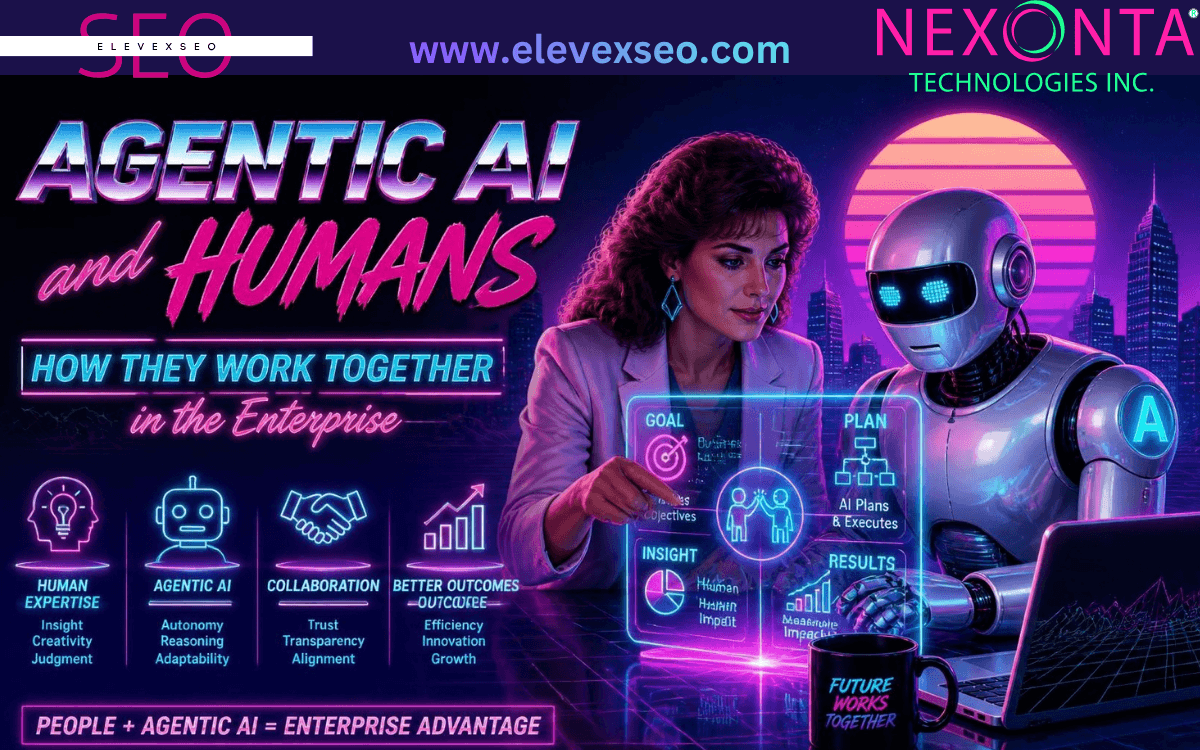
Agentic AI and Humans: How They Work Together in the Enterprise
Lately, we have been talking a lot about Agentic AI. There is good reason for that. The technology is moving quickly, and we are already hearing about some exciting developments expected in 2027.
But as we have become more involved in the Agentic AI conversation, we have noticed something else.
There is still a lot of confusion about how Agentic AI and humans actually work together.
Some people hear “AI agents” and immediately think about automation replacing people. Others imagine a business where AI simply takes over tasks and employees step aside.
That is not the way we see it.
At the enterprise level, Agentic AI is designed to create a working relationship between humans and AI.
And that distinction matters.
Agentic AI Is Not Just Another Automation Tool
Traditional automation is generally designed to follow a specific set of instructions.
If this happens, do that.
That can be incredibly useful. But businesses are rarely that simple.
Workflows change. Customers change. Priorities change. Problems appear unexpectedly. Employees have to make decisions and move information from one system to another.
This is where Agentic AI starts to become interesting.
Rather than simply completing one isolated task, an AI agent can be designed to work across a broader workflow. It can help interpret information, coordinate tasks, identify next steps and support people as work moves through a process.
The human is still part of that process.
The technology becomes another layer of intelligence within the workflow.
The Human and AI Relationship
Think about a business owner who spends hours every week dealing with repetitive administrative work.
There may be emails to review, information to organize, reports to prepare, customer inquiries to respond to and internal communications to coordinate.
None of these tasks may seem overwhelming on their own.
Together, however, they can consume a significant amount of time.
This is where the relationship between humans and Agentic AI can become valuable.
The AI can help manage parts of the workflow while people remain responsible for decisions that require judgment, context, relationships and accountability.
In simple terms:
Humans provide direction, judgment and oversight.
AI can help manage information, processes and repetitive work.
That creates a very different conversation from simply asking whether AI will replace employees.
The more useful question may be:
Where can humans and AI work together to make the business operate better?
Where Agentic AI Can Help Businesses
Every organization has bottlenecks.
Sometimes they are obvious.
Sometimes they are hidden inside everyday work.
A business might be dealing with:
* Repetitive workflows
* Operational bottlenecks
* Excessive administrative workloads
* Missed opportunities
* Inefficient communication
* Information scattered across different systems
* Slow follow-up
* Growing overhead
* Employees spending valuable time on low-value tasks
These problems can create a domino effect.
A small delay in one part of the business can create another delay somewhere else.
Eventually, people spend more time managing the process than actually moving the business forward.
Agentic AI can potentially help connect these pieces.
Instead of looking at AI as a collection of individual tools, businesses can begin looking at it as an **intelligent workflow layer**.
That is an important shift.
From Individual AI Tools to an Intelligent Workflow
Many businesses already use AI.
They may use ChatGPT to create content. Another tool might summarize meetings. Another might help with customer service. Someone else might use AI to analyze data.
Each tool can be useful.
But what happens when these tools operate as disconnected pieces?
People still have to move information between them.
That creates another problem.
The opportunity with Agentic AI is to think beyond individual applications and start looking at the entire workflow.
What happens when a customer inquiry comes in?
Where does the information go?
Who reviews it?
What happens next?
What information needs to be collected?
Who needs to be notified?
What happens if the customer does not respond?
Where is the information stored?
These are workflow questions.
Agentic AI can potentially help coordinate parts of that process while keeping humans involved where human judgment is important.
What About the Cost?
This is where every business owner should slow down and look at the numbers.
Adopting AI is not automatically a cost saving.
There can be software costs, implementation costs, integration costs, training costs and ongoing management costs.
There can also be a learning curve.
So the question should not simply be:
“How much does AI cost?”
A better question is:
“What does this workflow currently cost the business?”
That means looking at the time employees spend on repetitive work, the cost of delays, missed opportunities, unnecessary administrative work and the operational cost of keeping inefficient processes in place.
A simple cost-benefit assessment might look at four areas:
1. Time
How many hours are currently spent on repetitive or administrative tasks?
2. Labour
Could employees spend more of their working time on higher-value activities?
3. Revenue Opportunities
Are leads, customers or opportunities being missed because follow-up is slow or inconsistent?
4. Operational Efficiency
Could better coordination reduce delays, duplication or unnecessary overhead?
This does not mean every business will see the same financial return.
The economics will depend on the business, the workflow, the technology being implemented and how effectively it is adopted.
But the exercise itself is important.
Before investing in AI, understand the problem you are trying to solve.
The Competitive Advantage May Be the Workflow
There is another part of this conversation that businesses should consider.
AI tools are becoming increasingly accessible.
That means simply having access to AI may not be much of a differentiator.
The bigger opportunity may come from **how a business uses AI**.
Two companies could have access to similar AI technology.
One might use it to generate occasional content.
The other might integrate AI into customer communication, internal processes, research, reporting and operational workflows.
The technology may be similar.
The workflows are not.
That difference could become increasingly important as businesses continue adopting AI.
Competitive advantage may come less from owning a particular AI tool and more from building smarter ways of working.
Humans Still Matter
This is perhaps the most important part of the conversation.
Agentic AI does not eliminate the need for people.
Businesses still need people to understand customers, make strategic decisions, build relationships, handle complex situations and take responsibility for important outcomes.
AI can process information quickly.
That does not mean it understands the business in the same way the people inside that business do.
This is why human oversight remains important.
The goal is not to remove humans from the workflow.
The goal is to give people better tools.
Imagine an employee spending less time searching through information and more time talking to a customer.
Imagine a business owner spending less time chasing administrative tasks and more time working on growth.
Imagine a sales team receiving better-organized information before making a customer call.
That is where the human-AI relationship becomes much more interesting.
Start With the Bottleneck, Not the Technology
One of the biggest mistakes businesses can make is starting with the technology.
They find an exciting AI platform and then try to figure out where to use it.
We believe the conversation should start somewhere else.
Start with the bottleneck.
Where is the business losing time?
Where are employees frustrated?
Where are customers waiting?
Where is information getting lost?
Where is communication breaking down?
Where is overhead increasing?
Where are opportunities being missed?
Once those questions are answered, it becomes much easier to determine whether Agentic AI has a meaningful role to play.
Technology should solve a business problem.
It should not become another problem for the business to manage.
Looking Ahead to 2027
The next stage of AI is likely to be less about simply asking an AI chatbot a question and more about how AI can participate in the workflows that businesses already depend on.
That makes the conversation around Agentic AI particularly interesting.
The businesses exploring this technology today are not simply asking, “What can AI do?”
They are beginning to ask better questions.
Where can AI help us work more efficiently?
Where can humans add the most value?
Which workflows should be redesigned?
What should remain human-led?
How can we build a business that uses AI without losing the human element?
Those questions are likely to become even more important as Agentic AI continues to develop.
The Future Is the Relationship
Agentic AI does not have to be a story about humans versus machines.
It can be a story about better ways of working.
The opportunity is to combine human experience, judgment and creativity with AI’s ability to process information, coordinate workflows and handle repetitive work.
For business owners, that could mean fewer bottlenecks, less administrative pressure and more time focused on the work that actually moves the business forward.
But the first step is not buying an AI system.
It is understanding your business.
Find the bottlenecks.
Understand the workflows.
Calculate where time and resources are being spent.
Then ask where Agentic AI could create meaningful value.
That is where the human-AI relationship really begins.
Ready to Look at Your AI Opportunities?
If your business is dealing with repetitive workflows, growing administrative workloads, communication challenges or operational bottlenecks, it may be time to look at where AI can actually fit into the business.
Start with the workflow. Find the bottleneck. Then explore what Agentic AI could do.
[Explore Your AI Opportunities]
The future of business AI is not simply about using more technology.
It is about using technology more intelligently — and keeping people at the centre of the process.